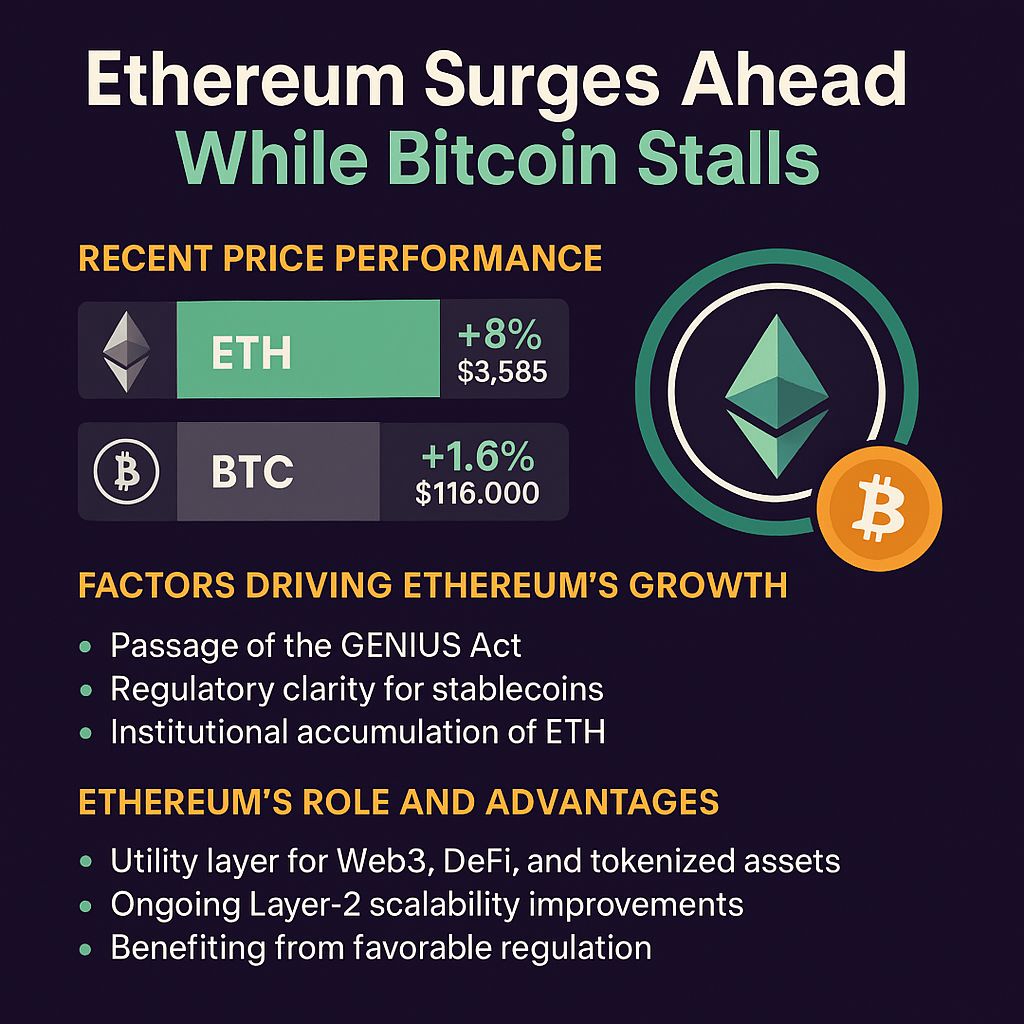
Ethereum (ETH) has once again proven itself as a dominant force in the crypto market. Over the past 24 hours, ETH recorded an impressive 8% price increase, outpacing Bitcoin (BTC), which only gained 1.6% despite momentarily surpassing the $120,000 mark.
This divergence isn’t simply due to market fluctuations; it’s rooted in growing institutional demand and critical legislative developments that uniquely benefit Ethereum’s infrastructure.
The passing of the GENIUS Act in the United States has triggered renewed bullish momentum for Ethereum. This new legislation offers long-awaited regulatory clarity for stablecoins, most of which are built directly on Ethereum. With stablecoins like USDC, DAI, and USDT playing a central role in DeFi and Web3 economies, the GENIUS Act validates Ethereum’s infrastructure as essential to the future of digital finance.
The GENIUS Act: A Regulatory Win for Ethereum and Web3
The GENIUS Act (Government-Enabled National Investment in Ubiquitous Systems) is a landmark bill that mandates stablecoins be fully backed by safe reserve assets such as U.S. dollars and treasuries. It also introduces a framework for federal oversight, which was previously absent from the fast-growing stablecoin ecosystem.
This legal clarity is a game-changer for Ethereum. As the network underpinning most stablecoins, tokenized assets, and decentralized finance protocols, Ethereum stands to benefit the most from this legislation.
Investors quickly responded. Ethereum surged to a weekly high of $3,626 on Friday before slightly retracing to $3,585.50 at the time of writing. The message from the market is clear: Ethereum is more than a cryptocurrency — it’s the core infrastructure of the future internet.
Bitcoin’s Consolidation Phase Raises Questions
While Ethereum charges forward, Bitcoin (BTC) has entered a phase of price consolidation. After reaching a local high of $122,838, BTC retraced to around $116,000 and currently trades sideways.
The reason for this pause is multifaceted. Unlike Ethereum, Bitcoin hasn’t had a major protocol upgrade or regulatory boost in recent weeks. Without a compelling narrative or ecosystem development, Bitcoin’s rally appears to have lost momentum, at least for now.
That said, Bitcoin’s long-term fundamentals remain strong. Institutional holdings, ETFs, and macroeconomic hedging strategies still support BTC as the “digital gold” of the crypto world. However, in the short term, investors are clearly rotating into assets with more utility, programmability, and regulatory clarity — and Ethereum is leading the charge.
Ethereum: The Infrastructure Layer of Web3
Ethereum’s appeal goes far beyond its price action. It remains the most widely used platform for:
Stablecoins (USDC, DAI, Tether ERC-20)
DeFi protocols (Uniswap, Aave, Compound)
NFT marketplaces (OpenSea, Blur, Foundation)
DAOs and token governance models
Tokenization of real-world assets
By enabling these applications, Ethereum functions as a settlement layer, a smart contract platform, and a global financial computer all rolled into one. This versatility is unmatched, and it’s why institutional interest keeps growing.
Moreover, Ethereum is undergoing major scalability improvements. With Layer-2 rollups like Arbitrum, Optimism, and Base gaining adoption, the Ethereum ecosystem is delivering faster, cheaper transactions, further strengthening its competitive advantage.
Why Regulation Benefits Ethereum More Than Bitcoin (For Now)
Bitcoin has historically thrived on decentralization and simplicity. But in today’s regulatory climate, clarity is king, and Ethereum has positioned itself perfectly to benefit.
The GENIUS Act is a perfect example. By legitimizing stablecoins that rely almost exclusively on Ethereum’s architecture, U.S. lawmakers have indirectly endorsed Ethereum’s role in the future of finance. Institutional players now have a clearer path to engage with Ethereum-based products without regulatory fear.
Meanwhile, Bitcoin lacks a similar utility layer. It remains a secure store of value but offers limited programmability. Without upcoming upgrades or new narratives, BTC is at risk of being overshadowed, not displaced, by more versatile platforms.
Ethereum’s Outlook: Institutional Fuel and Global Adoption
The rally in ETH is backed not only by retail enthusiasm but by deep-pocketed institutions looking to gain exposure to the most trusted infrastructure in crypto. As the GENIUS Act sets a precedent for global stablecoin regulation, other nations are likely to follow, giving Ethereum an even broader regulatory runway.
Global banks, fintech startups, and payment providers are already building on Ethereum or integrating ERC-20 standards. From tokenized treasuries to cross-border payment rails, Ethereum is emerging as the foundation layer for a multi-trillion-dollar digital economy.
The upcoming Ethereum Cancun-Deneb upgrade is also set to further improve Layer-2 interoperability and data availability, reducing rollup fees and increasing throughput. These enhancements are expected to drive even more adoption across Web3 platforms.
Ethereum Proves It’s More Than Just a Coin
Ethereum’s recent surge isn’t just about price, it’s about purpose. Backed by legislation like the GENIUS Act, Ethereum has transitioned from a speculative investment to a critical part of global financial infrastructure.
As Bitcoin consolidates and other altcoins struggle for identity, Ethereum stands out with utility, regulatory clarity, and growing institutional participation. This convergence of technology, legislation, and adoption is what’s powering ETH’s meteoric rise and it may only be the beginning.
For investors, builders, and policymakers, Ethereum has made one thing abundantly clear:
The future isn’t just digital it’s programmable. And Ethereum is building it.