


























































Introduction: Bitcoin Mining Faces Its Most Challenging Moment But Miners Are Winning
In August 2025, Bitcoin’s mining difficulty soared to unprecedented levels, reaching a new all-time high of 127.6 trillion. At first glance, this might appear concerning for miners, as greater difficulty usually translates to higher energy consumption, tighter margins, and reduced profitability. But surprisingly, the opposite is unfolding.
Bitcoin miners are smiling, and for good reason. Despite the challenging environment, daily mining revenues have hit post-halving highs, while profit margins continue to grow. This unexpected divergence has caught the attention of analysts and could signal a deeper bullish trend in the broader Bitcoin market cycle.
Let’s explore why Bitcoin mining is becoming increasingly complex, yet miners are thriving, and what it could mean for BTC’s future.
Record-Breaking Mining Difficulty: What Does It Mean?
The Basics of Bitcoin Mining Difficulty
Bitcoin’s mining difficulty is a measure of how hard it is to find the next block in the blockchain. The higher the difficulty, the more computational power is required. This adjustment happens roughly every two weeks (or every 2,016 blocks), based on the total network hash rate.
In early August 2025, Bitcoin’s mining difficulty surged to a historic high of 127.6 trillion, highlighting the growing global participation in the network. This means more miners are competing to validate transactions and secure the network, increasing overall security and decentralization.
Subsequent Adjustment Coming: Will It Ease the Load?
The subsequent scheduled adjustment, expected on August 9, 2025, is projected to reduce difficulty by around 124.71 trillion. This minor correction aims to bring the average block time back to the ideal 10-minute interval. Currently, blocks are being found every 10 minutes and 23 seconds, slightly slower than the target.
These automated recalibrations are core to Bitcoin’s self-regulating mechanism, ensuring network equilibrium regardless of short-term hash rate fluctuations.
Profitability Defies Logic: Miners Are Thriving
Miner Revenues Reach New Highs
Despite the climbing difficulty, Bitcoin miner revenues have soared to a post-halving peak of $52.63 million per exahash per day, according to YCharts. This is a notable increase from $25.64 million just a year ago, more than doubling in 12 months.
Although there was a slight day-to-day decline from $56.35 million, the overall trend remains strongly positive.
“Bitcoin Miners Revenue Per Day is at a current level of $52.63M, down from $56.35M yesterday and up from $25.64M one year ago. This is a change of -6.61% from yesterday and +105.3% from one year ago.”
– YCharts Analyst Note
This performance is awe-inspiring given rising global energy costs and intense mining competition across North America, Asia, and emerging markets.
Why Profit Margins Are Improving Despite Higher Difficulty
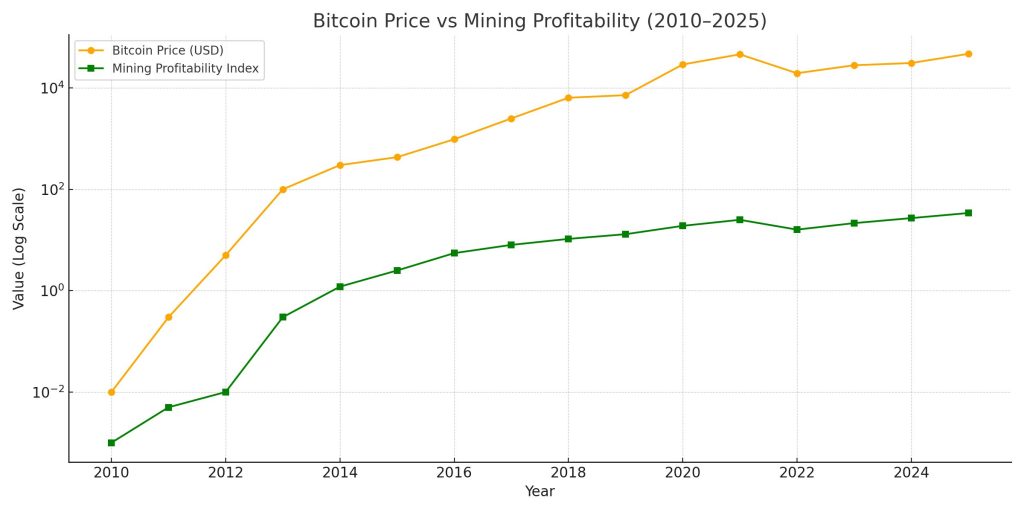
The Bullish Gap Between BTC Price and Difficulty
In a recent report, Blockware Intelligence, a leading mining analytics firm, emphasized the rare divergence between BTC/USD growth and mining difficulty. Over the past year:
- Bitcoin price increased by 75%
- Mining difficulty increased by 53%
This 22% gap indicates expanding profit margins for miners, as the price of BTC is outpacing the increase in operational difficulty.
Blockware summarizes the situation with clarity:
“The bull case for Bitcoin mining? BTC/USD increasing faster than mining difficulty… Profit margins for Bitcoin miners are increasing.”
Historical Patterns: Mining Signals a Bull Market Shift
Déjà Vu From 2016 and 2020 Bull Runs
This type of pattern, BTC price outpacing mining difficulty, has been seen before. Notably, similar trends emerged in early 2016 and again in mid-2020, both of which preceded significant bull runs. Analysts believe that the current mining profitability could be an early indicator of another bullish macro trend.
Kimchi Premium Adds Fuel to the Fire
Another telling sign of growing demand comes from South Korea, where the Kimchi Premium—the price difference between Korean exchanges and international BTC spot markets—stands at +0.6%.
This indicates strong retail appetite for Bitcoin in Asia, a historically bullish signal, especially when coupled with increased OTC and institutional inflows.
Miners Invest in Efficiency and Future Growth
Deployment of Advanced ASIC Machines
Miners are not just benefiting from price dynamics—they’re also investing heavily in next-gen ASIC hardware, significantly boosting hash rates while improving energy efficiency.
The result? Even as difficulty rises, per-unit profit remains strong for miners who upgrade to newer machines. This puts older equipment at a disadvantage, pushing smaller players to exit while well-capitalized operations scale up.
Institutional Mining Investments Surge
In addition to better machines, institutional investors are entering the mining space at an accelerated pace. Venture-backed data centers, private equity infrastructure funds, and energy conglomerates are either partnering with existing miners or building their own facilities.
This influx of capital and expertise is not just making mining more competitive—it’s professionalizing the industry and raising its long-term sustainability.
Bitcoin’s Scarcity: The Ultimate Bullish Signal
Over 94% of all Bitcoin Is Already Mined
As of August 2025, over 94% of the total 21 million BTC supply has already been mined. This leaves fewer than 1.26 million BTC left to be introduced into circulation over the coming decades.
This extreme scarcity, combined with Bitcoin’s halving schedule every 4 years, gives it a stock-to-flow ratio of approximately 120, which is twice that of gold.
This metric reinforces Bitcoin’s appeal as a hard-money asset and hedge against inflation, especially in an era of aggressive central bank monetary expansion.
Investor Sentiment Lags Behind Network Fundamentals
BTC Price Retreats Below $115K A Temporary Disconnect?
Despite the bullish on-chain and mining metrics, Bitcoin’s price has corrected below $115,000 following its July highs. This drop appears counterintuitive given the improving network fundamentals.
Analysts believe this temporary decoupling is due to macro headwinds, such as:
- U.S. trade policy tensions
- Interest rate uncertainty
- Shifting capital flows from equities to bonds
In other words, the price doesn’t always reflect on-chain health immediately. But historically, these dislocations tend to correct in favor of the fundamentals.
Miners Could Be Leading the Market Once Again
Are Miners the Smart Money in 2025?
In previous cycles, miners have often front-run broader market movements, accumulating BTC before major rallies. Their continued investment, rising profitability, and confidence in long-term pricing suggest they are preparing for another leg upward.
If Bitcoin follows historical patterns, this could be the final accumulation phase before a significant breakout.
What Comes Next for Bitcoin?
Bitcoin’s current mining landscape tells a powerful story. Despite record difficulty, rising energy costs, and global economic uncertainty, miners are more profitable and optimistic than ever.
With improved hardware, institutional investment, strong Asian demand, and a scarcity-driven narrative, the stage is set for the next major move in Bitcoin’s market cycle.
As miner behavior increasingly decouples from short-term price action, it’s clear they see something others don’t. And if history rhymes, that “something” may be the early stages of the next Bitcoin bull run.









