























































The Genesis of Bitcoin Mining
In January 2009, Bitcoin was born with the mining of its very first block: the Genesis Block. At that time, only a handful of cryptography enthusiasts, led by the pseudonymous Satoshi Nakamoto, understood the implications of this innovation. Bitcoin mining, in those early days, was simple and accessible to anyone with a regular CPU. Fast forward to 2025, and Bitcoin mining has transformed into a highly competitive, industrial-scale operation dominated by mining farms and advanced ASIC (Application-Specific Integrated Circuit) hardware.
This blog explores the complete journey of Bitcoin mining from its humble beginnings to the sophisticated global industry it is today. We’ll dive into key concepts like mining difficulty, hash rate, reward halvings, energy usage, and how the price of Bitcoin influenced mining activity across the years.
What Is Bitcoin Mining? A Technical Breakdown
Bitcoin mining is the process by which new bitcoins are created and transactions are added to the blockchain. Miners use computational power to solve complex mathematical puzzles. The first miner to solve the puzzle gets to add the following block to the blockchain and receives a block reward—in bitcoins—as an incentive.
Key components involved in Bitcoin mining include:
- Hash Function: SHA-256 is the cryptographic function used in mining. It converts input data into a fixed 256-bit output.
- Mining Hardware: CPUs (early), GPUs (2010-2013), FPGAs (2013), and ASICs (from 2013 onward).
- Block Reward: Initially 50 BTC per block, halved every 210,000 blocks (~every 4 years).
The Early Era: CPU Mining and the Golden Days (2009–2011)
During Bitcoin’s first two years, mining was straightforward. The network’s hash rate was low, and the mining difficulty—a measure of how hard it is to find a new block was minimal. Anyone with a laptop could mine Bitcoins.
- Bitcoin Price in 2009: Practically zero; Bitcoin was only traded informally.
- Hash Rate: Measured in kilo-hashes per second (kH/s).
- Difficulty Level: 1 (the minimum possible).
- Block Reward: 50 BTC per block.
In 2010, Laszlo Hanyecz famously paid 10,000 BTC for two pizzas. That same year marked the first real-world transaction involving Bitcoin and the launch of the first Bitcoin exchange, BitcoinMarket.com. Still, mining was easy and cost-efficient, with practically no competition.
The GPU and FPGA Age: Scaling the Operation (2011–2013)
As more people joined the network and Bitcoin’s price began to rise (reaching $1 in early 2011), miners sought more efficient methods. GPUs (graphics cards) replaced CPUs, offering up to 100x more hashing power. Then came FPGAs, configurable hardware that was even more power-efficient.
- Price Range: From $1 in 2011 to around $266 in April 2013.
- Hash Rate: From mega-hashes (MH/s) to giga-hashes (GH/s).
- Difficulty: Increased exponentially due to competition.
- Mining Pools: Slush Pool (launched in 2010) and others allowed miners to combine resources and share rewards.
This era showed how Bitcoin mining was becoming more specialized and lucrative. However, it also laid the foundation for the centralization of mining.
The ASIC Revolution: Industrial Mining Emerges (2013–2016
ASIC miners changed the game entirely. Purpose-built for mining Bitcoin, these machines offered unimaginable increases in hash rate and energy efficiency. Mining on home computers became unprofitable. Industrial-scale mining operations were born in countries like China, Iceland, and Canada.
- Bitcoin Price: Ranged from $100 to over $1,000.
- Hash Rate: Measured in tera-hashes per second (TH/s).
- Energy Consumption: Became a key concern.
- 2016 Halving: Block reward dropped from 25 BTC to 12.5 BTC.
ASICs created a technological arms race. Only those with the capital to invest in these machines and access to cheap electricity could remain competitive.
Institutionalization and Global Expansion (2017–2020)
As Bitcoin’s price surged to nearly $20,000 in December 2017, mining grew more lucrative and more exclusive. Entire warehouses filled with ASICs now dominated the landscape. Countries with cheap electricity (like China, Russia, and Iran) became mining hubs.
- Bitcoin Price: $1,000 in Jan 2017 to nearly $20,000 in Dec 2017, then fell to ~$3,000 in 2018.
- Difficulty: Grew into the trillions.
- Mining Pools: Became dominated by entities like BTC.com, Antpool, and F2Pool.
- Environmental Impact: Bitcoin mining’s energy usage drew criticism and debate.
In 2020, Bitcoin underwent its third halving, reducing the block reward from 12.5 to 6.25 BTC.
Green Mining and North American Boom (2021–2023)
China banned Bitcoin mining in 2021, shifting the mining landscape dramatically. The U.S., Canada, and Kazakhstan emerged as new mining strongholds. Meanwhile, the rise of “green mining” using renewable energy sources gained momentum.
- Bitcoin Price: All-time high of ~$69,000 in Nov 2021.
- Hash Rate: Exceeded 200 EH/s (exa-hashes).
- Difficulty: Surpassed 30T.
- Public Mining Companies: Riot Blockchain, Marathon Digital Holdings, and Core Scientific went public.
This era marked Bitcoin mining’s move into Wall Street, ESG debates, and regulatory scrutiny.
2024–2025: Record Difficulty and a New Mining Landscape
As of August 2025, Bitcoin mining is tougher than ever. Mining difficulty has reached historic highs, while the fourth halving event in April 2024 reduced block rewards to 3.125 BTC per block.
- Bitcoin Price (2025): Oscillating between $55,000 and $75,000.
- Hash Rate: Approaching 300 EH/s.
- Mining Farms: Located in Texas, Norway, Paraguay, and Africa.
- Green Innovation: Solar, wind, and hydropower dominate new mining infrastructure.
Despite increased difficulty, many miners remain profitable due to higher Bitcoin prices, optimized hardware, and long-term electricity contracts.
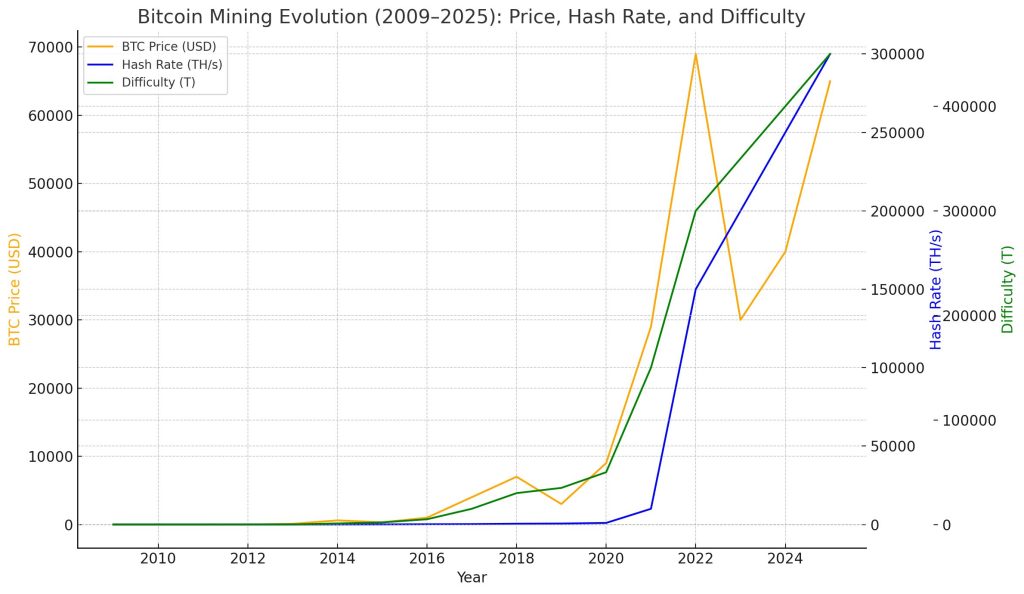
Here is a realistic graph visualizing the evolution of Bitcoin mining from 2009 to 2025, showcasing:
- Bitcoin Price (USD) in orange
- Hash Rate (TH/s) in blue
- Mining Difficulty (T) in green
Understanding Hash Rate and Mining Difficulty
The hash rate is a metric that indicates how many SHA-256 computations the network can perform every second. A higher hash rate means a more secure and decentralized network. Meanwhile, mining difficulty adjusts every 2,016 blocks (roughly every two weeks) to ensure block times remain around 10 minutes.
- When more miners join = higher hash rate = increased difficulty.
- When miners leave = lower hash rate = reduced difficulty.
The difficulty adjustment algorithm is a brilliant mechanism that maintains the integrity and timing of the Bitcoin network.
Why Mining Was Easier in the Beginning
Mining was easier in Bitcoin’s infancy for several reasons:
- Fewer miners.
- Lower hash rate and difficulty.
- No competition from specialized hardware.
- Cheap or negligible electricity costs.
- No institutional or governmental interference.
Early miners like Hal Finney and Satoshi Nakamoto themselves mined thousands of bitcoins using just their laptops. Today, those coins are worth hundreds of millions of dollars.
The Industrialization of Trust
Bitcoin mining has evolved from a hobbyist experiment into a trillion-dollar industry. It has influenced energy policy, sparked environmental debates, and become central to national economic strategies. As of 2025, it’s no longer just about solving puzzles it’s about securing the most valuable decentralized monetary network in history.
The future of mining may include nuclear-powered rigs, AI-optimized hardware, and increased nation-state participation. But one thing remains constant: Bitcoin mining is the heartbeat of the Bitcoin network.









