


























































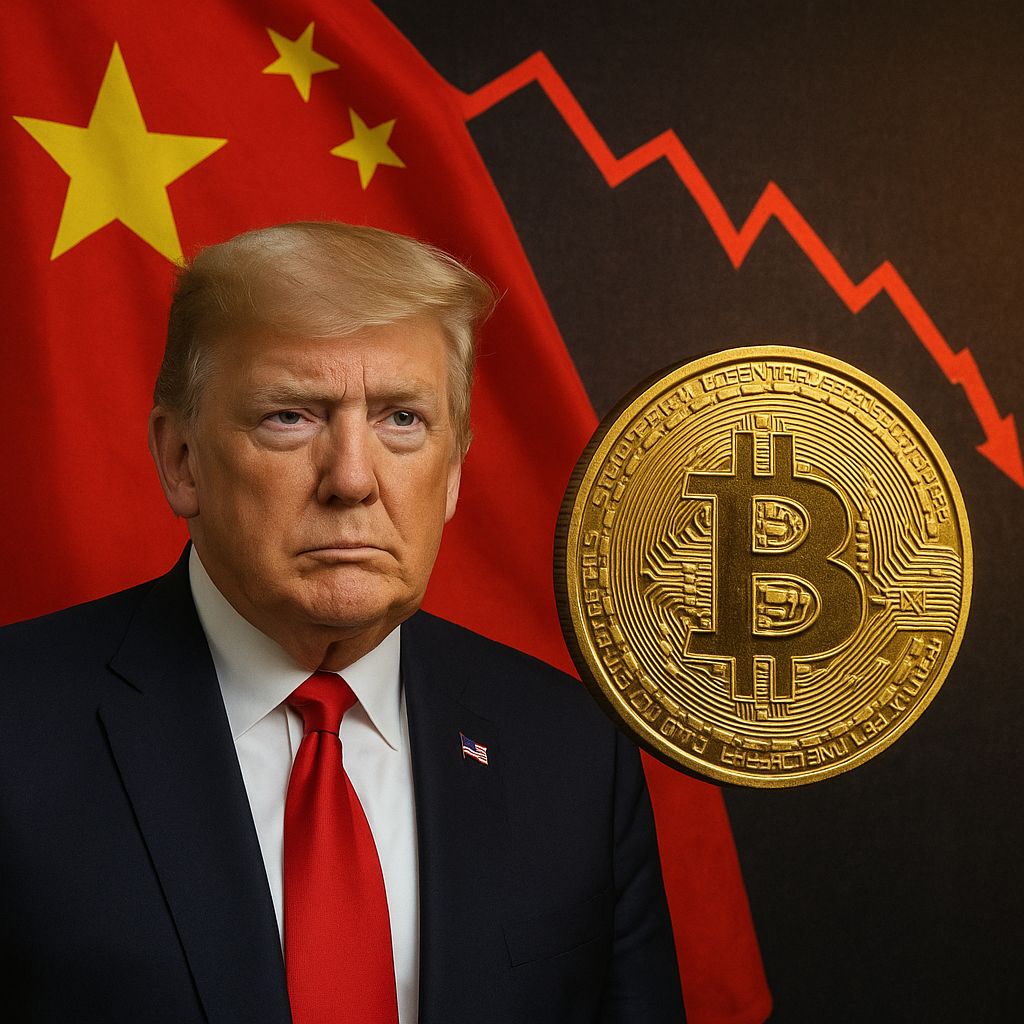
Panic Grips the Crypto Market After Sudden Selloff
The global cryptocurrency market was thrown into chaos on Friday night after a series of sharp declines across all significant digital assets. The selloff came immediately following U.S. President Donald Trump’s surprise announcement of new 100 percent tariffs on Chinese imports, which triggered a wave of panic across global financial markets.
Bitcoin (BTC) plunged more than 12 percent, briefly dropping below the $106,000 level, while Ethereum (ETH) fell almost 17 percent, trading below $3,600. The entire crypto sector reacted violently as traders rushed to liquidate positions amid renewed fears of global economic disruption.
Market volatility intensified as billions of dollars were wiped out in leveraged trades, marking one of the most severe and rapid downturns in recent months. Analysts now warn that unless sentiment improves quickly, the broader crypto market could be on the verge of a deeper correction.
Bitcoin and Ethereum Lead the Decline
According to CoinGecko data, the total cryptocurrency market capitalization dropped by approximately 15 percent, reaching $3.59 trillion. This sharp decline reflects the widespread risk-off mood that gripped investors following the trade policy shock.
Bitcoin, which had been consolidating around the $120,000 mark earlier in the week, plunged as low as $105,896 before stabilizing slightly above $106,000. Ethereum mirrored the trend, falling 17 percent to trade near $3,580, its lowest level in over two months.
Market experts note that Bitcoin’s failure to hold key psychological support levels triggered automatic sell orders, further accelerating the decline. The move below $106K marked the largest single-day percentage loss for Bitcoin in nearly half a year.
Ethereum’s decline was even more pronounced, as its network activity and gas fees remained relatively high, suggesting traders were rushing to exit positions. The ETH price drop also dragged several Ethereum-based tokens lower, magnifying the overall selloff across decentralized finance (DeFi) markets.
Altcoins Hit Hard – Massive Losses Across the Board
The selloff extended far beyond Bitcoin and Ethereum. Major altcoins suffered even steeper declines as liquidity evaporated and traders scrambled to close leveraged positions.
- XRP fell a shocking 31 percent, hitting $1.90, its lowest price since November 2024. Its market capitalization dropped by 15 percent to $115 billion, as experts warned of a potential “price crash” scenario if selling pressure continues.
- BNB managed to hold slightly above $1,000, though it still lost nearly 20 percent in the same trading session.
- Dogecoin (DOGE), the largest memecoin by market cap, tumbled 39 percent in a single day, erasing weeks of gains.
- Story’s IP token, a newer altcoin project, was the biggest loser of all, collapsing by 61 percent.
Altcoin markets tend to amplify volatility during broader corrections, and this time was no exception. Liquidity thinned quickly, order books became unbalanced, and automated sell-offs accelerated price declines. Many traders described the event as a “flash crash” across multiple exchanges.
Record Liquidations – $9 Billion Wiped Out in 24 Hours
Data from Coinglass shows that the crypto market experienced $7.44 billion worth of leveraged position liquidations in just one hour, followed by a total of nearly $9 billion in the past 24 hours.
This marks the largest single-day liquidation event in cryptocurrency history, surpassing previous records from early 2021 and 2022. Out of the $9 billion, approximately $7.5 billion were long positions, meaning that bullish traders betting on price increases were forced to close positions at a loss.
Leveraged trading, while profitable in bull markets, can lead to devastating losses when markets reverse abruptly. As prices fell, liquidation cascades triggered automatic sell orders, which pushed prices down further, creating a self-reinforcing downward spiral.
Analysts note that such extreme liquidations often lead to temporary overselling, followed by short-term rebounds as the market stabilizes. However, with geopolitical uncertainty rising, traders remain cautious about jumping back in too early.
The Trigger – Trump’s 100% Tariffs on China Imports
The crypto crash came shortly after President Donald Trump announced his decision to impose a 100 percent tariff on all Chinese imports, citing what he called “unfair trade practices” and “hostile economic behavior.”
According to CNBC, the new tariffs are set to take effect on November 1, escalating the ongoing trade tensions between the world’s two largest economies. The announcement sent shockwaves across global financial markets, with major stock indices turning red and safe-haven assets like gold and the U.S. dollar spiking in value.
In a post on his Truth Social account, Trump stated:
“It has just been learned that China has taken an extraordinarily aggressive position on trade in sending an extremely hostile letter to the World, stating that they were going to, effective November 1, 2025, impose large-scale export controls on virtually every product they make, and some not even made by them.”
He added,
“This affects all countries without exception and was obviously a plan devised by them years ago. It is absolutely unheard of in international trade and a moral disgrace in dealing with other nations.”
These remarks added fuel to market uncertainty, causing investors to flee risky assets, including cryptocurrencies, and seek safety in more stable assets. The combination of political tension and financial panic proved toxic for the already fragile crypto market.
Investor Reaction – Fear Dominates the Market
Investor sentiment across crypto social media platforms turned deeply bearish as panic spread. Popular crypto influencers and traders on X (formerly Twitter) described the situation as “a bloodbath” and “the largest single-hour sell-off since the early 2020s.”
Fear indexes spiked to levels not seen since the 2022 bear market. Analysts pointed out that the sudden policy announcement blindsided the market, catching even seasoned traders off guard.
Many institutional investors and trading firms were forced to de-risk quickly to avoid further losses. Retail investors, meanwhile, reacted emotionally, selling into weakness and further driving prices down.
Several analysts commented that this selloff mirrors earlier market reactions to unexpected geopolitical shocks, such as the 2020 oil price war or the 2022 inflation surge, when investors abandoned high-risk assets to seek stability.
How This Tariff Shock Impacts Crypto Fundamentals
While tariffs themselves do not directly affect blockchain technology or crypto networks, they have a powerful psychological and economic impact on investors. The reasoning is straightforward: higher tariffs can slow global trade, reduce liquidity, and increase inflationary pressure.
As a result, investors anticipate a slowdown in risk-taking behavior, leading to declines across equities, commodities, and cryptocurrencies. Historically, crypto markets have struggled during periods of high geopolitical uncertainty, particularly when tied to U.S.-China relations.
Experts suggest that if the trade war escalates further, it could prolong volatility in the crypto sector and delay any potential recovery.
What Analysts Are Watching Next
Market analysts are now closely monitoring several key developments that could shape crypto’s short-term trajectory:
- Bitcoin’s ability to reclaim $110K: A sustained move above this level could indicate a stabilization phase.
- Ethereum’s support at $3,500: If ETH fails to hold above that zone, further declines may follow.
- Macroeconomic signals: Inflation data, U.S. treasury yields, and global trade headlines will likely dictate investor mood.
- Binance and exchange activity: High withdrawal volumes can signal panic or institutional repositioning.
Most analysts agree that Bitcoin’s recovery will set the tone for the broader market. If BTC stabilizes, other major assets like Ethereum, BNB, and Solana could follow.
Long-Term Outlook – Correction or Crisis?
Despite the violent price action, some experts argue that this correction could ultimately prove healthy for the market. Rapid declines often flush out overleveraged traders and reset valuations closer to sustainable levels.
Long-term investors view current levels as potential accumulation zones, especially for assets with strong fundamentals. Bitcoin and Ethereum, in particular, remain widely regarded as the market’s safest long-term bets.
However, if the geopolitical situation worsens and global markets continue to slide, crypto could face a prolonged consolidation period. Much will depend on how central banks and policymakers respond to the economic fallout of Trump’s tariff escalation.
Panic Today, Opportunity Tomorrow?
The latest crash reminds investors how deeply global politics can influence cryptocurrency prices. The combination of sudden tariffs, leveraged liquidations, and fear-driven selling created one of the harshest days for crypto markets in recent memory.
Still, many seasoned traders argue that such extreme moves often present new opportunities. Once panic subsides and the market digests the tariff news, a rebound could follow, especially if Bitcoin reclaims stability above $110K.
For now, caution remains essential. As the market continues to digest the ripple effects of Trump’s trade decision, traders and investors alike are bracing for a volatile road ahead.