



























































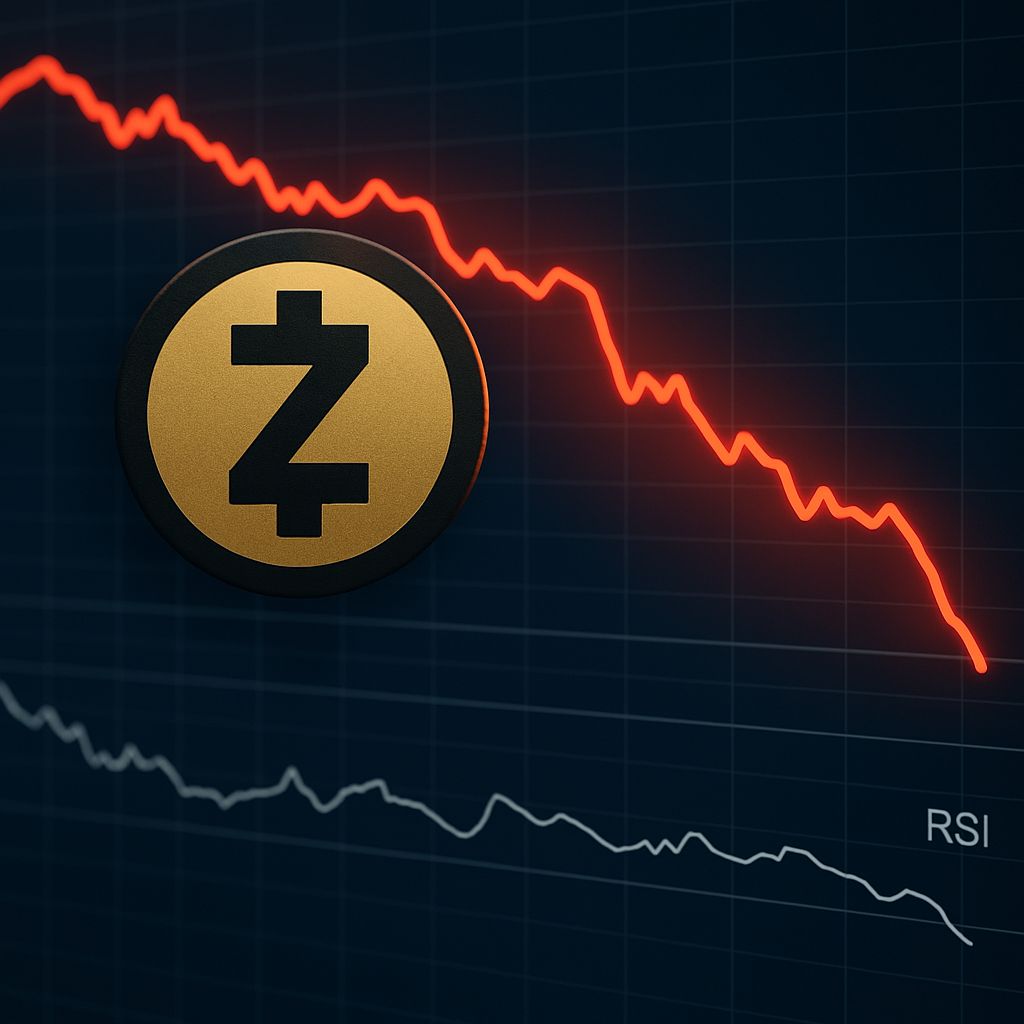
Zcash has entered one of its most turbulent phases of the year after an aggressive price correction sent the asset sharply lower. The privacy focused cryptocurrency has dropped more than thirty two percent in the past week and continues to show signs of instability across multiple technical indicators. With the price now hovering near the three hundred sixty five dollar region after another steep fall in the last twenty four hours, traders are beginning to question whether this decline represents a short term pullback or the beginning of a deeper bearish trend.
Just weeks ago, sentiment surrounding Zcash was completely different. The asset had surged impressively from forty dollars to seven hundred dollars within a relatively short period of time. This dramatic upward movement attracted attention from traders across the market, with many expecting continued upside and additional breakout attempts. The current reversal, however, has erased a significant portion of those gains and raised concerns about whether the trend has shifted permanently in favor of sellers. With several major support levels already breached, Zcash is now entering a critical phase where both long term holders and short term traders are watching closely for signs of stabilization.
This article explores Zcash’s recent weakness, the technical signals pointing toward further downside, the broader market context influencing the trend, and the potential scenarios for price movement as the market approaches early 2026. With liquidity zones being tested and momentum indicators signaling caution, Zcash faces an important test in determining its medium term trajectory.
Zcash Breaks Multiple Key Price Levels and Signals a Shift in Trend
Zcash’s rapid decline has been driven largely by the loss of significant technical levels that previously acted as strong support zones. The first major warning emerged when the price broke below the fifty day simple moving average, signaling a potential shift in trend direction. This moving average had played an important role during the earlier uptrend, offering consistent support during retracements. Losing this level suggested that bullish control was weakening.
Another major breakdown occurred when Zcash lost the four hundred eighty dollar horizontal support zone. This area had acted as a strong structural level throughout the past few months and was widely viewed as an important point for buyers to defend. The failure to hold this region indicated that sellers were gaining momentum and that long positions were being forced to unwind rapidly.
The decline also pushed Zcash through the thirty eight point two percent Fibonacci retracement level. Fibonacci levels are often used by traders to analyze potential bounce zones during corrections. Dropping below this level created further pressure and opened the path toward deeper liquidity pools.
After losing these major supports, Zcash quickly entered the first liquidity zone near four hundred dollars, a region that typically attracts high volume and increased volatility. Even this area failed to hold, and the price continued its descent toward a second liquidity zone near three hundred seventy dollars. This zone offered only temporary relief before selling pressure intensified again.
Crypto analyst Ardi had been warning of growing weakness well before the major breakdowns occurred. He highlighted multiple structural issues and pointed out that the RSI trend had failed to break out. According to his analysis, the RSI had shown repeated signs of stress, indicating that momentum was weakening. He also noted that the market was highly exposed to long liquidation risk, stating that even small five percent moves were triggering cascading liquidations and accelerating the decline. This created a dangerous feedback loop where increasing sell pressure pushed Zcash into deeper losses.
Ardi reported that he partially closed his short position near the three hundred seventy dollar liquidity zone, but he cautioned that if this zone failed to hold, the next major area to watch would lie between two hundred ninety seven dollars and three hundred eleven dollars. This region includes the sixty one point eight percent Fibonacci retracement level and contains a high concentration of past liquidity.
With multiple structural breaks already confirmed and momentum indicators turning sharply negative, the technical picture for Zcash suggests that the downtrend may not be over yet.
Momentum Indicators Confirm Bearish Pressure Across the Market
Momentum indicators provide important insight into the strength and direction of price movements. In Zcash’s case, these indicators have continued to highlight bearish conditions. The Moving Average Convergence Divergence indicator, commonly known as the MACD, remains pointed firmly downward. The MACD line is positioned below the signal line, and the red histogram bars continue to expand. This pattern reflects sustained negative momentum and suggests that sellers remain firmly in control.
The Money Flow Index also supports the bearish narrative. The indicator has dropped toward the thirty five level, indicating that capital is flowing out of the asset rather than entering. Although the MFI is nearing a region where reversals have occurred in the past, the current reading still reflects strong distribution pressure. Until this indicator stabilizes or begins to rise, the probability of a continued downtrend remains high.
Analyst Ali Martinez pointed out earlier that Zcash had returned to a historically important support zone near four hundred forty dollars. He described this level as a potential bounce point but cautioned that a breakdown would confirm a continuation of the bearish structure. With the level now decisively broken, Martinez’s warning has proven accurate, and the market remains focused on lower support zones.
Trading volume has increased dramatically during this decline, crossing the one billion dollar mark within twenty four hours. This surge in volume reflects panic driven selling as well as high interest from short sellers. When high volume accompanies sharp price drops, it often indicates capitulation or heavy liquidation activity. Zcash has been trading between three hundred fifty six dollars and four hundred fifty seven dollars within the last day, showing large intraday volatility. Over the past week, CoinGecko data shows a high of five hundred eighty five dollars and a low near three hundred fifty eight dollars, illustrating just how quickly the asset has retraced.
These technical and volume based indicators provide overwhelming evidence that Zcash is currently experiencing a strong bearish phase with a clear downward trend. Until momentum indicators begin to stabilize, deeper declines remain possible.
Market Sentiment Weakens as Analysts Debate Long Term Direction
The market remains divided on Zcash’s long term potential. Some analysts believe that the dramatic rise from forty dollars to seven hundred dollars was unsustainable and that the current correction is a natural response to extreme overextension. Others argue that the broader market conditions, including liquidity challenges and increasing risk aversion, have played a larger role in the decline.
Max Keiser, known for his strong views on the crypto market, took a very bearish stance. He suggested that the Zcash rally was nothing more than a pump and dump cycle and stated that a return to fifty five dollars seems inevitable. While this view is much more extreme than the average analyst prediction, it reflects the growing skepticism that has followed Zcash’s rapid price drop.
At the same time, there are developments that could influence the long term outlook in a more positive way. One of the most notable is Grayscale’s reported plan to convert its Zcash Trust into an exchange traded fund. If approved, this ETF would allow investors to gain exposure to Zcash through regulated markets without holding the token directly. This could increase institutional interest and generate additional demand for ZEC, particularly among investors who prefer regulated investment vehicles.
However, even if such an ETF becomes available, Zcash will still need to prove that it can regain technical strength, stabilize price levels, and rebuild investor confidence after this sharp correction. Until the market sees signs of accumulation or structural recovery, sentiment will remain cautious.
Is More Downside Ahead or Is Zcash Approaching a Potential Reversal Zone?
Zcash’s immediate future depends largely on whether it can stabilize within the current liquidity range. The three hundred sixty five dollar region is the latest point where buyers have attempted to slow the decline, but the strength of this zone remains uncertain. If ZEC loses this level, the next major support zone between two hundred ninety seven dollars and three hundred eleven dollars will become the primary area of interest. This region offers the strongest technical support based on historical liquidity and important Fibonacci levels.
If the price can consolidate and hold within one of these zones, Zcash may begin forming a base for recovery. A stabilization pattern, combined with improving momentum indicators, could set the stage for a rebound. However, this scenario requires both a slowdown in selling pressure and an improvement in broader market sentiment.
On the other hand, if market conditions worsen or if liquidity continues to drain from the crypto sector, Zcash could face additional pressure. Without clear signs of accumulation or reduced volatility, the path of least resistance remains downward until proven otherwise.
As the market approaches early 2026, traders should remain cautious. Zcash has shown the ability to make explosive moves in both directions, and the current environment suggests that volatility is likely to remain elevated. The next major movements will determine whether ZEC can recover from this steep correction or whether the asset will continue deeper into its bearish phase.
Zcash Faces a Critical Turning Point After RSI Breakdown
Zcash’s recent decline represents one of its sharpest corrections in months. With multiple key support levels broken, momentum indicators trending lower, and liquidity zones being tested one after another, the asset is now at a critical point. Whether it stabilizes or continues downward will depend on how it behaves in the next support regions and how the broader crypto market evolves.
Traders analyzing the Zcash forecast should remain aware of both the risk of further declines and the possibility of high volatility during any potential recovery attempt. The next few weeks will play a decisive role in determining whether Zcash can regain its footing or whether the market will continue to push the asset toward lower levels.