


























































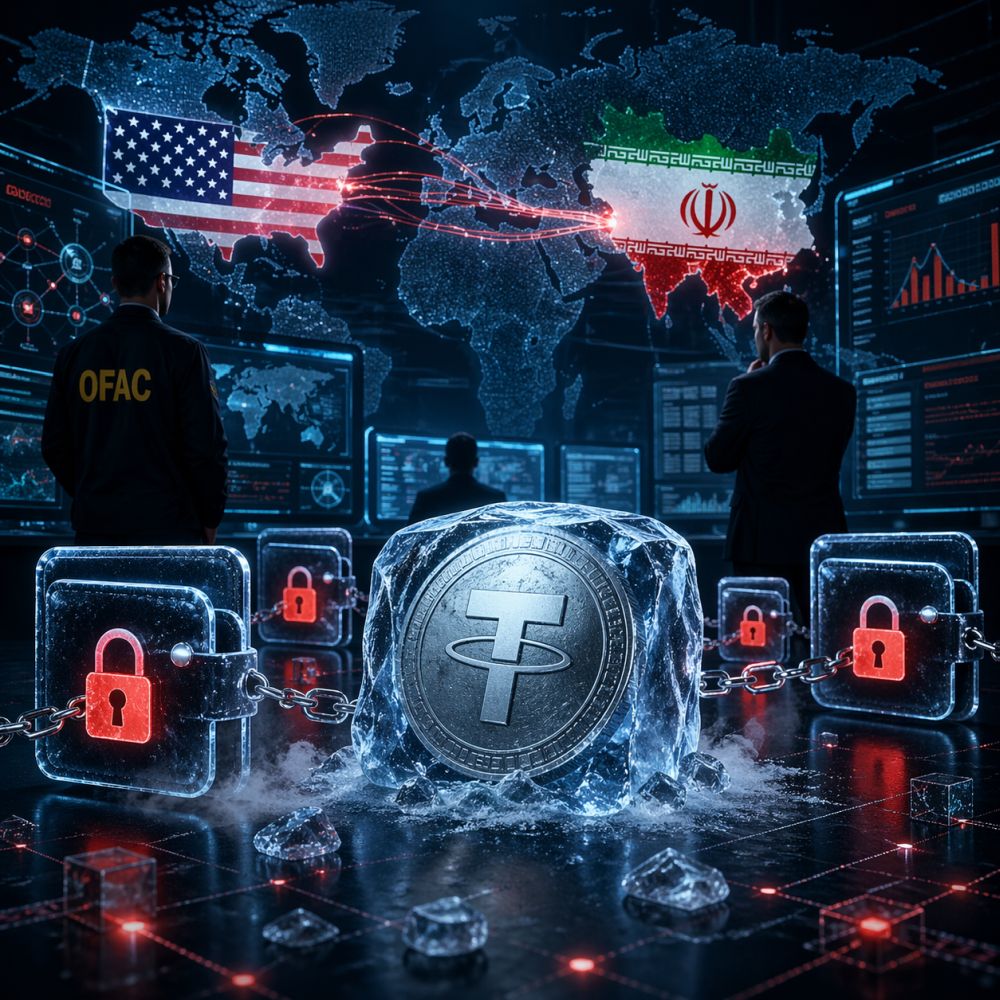
The intersection of decentralized finance and global geopolitics reached a boiling point this week as the United States government intensified its efforts to choke off illicit financial lifelines. In a coordinated move that has sent shockwaves through the blockchain industry, the U.S. Department of the Treasury’s Office of Foreign Assets Control (OFAC) announced new sanctions targeting cryptocurrency wallets with direct ties to the Iranian regime. This enforcement action was bolstered by an unprecedented level of cooperation from Tether, the issuer of the world’s largest stablecoin, USDT. According to official reports, Tether acted decisively to freeze over $344 million held across specific wallet addresses flagged by American authorities.
This massive asset freeze represents one of the largest single compliance actions in the history of the cryptocurrency market. For years, critics of digital assets have argued that the pseudonymous nature of blockchain technology provides a “safe haven” for sanctioned nations like Iran to bypass traditional banking systems such as SWIFT. However, the speed and scale of this recent intervention suggest that the “wild west” era of crypto is rapidly closing. By blacklisting these specific digital nodes, the U.S. government is signaling that even the most sophisticated attempts to move value through “shadow banking” layers will be met with overwhelming regulatory force.
The frozen funds, primarily consisting of USDT on the Tron network, are allegedly part of a broader infrastructure used by Iranian entities to stabilize their local economy and fund regional activities. For the average investor, this event serves as a stark reminder that while blockchain is decentralized in its architecture, the on-ramps, off-ramps, and major stablecoin issuers are increasingly integrated into the global regulatory framework. The $344 million currently sitting in digital limbo is a testament to the transparency of public ledgers, which, ironically, provided the breadcrumbs necessary for investigators to track and eventually halt the flow of these millions.
The Strategic Partnership Between US Law Enforcement and Stablecoin Issuers
One of the most significant takeaways from this incident is the evolving relationship between private crypto companies and federal law enforcement. Tether CEO Paolo Ardoino has been vocal about the company’s commitment to safety and compliance, stating that “USDT is not a safe haven for illicit activity.” In this specific case, the freeze was not a unilateral decision by a private corporation but a response to actionable intelligence provided by U.S. authorities. This partnership highlights a growing trend where centralized stablecoin providers act as “digital deputies” for the Treasury Department.
Tether’s cooperation in this $344 million freeze is part of a much larger effort. To date, the company has assisted in freezing over $4.4 billion in assets globally, with more than $2.1 billion of that total being tied directly to requests from the United States. This level of cooperation is designed to protect the integrity of the dollar-pegged stablecoin market. If USDT were to be widely perceived as a tool for terrorists or sanctioned regimes, it would face existential threats from Western regulators. By acting “immediately and decisively,” Tether preserves its ability to operate within the global financial system.
However, this proactive stance is not without its critics within the crypto community. Many “privacy purists” argue that the ability of a centralized entity to flip a switch and render millions of dollars unspendable goes against the core ethos of Bitcoin and decentralized finance. These critics suggest that “your stablecoins are not truly yours” if they can be seized at the behest of a government. Despite these philosophical debates, the reality of the 2026 regulatory environment is clear: if you are a major player in the financial space, you must choose between total decentralization (which limits scale) or compliance (which allows for institutional adoption).
How Iran Uses Cryptocurrency to Evade International Sanctions
The specific targeting of Iran-linked wallets is no coincidence. For several years, blockchain analytics firms like Elliptic and TRM Labs have been tracking a sophisticated “shadow banking” apparatus within the Iranian state. Reports indicate that the Central Bank of Iran (CBI) and the Islamic Revolutionary Guard Corps (IRGC) have moved billions of dollars through digital assets to prop up the Iranian rial and settle international trade. By using USDT, the regime essentially creates “digital off-book eurodollar accounts,” allowing them to hold and move U.S. dollar value outside the reach of traditional U.S. banking monitoring.
The scale of this operation is staggering. Recent data suggests that IRGC-linked networks moved approximately $1 billion between 2023 and 2025 using UK-registered cryptocurrency exchanges like Zedcex and Zedxion. These platforms allegedly functioned as gateways, allowing the regime to convert oil revenue and other funds into stablecoins that could be easily transferred across borders. The $344 million frozen this week is likely just the tip of an iceberg that includes hundreds of millions more in various “warm” and “cold” wallets spread across the global blockchain.
The use of the Tron network for these transactions is also a strategic choice. Tron’s low transaction fees and high throughput have made it the preferred network for USDT transfers, surpassing Ethereum in daily volume for stablecoins. Unfortunately, this efficiency has also made it a favorite for those looking to move large sums of money quickly. The U.S. Treasury’s focus on these specific Tron-based addresses shows that their surveillance capabilities have matured to the point where they can monitor high-frequency stablecoin movements across multiple blockchains in real-time.
The Future of Crypto Regulation and National Security
As we look toward the future, the $344 million freeze is a precursor to a more aggressive “blockchain-first” sanctions strategy. The U.S. government is no longer just targeting individuals or specific companies; it is targeting the very infrastructure of digital finance. By designating exchanges and freezing wallet addresses, authorities are making it increasingly difficult for sanctioned actors to find liquidity. This “choke point” strategy is designed to make the cost of using crypto for sanctions evasion so high that it becomes a liability rather than an asset for the regime.
Furthermore, this event is likely to fuel the debate over the regulation of stablecoins in the United States and abroad. With the Financial Action Task Force (FATF) issuing warnings about the use of digital assets for money laundering, we can expect more stringent Know Your Customer (KYC) and Anti-Money Laundering (AML) requirements for all stablecoin users. The “unhosted wallet” rule, which would require exchanges to collect information on self-custodied wallets, may gain renewed momentum as a result of these high-profile Iranian cases.
The freezing of $344 million in Iran-linked assets marks a turning point in the history of cryptocurrency. It proves that the “transparency” of the blockchain is a double-edged sword: while it offers freedom from traditional banks, it also provides a permanent, public record for law enforcement to follow. For the crypto industry to survive and thrive, it must navigate this delicate balance between privacy and the rule of law. As Tether and the U.S. Treasury continue to tighten the net, the message is loud and clear: the digital frontier is being tamed, and the cost of non-compliance has never been higher.









