

























































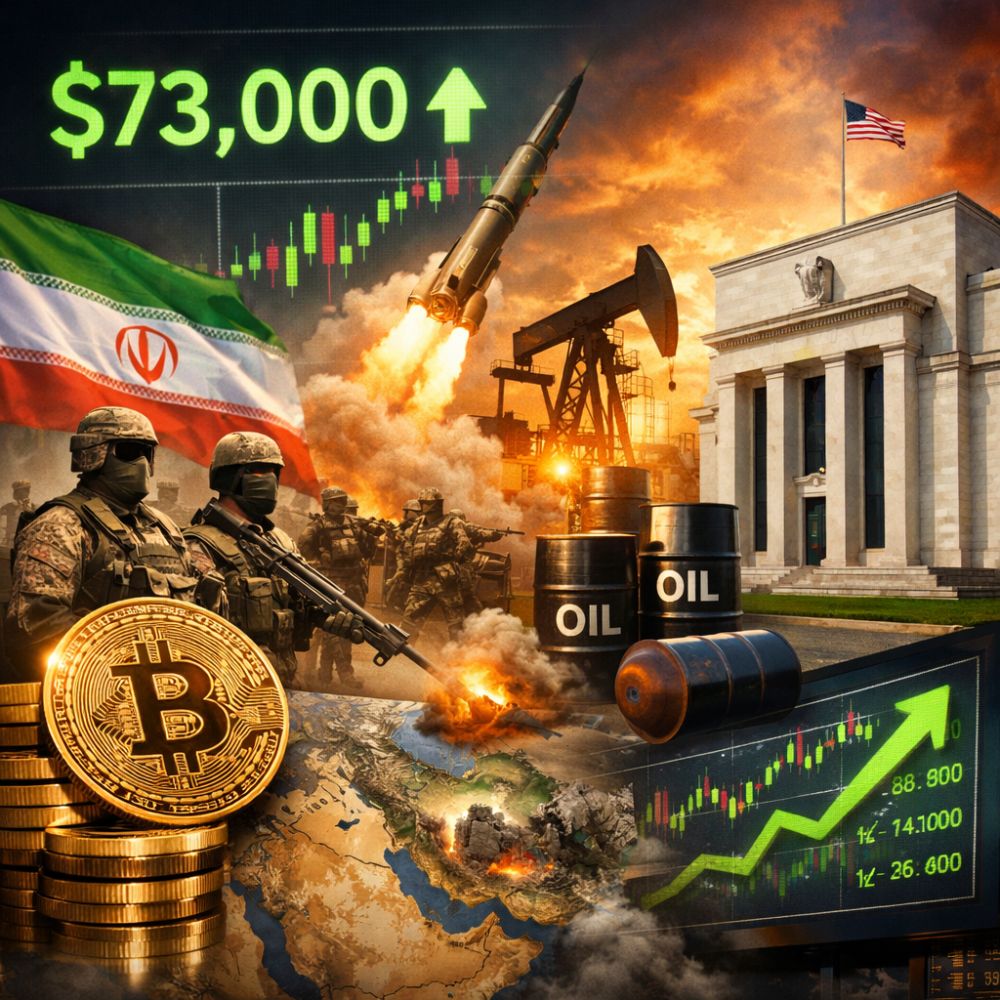
Bitcoin has once again demonstrated its remarkable ability to shrug off global instability, reclaiming the critical $73,000 level in a decisive display of bullish strength. This latest surge occurs against a backdrop of complex geopolitical narratives, primarily involving the ongoing conflict involving Iran and the subsequent stress on global energy markets. Despite the threat of shipping disruptions and volatile oil prices, investors are doubling down on high beta assets. The rally has been fueled by a combination of resilient US equity markets and a growing consensus that the Federal Reserve will maintain a supportive liquidity environment through at least one rate cut before the conclusion of 2026. However, while the price action remains undeniably positive, the underlying market structure reveals a growing reliance on aggressive derivatives positioning rather than pure spot demand, suggesting that the current climb is built on a foundation of high leverage.
The push above $73,000 represents a 4% gain in a single trading session, pushing the digital asset into new all-time high territory. This move is largely a reflection of renewed risk appetite as traders look past immediate war headlines to focus on broader macro liquidity. Major centralized exchanges and Bitcoin exchange-traded funds (ETFs) have reported sustained inflows, yet market analysts warn that the actual market depth remains thinner than in previous cycles. This lack of resting liquidity, combined with soaring open interest and funding rates, creates a “gamma squeeze” effect where small movements in price are amplified by the forced buying of derivatives dealers. While this is excellent for upside momentum, it leaves the market extremely vulnerable to a “violent flush” if the narrative shifts or if inflation data surprises to the upside, forcing a repricing of Fed expectations.
Crowded Leverage and the Risk of Cascade Liquidations
As Bitcoin tests these psychological heights, the concentration of risk in the derivatives market has reached levels that historically precede massive volatility events. On-chain data and derivatives tracking dashboards indicate that large scale “whales” have significantly increased their exposure, often utilizing double digit leverage. One notable example includes a heavily watched institutional account building massive long positions on Ethereum with leverage ratios as high as 15x. This echoes the high stakes trading patterns seen throughout 2025, where single players held notionals exceeding $100 million in exposure. When a handful of players control such a large portion of the market’s momentum, a sudden reversal can trigger a domino effect of liquidations, where the forced closing of one position drives the price down and triggers the next, regardless of the asset’s long term value.
In addition to individual whale activity, major research firms and crypto focused hedge funds have been observed moving massive tranches of Ether and Bitcoin between self custody and centralized exchanges. These movements, often involving tens of thousands of tokens valued in the hundreds of millions of dollars, suggest that smart money is preparing for either a massive distribution phase or a strategic hedge against late cycle volatility. As these funds rotate capital through lending protocols to maximize yield, the “chasing of beta” becomes a dangerous game. For the average retail trader, this environment requires a shift toward tighter stop loss orders and staged profit taking, as the gap between nominal price and actual liquidity continues to widen in these uncharted territories.
Geopolitical Headwinds: Oil Shocks and the Iran Factor
The “war premium” in the crypto market has become a double edged sword. While initial fears of a conflict involving Iran caused a brief dip in previous weeks, the market has since moved into a phase where it views Bitcoin as a potential hedge against currency debasement resulting from geopolitical spending. However, the threat to global shipping lanes and the resulting oil shocks remain a primary concern for macroeconomists. If Iran were to successfully disrupt maritime trade, the resulting spike in energy costs would likely reignite inflationary pressures, forcing the Federal Reserve to pivot away from its projected rate cuts. This would be a direct blow to the “soft landing” narrative that is currently supporting Bitcoin’s record highs.
Traders are now closely monitoring the options market to hedge against such “black swan” events. There has been a notable increase in the purchase of protective puts as investors seek to lock in gains from the run to $73,000. The correlation between Bitcoin and traditional risk assets remains high, meaning that any sudden “de-risking” in the S&P 500 due to war escalations would likely result in an immediate correction for BTC. The current bullish phase is intact, but it is increasingly characterized by “blow off” conditions where the price is driven by the excitement of new highs rather than stable, long term accumulation. Navigating this late cycle volatility requires a disciplined approach to risk management, as the technical indicators flash “overbought” signals across multiple timeframes.
Looking Ahead: Will Bitcoin Hold the $70,000 Support?
The ultimate question for the coming sessions is whether Bitcoin can transform its previous resistance at $70,000 into a permanent support floor. A successful consolidation above this level would clear the path for a move toward $80,000, provided the macro environment remains stable. However, if the current leverage is flushed out, a re-test of the $65,000 to $68,000 zone is highly probable. Market participants are looking toward the next US inflation report and further updates from the Middle East as the primary triggers for the next major move. While the bulls are clearly in control of the tape, the “packed longs” and high funding rates serve as a warning that the market is currently a “crowded trade.”
In conclusion, Bitcoin’s ascent above $73,000 is a testament to the asset’s growing role in the global financial system, but it is a climb fraught with structural risks. The combination of geopolitical uncertainty, energy market stress, and extreme derivatives leverage has created a high stakes environment. Investors should be prepared for rapid price swings and maintain a focus on total portfolio risk rather than just nominal price targets. Whether this rally leads to a sustained new plateau or a sharp correction will depend on how the market handles the next wave of macro data and whether the current whale driven momentum can transition back into broad based spot demand.
bitcoin price, btc news, iran war crypto, oil market shock, fed rate cuts 2026, bitcoin 73k, crypto market analysis, bitcoin leverage, crypto whale trades, btc liquidations, crypto risk management, ethereum news, trend research crypto, bitcoin all time high, btc derivatives, crypto funding rates, macro economy 2026, bitcoin etf inflows, crypto options hedging, technical analysis btc
To provide a clear picture of the current market structure, we’ve analyzed the Bitcoin (BTC) funding rates for mid-March 2026 and compared them to the historic “blow-off” peaks seen during the 2024 and 2025 bull runs.
The Leverage Reality: March 2026 vs. Historic Peaks
The current breakout above $73,000 is characterized by a “two-speed” market. While the price is hitting new local highs, the cost of leverage—as measured by funding rates—shows that the market is actually less “overheated” than it was during the absolute peaks of 2024.
Comparative Funding Rate Data
| Metric | 2024 Cycle Peak (March) | 2025 All-Time High ($126k) | Current (March 14, 2026) |
| Avg. Funding Rate | +0.06% to +0.08% | +0.10% (Extreme Greed) | -0.01% to +0.005% |
| Annualized Cost | ~65% – 85% | ~100%+ | -3.6% to +5.4% |
| Market Sentiment | Extreme Euphoria | Blow-off Top | Cautious Disbelief / Short Bias |
Why This Matters for Your Strategy
- The “Short Squeeze” Fuel: Unlike 2024, where everyone was “longing” the breakout, current data shows that funding rates have recently dipped into negative territory (-0.01%). This means short sellers are actually paying long holders. This is a “fuel for the fire” scenario—if Bitcoin continues to climb, these short sellers will be forced to buy back their positions, potentially launching BTC toward $80,000.
- Institutional Efficiency: The massive inflows into Spot ETFs ($1.14 billion in early March) are “non-leveraged” demand. This provides a much sturdier floor than the leverage-driven rallies of the past. When institutional spot buying meets a “short-heavy” derivatives market, the resulting moves are typically more violent to the upside.
- Volatility Cushion: Because funding rates aren’t sitting at +0.10%, the risk of a “long liquidation cascade” is currently lower than it was at previous all-time highs. The market has “reset” its leverage over the last 30 days, making the current $73,000 level a more credible support zone than it was during the 2024 spike.