





















































South Korea’s FSC Tightens Crypto Oversight: Mandatory KYC Measures Set for June
The South Korean Financial Services Commission (FSC), the country’s top financial regulator, is introducing rigorous Know Your Customer (KYC) standards for cryptocurrency exchanges and nonprofit organizations starting in June 2025. This regulatory move is part of a broader framework to strengthen the transparency and security of the country’s rapidly growing digital asset sector. In the official announcement, the FSC confirmed that these entities will now be allowed to sell digital assets, marking a pivotal shift in the national crypto policy.
These new regulations reflect South Korea’s commitment to building a more secure digital finance ecosystem. Under the revised policy, non-profit organizations are authorized to liquidate digital assets acquired through donations and sponsorships, while crypto exchanges can sell digital assets accumulated as user transaction fees. This decision aligns with the government’s strategy to gradually liberalize crypto trading for institutional and corporate entities.
Nonprofits Can Now Sell Donated Cryptos – but With Strict Limitations
A major highlight of the new FSC regulations is the permission granted to nonprofit corporations to sell cryptocurrencies received as part of their charitable fundraising. However, this is not without stringent limitations. To ensure responsible handling of donated assets and to minimize the risk of illicit financial flows, non-profits are only allowed to trade virtual assets that meet specific criteria.
According to the FSC’s statement, nonprofit organizations are restricted to cryptocurrencies that are listed on at least three or more domestic Korean Won (KRW)-based exchanges. This measure is designed to guarantee that only highly liquid and credible digital assets are being sold. Moreover, donations must be received exclusively through domestic bank accounts tied to Korean won exchanges, closing any potential backdoors for offshore crypto-based donations.
The FSC emphasized that these enhanced measures are in place to prevent misuse of charitable funds and to comply with international anti-money laundering (AML) standards. Nonprofits will also be subject to deeper scrutiny regarding the origins of the donated assets, with full documentation of the transaction purpose and source of funds now required.
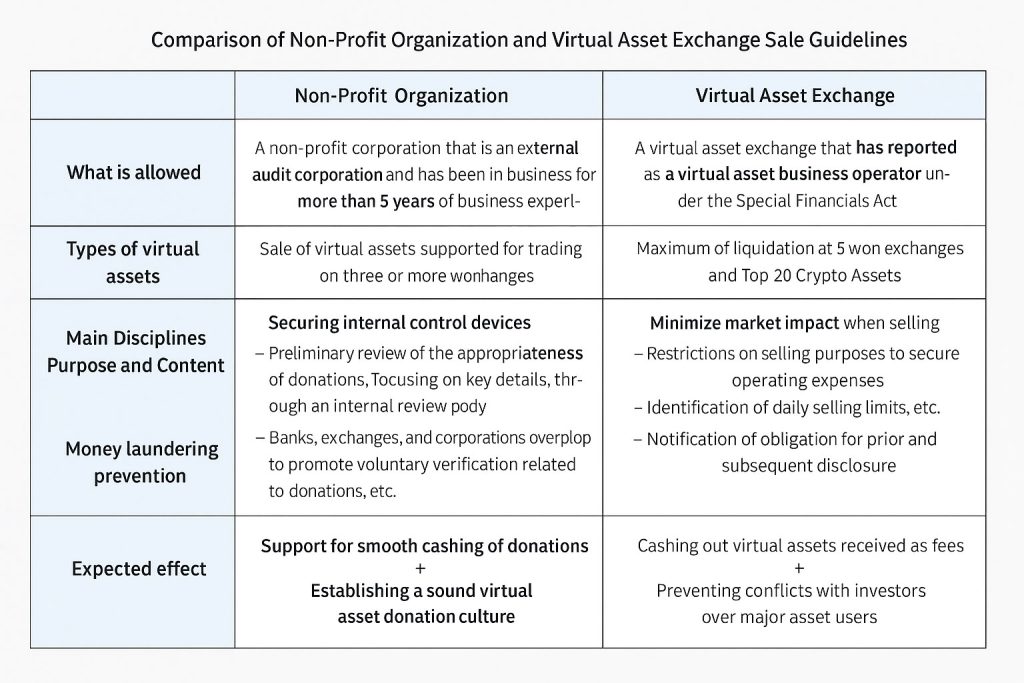
Exchanges Must Comply With Internal Governance Protocols for Crypto Sales
In tandem with the rules for nonprofits, cryptocurrency exchanges operating in South Korea will also face reinforced compliance responsibilities. Under the updated guidelines, exchanges will be allowed to sell cryptocurrencies they receive from transaction fees, but only those assets that rank in the top 20 cryptocurrencies by market capitalization across five major Korean won exchanges.
Additionally, exchanges must introduce stricter internal control mechanisms, including obtaining resolutions from their board of directors regarding any virtual asset sale plans. They must also fulfill prior disclosure obligations to maintain market transparency. These measures are aimed at reinforcing accountability and deterring any fraudulent or unethical practices within the exchange ecosystem.
By obliging exchanges to clearly define and disclose the purpose of their crypto asset sales, the FSC hopes to reduce speculative trading activities and promote greater confidence among institutional and retail investors.
FSC Reforms Extend to Zombie Tokens and Memecoins
In an effort to address market volatility and investor protection, the FSC has also revised the transaction support guidelines for meme coins and so-called “zombie tokens”. Coins with little trading volume or practical utility that nonetheless continue to be listed on exchanges. These types of tokens have become increasingly common, raising concerns about market manipulation and pump-and-dump schemes.
Under the new rules, support for meme coins will only be permitted if they meet a minimum threshold of cumulative transactions. In essence, this requirement aims to ensure that meme coins have a sufficient level of genuine market activity before being allowed for trade. This will effectively eliminate speculative or “hype-based” token listings that contribute to instability in the virtual asset markets.
Furthermore, exchanges will need to provide detailed due diligence and documentation before listing such coins, in line with the FSC’s commitment to preventing the influx of low-quality or fraudulent tokens into the market.
South Korea’s Regulatory Vision: Balancing Innovation With Security
These developments signal South Korea’s firm stance on balancing innovation in the blockchain and crypto space with a well-regulated financial environment. With its latest actions, the FSC is positioning the country as a global leader in setting high regulatory standards while cautiously embracing the future of decentralized finance.
The broader strategic plan includes potential reforms to allow corporations, not just nonprofits or exchanges, to buy, hold, and sell cryptoassets in a regulated manner. Earlier this year, the South Korean government also announced its intent to lift the ban on local institutional participation in cryptocurrency trading, signaling a shift toward mainstream financial adoption.
By implementing detailed KYC and AML regulations, South Korea aims to reassure global markets, encourage responsible crypto innovation, and create a safer digital asset economy for all participants, from individual donors and retail investors to major financial institutions.
Key Takeaways
- Mandatory KYC: All crypto exchanges and nonprofits must implement enhanced KYC measures starting June 2025.
- Crypto Sales Permitted: Nonprofits can sell donated cryptocurrencies, and exchanges can liquidate assets received via user transaction fees.
- Regulated Tokens Only: Nonprofits are limited to coins listed on three or more won-based exchanges; exchanges are restricted to top 20 coins.
- Internal Controls: Exchanges must undergo board approvals and fulfill disclosure requirements for asset sales.
- Meme & Zombie Coins: Must meet transaction thresholds to qualify for exchange support, curbing speculative volatility.









