






























































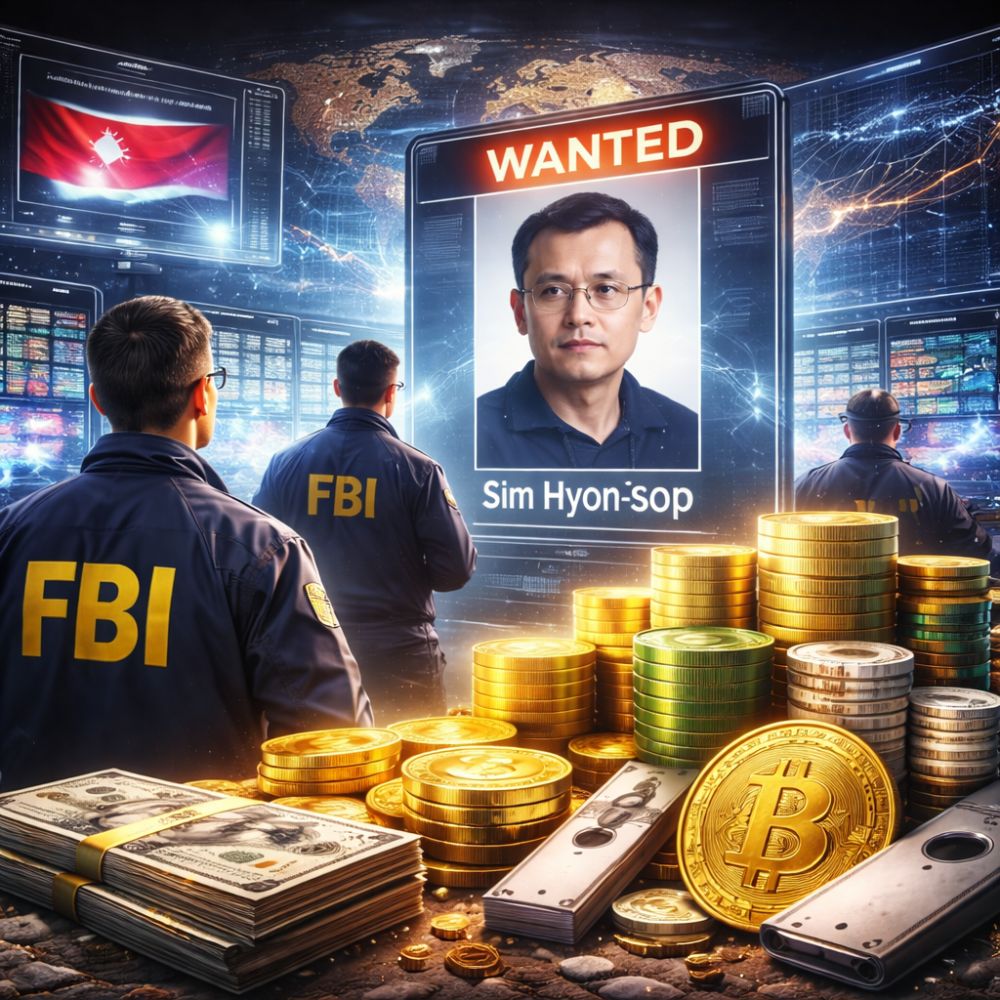
Global law enforcement agencies are intensifying efforts to disrupt North Korea’s use of cryptocurrency to evade international sanctions, with the United States Federal Bureau of Investigation now placing a key alleged financial operator on its most-wanted list. The FBI has identified Sim Hyon-sop as a central figure in a long-running crypto laundering network that allegedly supported the North Korean regime by moving stolen digital assets across borders and converting them into usable funds.
According to U.S. authorities, Sim has spent years facilitating the movement of illicit cryptocurrency obtained through hacking operations and overseas IT schemes linked to Pyongyang. These activities are believed to have generated substantial revenue for the regime of Kim Jong-un, allowing it to bypass restrictions imposed by the international community. The investigation highlights how digital assets have become a crucial tool for sanctioned states seeking financial access beyond traditional banking systems.
The FBI has announced a reward of up to seven million dollars for information leading to Sim’s arrest. Officials say the size of the bounty reflects the importance of the case and the scale of the alleged operation. Investigators believe Sim played a pivotal role in converting stolen cryptocurrency into cash and using shell companies and intermediaries to obscure the origin of funds.
This development underscores the growing intersection between cryptocurrency markets, cybersecurity threats, and geopolitical conflict. While blockchain technology offers transparency at the protocol level, sophisticated actors continue to exploit gaps in enforcement, cross-border regulation, and compliance oversight.
The Alleged Architect Behind North Korea’s Crypto Laundering Network
U.S. investigators describe Sim Hyon-sop as one of North Korea’s external financial operators, often referred to as offshore bankers for the regime. According to the FBI, he operated under multiple aliases, including Sim Ali and Sim Hajim, and spent years working outside North Korea while managing financial flows on behalf of the state.
Sim is reported to have graduated from one of North Korea’s most elite universities and is fluent in both English and Chinese. These skills, combined with his international experience, allegedly allowed him to operate effectively in global financial hubs. At one point, he was sent abroad as the head of a subsidiary linked to North Korea’s Foreign Trade Bank, a key institution often cited in sanctions enforcement actions.
His overseas assignments reportedly included long stays in Kuwait and the United Arab Emirates, regions that have historically hosted North Korean commercial operations. During this time, Sim is accused of establishing a network of shell companies and financial intermediaries designed to move funds discreetly across jurisdictions.
Authorities believe Sim’s role extended beyond simple money movement. Investigators allege he coordinated with brokers, facilitated currency conversions, and ensured proceeds were routed back to entities controlled by or aligned with the North Korean government.
Testimony From a Defector Sheds Light on the Operation
Additional insight into Sim’s alleged activities comes from testimony provided by Ryu Hyun-woo, a former North Korean diplomat who defected in 2019. Ryu served as acting chargé d’affaires at the North Korean Embassy in Kuwait and claims to have met Sim more than ten times during his posting.
According to Ryu, Sim frequently transported him in a Toyota Land Cruiser and often dined with other North Korean operatives operating abroad. During these meetings, Sim allegedly spoke openly about his role in managing funds generated through overseas operations.
Ryu stated that Sim described how cryptocurrency was moved between countries using multiple wallets to disguise its origins. Once sufficiently obfuscated, the digital assets were transferred to brokers in the United Arab Emirates or China. These brokers would then convert the cryptocurrency into cash and deposit the proceeds into bank accounts opened under the names of shell companies.
The defector also claimed that many North Korean nationals working overseas as computer programmers were involved in generating illicit revenue, either through hacking activities or unauthorized IT contracts. Cryptocurrency earnings from these operations were allegedly sent to Sim, who coordinated their laundering and eventual use.
How Stolen Crypto Was Converted Into Real-World Assets
Investigators believe that once funds were successfully converted into cash, Sim used them to purchase goods on behalf of the North Korean regime. These transactions were designed to avoid direct transfers into accounts linked to Pyongyang, thereby evading international sanctions.
According to U.S. authorities, items allegedly acquired through these schemes included raw materials used to manufacture counterfeit cigarettes, communications equipment, and even helicopters. Such purchases are believed to have supported both civilian and military objectives within North Korea.
Officials also allege that Sim personally benefited from these operations, living a lavish lifestyle funded by a share of the illicit proceeds. However, the complexity of the laundering network eventually drew scrutiny as funds passed through the payment systems of major international banks.
Reports indicate that transactions linked to Sim’s network moved through institutions such as Citibank, JPMorgan Chase, and HSBC. This exposure triggered internal compliance alerts and contributed to the broader investigation that ultimately led to the FBI’s public action.
International Sanctions and the Role of Global Banks
The case illustrates how even sophisticated laundering operations can leave traces within the global financial system. According to investigative reports, one scheme allegedly involved more than three hundred transactions worth approximately seventy-four million dollars processed through U.S. banks.
In response to mounting evidence and in line with United Nations sanctions, the United Arab Emirates revoked Sim’s residency visa in 2019. His departure from the country was delayed for several years due to the global pandemic, but authorities believe he eventually left the region.
U.S. officials now suspect that Sim may have traveled to Dandong, a Chinese city located near the North Korean border. While this information has not been independently confirmed, it highlights the challenges of tracking individuals who operate across multiple jurisdictions.
China’s Foreign Ministry has stated that it is unaware of Sim’s alleged activities and has expressed opposition to what it describes as unilateral U.S. sanctions. This diplomatic friction underscores the complexity of enforcing sanctions in a multipolar financial world.
The Seven Million Dollar Bounty and Criminal Charges
The FBI has formally listed Sim Hyon-sop as wanted on multiple charges, including conspiracy to commit bank fraud, money laundering, and evasion of international sanctions imposed on North Korea. The seven million dollar reward offered for information leading to his arrest reflects the strategic importance of disrupting the alleged network.
U.S. authorities believe dismantling Sim’s operations could significantly weaken North Korea’s ability to monetize cybercrime and overseas labor schemes. In recent years, North Korean hacking groups have been linked to some of the largest crypto thefts on record, making financial facilitators like Sim critical targets.
The case also serves as a warning to intermediaries and brokers who may unknowingly or deliberately assist sanctioned actors. As blockchain analytics improve and regulatory scrutiny increases, law enforcement agencies are becoming more effective at tracing illicit flows, even when mixers and multiple wallets are involved.
Why This Case Matters for the Crypto Industry
Beyond its geopolitical implications, the investigation highlights broader risks facing the cryptocurrency ecosystem. Self-custody, decentralized finance, and cross-border transactions remain core features of crypto markets, but they also create opportunities for misuse when oversight is limited.
The case reinforces the importance of compliance, transaction monitoring, and international cooperation. Exchanges, wallet providers, and financial institutions are under increasing pressure to implement robust controls that prevent illicit actors from exploiting their platforms.
For everyday crypto users, the story is a reminder that regulatory scrutiny is intensifying and that the actions of state-linked criminals can shape policy decisions affecting the entire market. As governments seek to curb abuse, legitimate participants may face stricter reporting and compliance requirements.
A Broader Signal in the Global Crypto Enforcement Landscape
The FBI’s pursuit of Sim Hyon-sop reflects a broader shift in how authorities approach crypto-related crime. Rather than focusing solely on individual hacks or isolated incidents, law enforcement is increasingly targeting the financial infrastructure that enables large-scale illicit activity.
This approach recognizes that while hackers steal funds, facilitators are often the key to turning stolen digital assets into real-world value. By disrupting laundering networks, authorities aim to reduce the incentives behind cybercrime itself.
As crypto adoption continues to grow, cases like this illustrate how digital assets have become intertwined with global security concerns. The outcome of this investigation may influence future cooperation between governments, financial institutions, and blockchain analytics firms.