





















































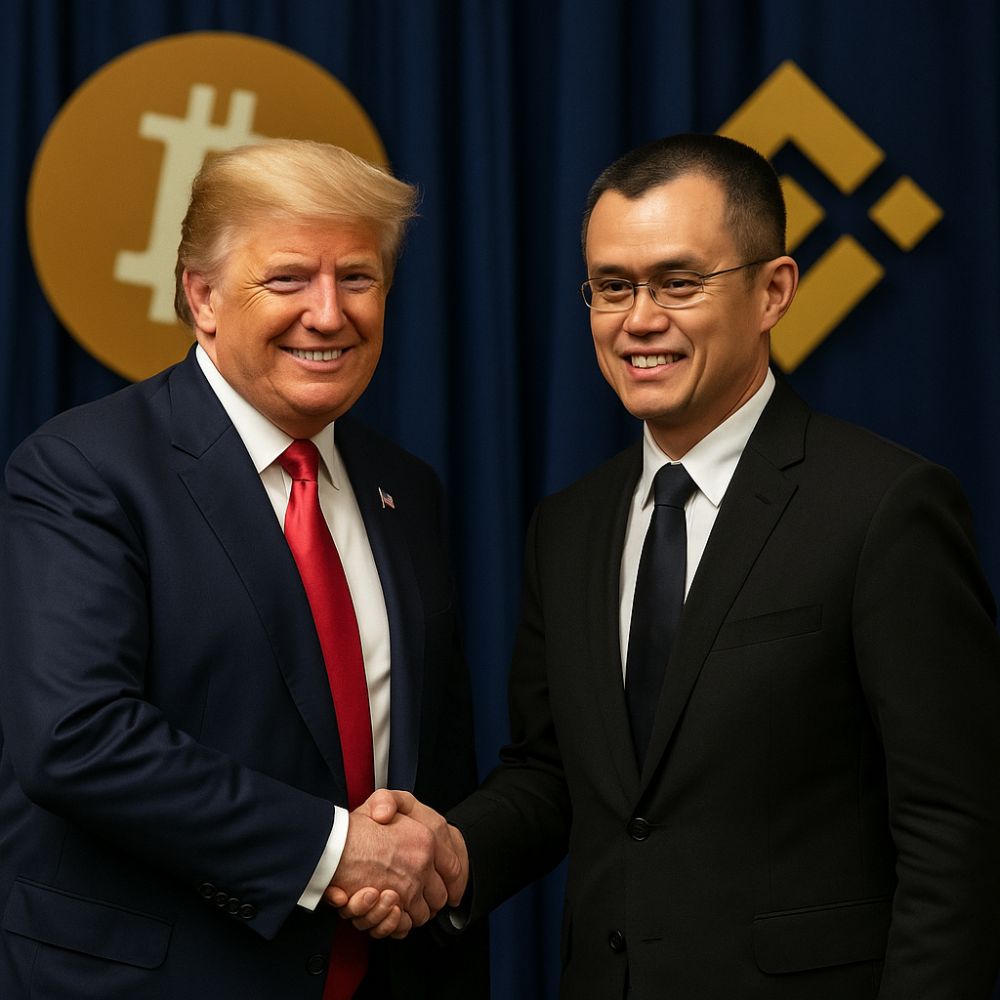
A Historic Decision and Its Immediate Effects
Changpeng Zhao, better known as CZ, had been battling legal challenges since 2023, when Binance faced a U.S. Department of Justice case over alleged violations of the Bank Secrecy Act. The case resulted in a conviction, steep fines, and a temporary restriction on CZ’s ability to operate within the U.S. financial system.
Trump’s pardon effectively wipes away those restrictions, restoring Zhao’s freedom to travel, operate, and re-engage with the U.S. crypto market.
In a statement posted on X (formerly Twitter), CZ expressed gratitude to the President, promising to use his renewed freedom to contribute to the growth of digital finance in America:
“I am deeply grateful for the pardon received today. My heartfelt thanks to President Trump for his commitment to fairness, innovation, and justice in the United States. I will do everything possible to help the U.S. become the cryptocurrency capital of the world and to promote the development of Web3 globally.”
The announcement immediately sparked a flurry of reactions from across the political spectrum. Supporters celebrated it as a pro-innovation milestone, while opponents saw it as a dangerous precedent undermining the rule of law.
Crypto Markets React: BNB and Bitcoin Surge
Markets wasted no time responding. Within hours of the announcement, Binance Coin (BNB) jumped more than 5%, hitting $1,127.70 and pushing its market capitalization to over $156 billion. Bitcoin and Ethereum also posted moderate gains as traders interpreted the pardon as a sign that the U.S. could finally be embracing a more open stance toward cryptocurrencies.
Data from CoinMarketCap shows BNB’s 24-hour trading volume exceeding $5.5 billion, while broader crypto sentiment improved across multiple exchanges. Analysts believe the news could trigger a short-term rally, especially if followed by further policy easing or formal guidance on crypto innovation.
According to market strategist David Franks of BlockMetrics, “The Trump pardon is more than symbolic. It tells markets that the world’s largest economy is ready to compete for crypto leadership again. That’s why we’re seeing risk appetite return, particularly in coins associated with large ecosystems like Binance Smart Chain.”
Political Reactions: Celebration, Criticism, and Controversy
Crypto Community Cheers While Lawmakers Push Back
Reactions within the crypto industry were overwhelmingly positive. Influential figures such as Michael Saylor, Elon Musk, and Arthur Hayes praised the move, calling it a “necessary correction” after years of what they viewed as regulatory overreach.
Crypto traders on X celebrated the decision with hashtags like #CZPardon and #CryptoFreedom, with many speculating that Binance could soon reapply for full operational licensing in the United States.
However, not everyone shared the enthusiasm. Senator Elizabeth Warren immediately condemned the pardon, calling it a “reward for corporate misconduct.” She argued that the decision undermines efforts to regulate the digital asset space fairly, warning that it could embolden other executives facing similar charges.
In her statement, Warren said:
“This pardon is a clear signal that under Trump’s administration, financial accountability takes a back seat to political connections. It sets a dangerous example for the industry.”
The White House, meanwhile, defended the decision, with Trump advisors claiming that innovation, not punishment, should drive the next phase of America’s digital economy.
Binance’s Comeback: Regulatory Relief and Market Revival
Pardon Opens Path for U.S. Expansion
With CZ now cleared of legal barriers, Binance is expected to re-enter the U.S. market more aggressively. While the exchange had operated under strict oversight in recent years, the new political climate could provide fertile ground for expansion.
Sources close to the company indicate that Binance plans to relaunch a U.S. compliance and infrastructure initiative, potentially establishing new partnerships with regulated banks and blockchain startups.
Industry insiders believe this could also encourage foreign crypto companies to consider U.S. operations, reversing the talent and capital outflows that occurred under previous administrations.
“Crypto innovation has always thrived where regulations are clear and fair,” said blockchain lawyer Cameron Lee. “If Trump’s pardon is followed by structured policy reforms, the U.S. could reclaim its position as the global hub for digital finance.”
BNB Price Outlook and Investor Sentiment
The Binance Coin (BNB) remains one of the top five cryptocurrencies by market capitalization. Following the pardon, analysts expect sustained bullish momentum, particularly as Binance reopens doors for American investors and institutional partnerships.
Coincu Research suggests that the pardon could serve as a signal to global regulators that the U.S. is shifting toward a more balanced approach—one that encourages growth while still enforcing compliance.
Historical patterns support this possibility. In previous years, BitMEX’s settlement and regulatory pardons in 2025 led to temporary market rallies, suggesting that political forgiveness often translates into renewed confidence across the digital asset space.
The Bigger Picture: America’s Evolving Crypto Policy
From Hostility to Innovation
The Trump administration’s actions reflect a clear departure from the cautious tone adopted by previous regulators.
Instead of tightening restrictions, the focus now appears to be on fostering technological innovation and domestic competitiveness in blockchain and digital assets.
Trump has previously referred to Bitcoin and crypto as “the new frontier of American capitalism,” pledging to make the U.S. the “world leader in blockchain technology.” His administration’s recent initiatives, including the Digital Dollar Integration Task Force and Fintech Deregulation Directive, aim to modernize outdated financial laws to better accommodate decentralized finance (DeFi) and tokenized assets.
Experts argue that this shift is not just ideological—it’s economic. As nations like Singapore, the UAE, and Hong Kong attract billions in blockchain investment, the U.S. risks being left behind unless it embraces crypto innovation at the federal level.
Will This Lead to New Legislation?
According to Reuters, a bipartisan group of lawmakers is already drafting a new “Crypto Clarity Framework Act” designed to formalize regulations for stablecoins, exchange operations, and decentralized applications.
The act would likely define the roles of agencies such as the SEC, CFTC, and FinCEN, reducing the overlapping jurisdictions that have plagued the industry for years.
CZ’s pardon may serve as a political catalyst, accelerating these legislative discussions. Several pro-crypto legislators, including Senator Cynthia Lummis and Representative Patrick McHenry, have already praised Trump’s decision, framing it as a “turning point” for American innovation policy.
Global Reactions: Ripple Effects Across the Crypto Ecosystem
Asia and Europe Welcome the Move
The effects of the pardon are being felt beyond U.S. borders.
In Asia, regulators in Singapore, Japan, and South Korea have publicly acknowledged the decision, viewing it as a possible indicator of more harmonious global crypto relations.
European analysts, meanwhile, predict that EU crypto firms could seek stronger partnerships with U.S. institutions following the policy shift. The European Blockchain Association released a statement calling the pardon “a milestone that may finally synchronize regulatory perspectives between major economies.”
Binance’s Global Operations Stand to Benefit
Binance’s international business, already spanning over 180 countries, is likely to gain renewed legitimacy in light of the U.S. pardon. Many regions that had restricted or delayed licensing applications may now reconsider, viewing the company through a more favorable lens.
In addition, Binance’s BNB Chain ecosystem and Web3 initiatives are expected to expand in areas like decentralized finance, AI-integrated trading, and blockchain identity solutions.
According to a statement from Binance’s leadership, the company remains committed to “building bridges between traditional finance and decentralized systems” and will continue to prioritize compliance, transparency, and innovation in all jurisdictions.
The Economic Angle: Crypto as a Catalyst for Growth
Why the Pardon Matters for Investors
From an economic standpoint, Trump’s pardon could unleash a new wave of investment into digital assets. Institutional investors that previously hesitated due to regulatory uncertainty may now re-enter the market, especially if Binance regains its reputation as a legitimate, compliant global exchange.
Crypto funds and ETFs could also benefit from renewed public interest. Several analysts believe that the decision will reinforce Bitcoin’s role as a macroeconomic hedge and boost altcoin participation among retail investors.
“With CZ’s return to leadership and Trump’s open stance on blockchain,” said Hannah Park, a financial economist at TradeView Analytics, “we may be witnessing the start of America’s next digital asset boom.”
Critics Warn of Overconfidence
Not all experts are celebrating. Some warn that political involvement in regulatory enforcement could create a moral hazard, encouraging executives to take excessive risks under the assumption that pardons or settlements will protect them from severe penalties.
Economist Paul Donovan cautioned that “while innovation is vital, so is accountability. Investors should remember that the line between technological progress and speculative excess can blur very quickly.”
Still, the general consensus across markets is cautiously optimistic, with the pardon viewed as a net positive for crypto adoption, especially in the U.S.
A Defining Moment for the Future of Crypto
The pardon of Changpeng Zhao may well go down as a defining moment in cryptocurrency history. It not only marks the rehabilitation of one of the industry’s most influential figures but also reflects a turning point in America’s attitude toward blockchain innovation.
For Binance, it opens doors to renewed partnerships, market expansion, and policy influence. For the U.S., it signals a readiness to compete for leadership in the rapidly evolving world of decentralized finance.
As markets digest the news, one thing is clear: Trump’s decision has transformed CZ from a symbol of controversy into a symbol of crypto’s resilience – and perhaps, its future in mainstream finance.









