



































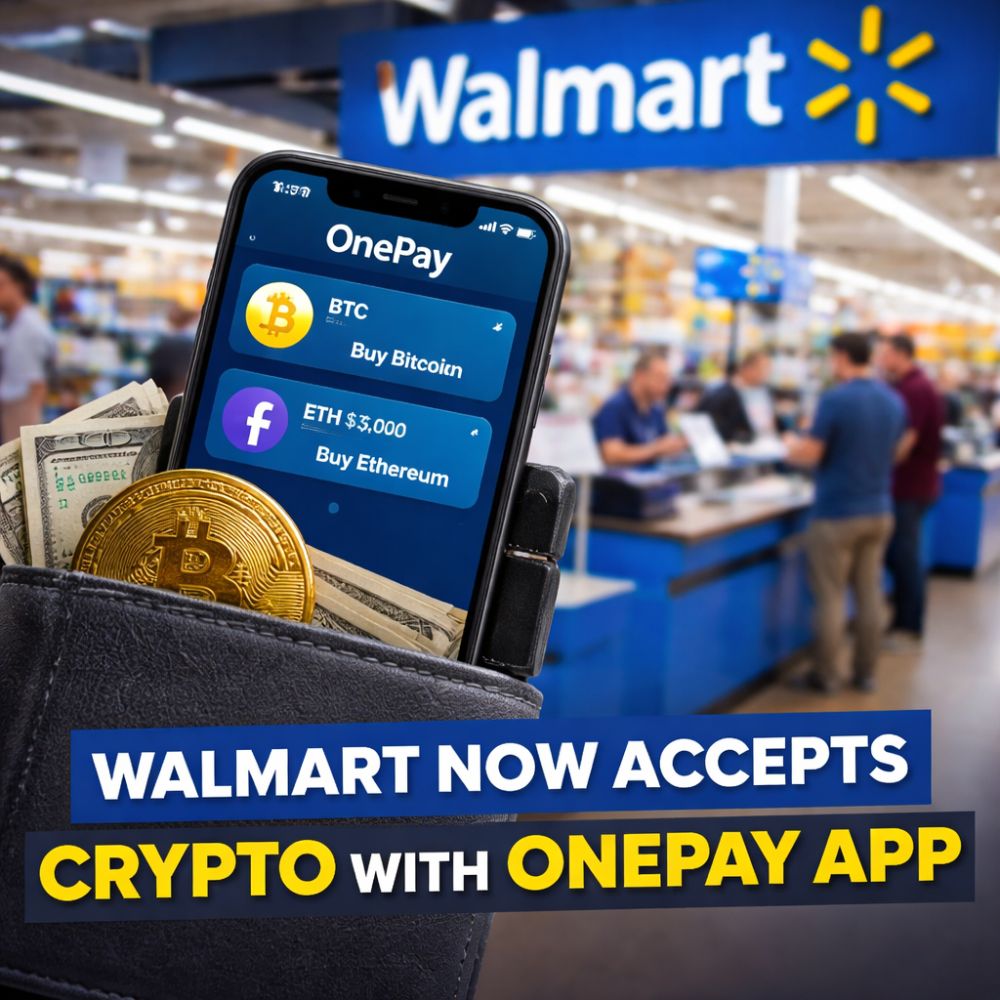
Walmart Expands Digital Payments Through Crypto Integration
Walmart Inc. has taken a notable step in the evolution of digital payments by expanding the capabilities of its OnePay Cash app to include cryptocurrency transactions. Through this update, Walmart customers can now purchase Bitcoin and Ethereum directly within the OnePay app, convert these assets into US dollars, and then use the resulting balance for purchases across Walmart retail locations. While this move does not introduce direct crypto payments at checkout counters, it represents a meaningful shift in how one of the world’s largest retailers approaches digital finance and consumer payment flexibility.
The development reflects Walmart’s broader strategy of modernizing financial access for its massive customer base. Rather than replacing existing payment infrastructure, the company has opted for a hybrid model that blends cryptocurrency exposure with traditional currency settlement. This approach allows Walmart to remain fully compliant with existing financial regulations while offering consumers an entry point into the digital asset economy. The result is a system where cryptocurrency acts as a bridge rather than a replacement for fiat currency within the retail experience.
By integrating crypto purchasing into a familiar retail app, Walmart lowers the psychological and technical barriers that often prevent mainstream users from engaging with digital assets. Customers do not need to manage external exchanges, private wallets, or unfamiliar interfaces. Instead, crypto becomes another financial tool available within a trusted environment, reinforcing Walmart’s role as both a retailer and a financial services facilitator.
How the OnePay App Enables Crypto Access
The OnePay Cash platform functions as Walmart’s in house financial ecosystem, designed to support payments, transfers, and now digital asset conversions. With the latest update, users can buy Bitcoin and Ethereum directly inside the app using traditional funding methods. Once purchased, these cryptocurrencies can be converted into US dollars within the same interface. The converted balance is then available for immediate use at Walmart stores and online.
Importantly, this process happens entirely before checkout. Walmart registers do not interact with blockchain networks or crypto wallets. Instead, the system ensures that by the time a customer reaches the point of sale, the transaction is settled in US dollars. From the perspective of Walmart’s retail systems, nothing has changed. The point of sale infrastructure continues to operate exclusively in fiat currency, preserving consistency and operational efficiency.
This structure offers several advantages. It shields Walmart’s retail operations from crypto price volatility during transactions, simplifies accounting, and avoids the need for staff training related to digital asset payments. At the same time, it gives customers the flexibility to convert crypto holdings into spending power without leaving the Walmart ecosystem.
The Role of Zero Hash in Crypto Conversion
Behind the scenes, Walmart relies on Zero Hash to manage cryptocurrency transactions and conversions. Zero Hash provides the regulatory and technical infrastructure required to securely process crypto purchases, custody assets, and execute conversions into US dollars. This partnership allows Walmart to offer crypto services without directly handling blockchain operations or assuming unnecessary regulatory risk.
Zero Hash operates as a regulated financial intermediary, ensuring compliance with money services business requirements and other applicable regulations. This compliance framework is critical for a company of Walmart’s scale, as it minimizes exposure to legal and operational uncertainty. By outsourcing crypto infrastructure to a specialized provider, Walmart maintains control over the customer experience while relying on established expertise for asset management and conversion.
The use of a third party crypto infrastructure provider also underscores a growing trend in fintech and retail. Rather than building blockchain systems internally, large corporations are increasingly integrating modular crypto services that can scale alongside demand. This approach reduces development costs and accelerates time to market, making it easier for traditional companies to experiment with digital asset functionality.
Why Walmart Chose a Convert to Cash Model
Walmart’s decision to adopt a convert to cash model rather than direct crypto acceptance reflects both practical and strategic considerations. Direct crypto payments at checkout would expose the company to price fluctuations, settlement delays, and regulatory complexity. By converting crypto into US dollars before transactions occur, Walmart avoids these challenges entirely.
This model also aligns with consumer behavior patterns. Most shoppers are not seeking to spend crypto directly at the register. Instead, they want a simple way to turn digital assets into everyday purchasing power. The OnePay approach delivers exactly that, transforming crypto from a speculative asset into a practical financial resource without disrupting existing retail workflows.
The convert to cash structure also ensures that Walmart’s accounting, tax reporting, and supplier payments remain unchanged. All transactions settle in US dollars, preserving compatibility with established financial systems. This design choice allows Walmart to innovate at the customer level while maintaining stability at the operational level.
Comparisons to Other Retail Crypto Experiments
Walmart’s approach is not without precedent. Similar models have been explored by major retailers such as Starbucks and Home Depot. In these cases, customers could use apps or third party platforms to convert digital assets into store credit or prepaid balances, which were then spent in traditional fiat transactions.
These initiatives demonstrated that consumers are more comfortable with indirect crypto usage than with direct blockchain payments. By abstracting away the complexity of crypto networks, retailers can offer digital asset exposure without overwhelming customers. Walmart’s implementation builds on these lessons, leveraging a proven framework that prioritizes usability and compliance.
The consistency across these examples suggests a broader industry trend. Retailers are not rushing to replace fiat currency, but they are actively exploring ways to integrate crypto into existing payment ecosystems. Convert to cash models provide a scalable path forward, allowing companies to test demand while minimizing risk.
Impact on Mainstream Crypto Adoption
One of the most significant implications of Walmart’s move is its potential impact on mainstream crypto adoption. With millions of daily customers, Walmart has the ability to introduce digital assets to an audience far larger than most crypto native platforms. Even limited exposure through an app based purchase and conversion system can significantly increase consumer familiarity with cryptocurrencies.
For many users, this may be their first interaction with Bitcoin or Ethereum. The simplicity of the OnePay interface reduces intimidation and encourages experimentation. Over time, repeated exposure can normalize crypto as part of everyday financial life rather than a niche investment category.
This normalization effect could have ripple effects across the broader digital asset ecosystem. Increased user engagement may drive higher transaction volumes, greater demand for crypto services, and expanded interest in blockchain based financial products. While Walmart is not positioning itself as a crypto exchange, its scale makes it an influential gateway into the digital currency landscape.
Regulatory Considerations and Compliance
Walmart’s crypto initiative operates firmly within existing regulatory frameworks. By ensuring that all transactions settle in US dollars and by partnering with a compliant infrastructure provider, the company avoids many of the regulatory challenges associated with direct crypto payments. This cautious approach reflects an understanding of the evolving regulatory environment surrounding digital assets.
As a money services business participant, Walmart must adhere to strict compliance standards, including anti money laundering and know your customer requirements. The OnePay model supports these obligations by maintaining clear transaction records and fiat settlement pathways. This transparency may also attract regulatory attention, as authorities monitor how large corporations integrate crypto functionality.
Increased regulatory scrutiny is not necessarily a negative outcome. In fact, Walmart’s involvement could help shape future guidelines by demonstrating how crypto can coexist with traditional financial systems. By setting a precedent for compliant integration, Walmart may influence how regulators approach similar initiatives across the retail and fintech sectors.
Financial and Infrastructure Implications
From a financial perspective, the integration of crypto purchasing into OnePay has the potential to increase transaction volume and user engagement within the app. Customers who might not otherwise use OnePay may be drawn in by the ability to buy and convert digital assets. This increased activity can strengthen Walmart’s fintech ecosystem and create new revenue opportunities.
For infrastructure providers like Zero Hash, partnerships with large retailers offer significant scaling potential. As transaction volumes grow, so does the importance of reliable conversion and settlement systems. Walmart’s adoption may encourage other major retailers to explore similar partnerships, further expanding the role of crypto infrastructure companies in mainstream commerce.
At the same time, the model reinforces the importance of liquidity and efficient conversion mechanisms. Smooth user experiences depend on fast and accurate exchange processes. Any friction in conversion or settlement could undermine consumer confidence, highlighting the need for robust backend systems.
Industry Reactions and Expert Perspectives
The announcement has generated discussion among fintech professionals and industry observers. Many view Walmart’s approach as a pragmatic compromise between innovation and operational reality. Rather than making bold but risky changes to checkout systems, Walmart has chosen a measured path that delivers value without disruption.
Fintech expert Simon Taylor summarized the structure clearly by noting that customers are not actually paying with Bitcoin at checkout. The Walmart point of sale system never interacts with crypto. It only processes US dollars. This distinction is crucial, as it clarifies that the innovation lies in pre transaction conversion rather than payment execution.
Such perspectives highlight the importance of understanding what this integration does and does not represent. It is not a wholesale adoption of crypto payments, but it is a meaningful expansion of crypto accessibility within a trusted retail environment.
What This Means for the Future of Retail Payments
Walmart’s OnePay crypto functionality offers a glimpse into the future of retail payments, where traditional and digital financial systems coexist rather than compete. The model demonstrates that crypto does not need to replace fiat currency to be useful. Instead, it can function as an intermediary asset that enhances flexibility and choice.
As consumer expectations evolve, retailers may increasingly offer integrated financial tools that blur the lines between spending, saving, and investing. Crypto assets could become a standard component of these ecosystems, alongside loyalty points, gift cards, and digital wallets.
For now, Walmart’s initiative serves as a proof of concept. Its success or limitations will likely inform how other large retailers approach crypto integration. If adoption grows and customer feedback remains positive, similar models could become commonplace across the retail landscape.
Walmart’s partnership with OnePay and Zero Hash marks a significant step in the gradual integration of cryptocurrency into everyday commerce. By enabling users to purchase Bitcoin and Ethereum within its app and convert them into US dollars for spending, Walmart balances innovation with practicality. The company avoids the complexities of direct crypto payments while still offering meaningful access to digital assets.
This approach reinforces a broader trend toward convert to cash models in retail, emphasizing usability, compliance, and scalability. As one of the world’s largest retailers, Walmart’s involvement carries weight, potentially accelerating consumer familiarity with crypto and shaping future industry standards.
While the point of sale remains firmly rooted in fiat currency, the pathway leading to it has become more flexible. In that flexibility lies the real impact of Walmart’s move, signaling a future where digital assets are seamlessly woven into everyday financial experiences.