





















































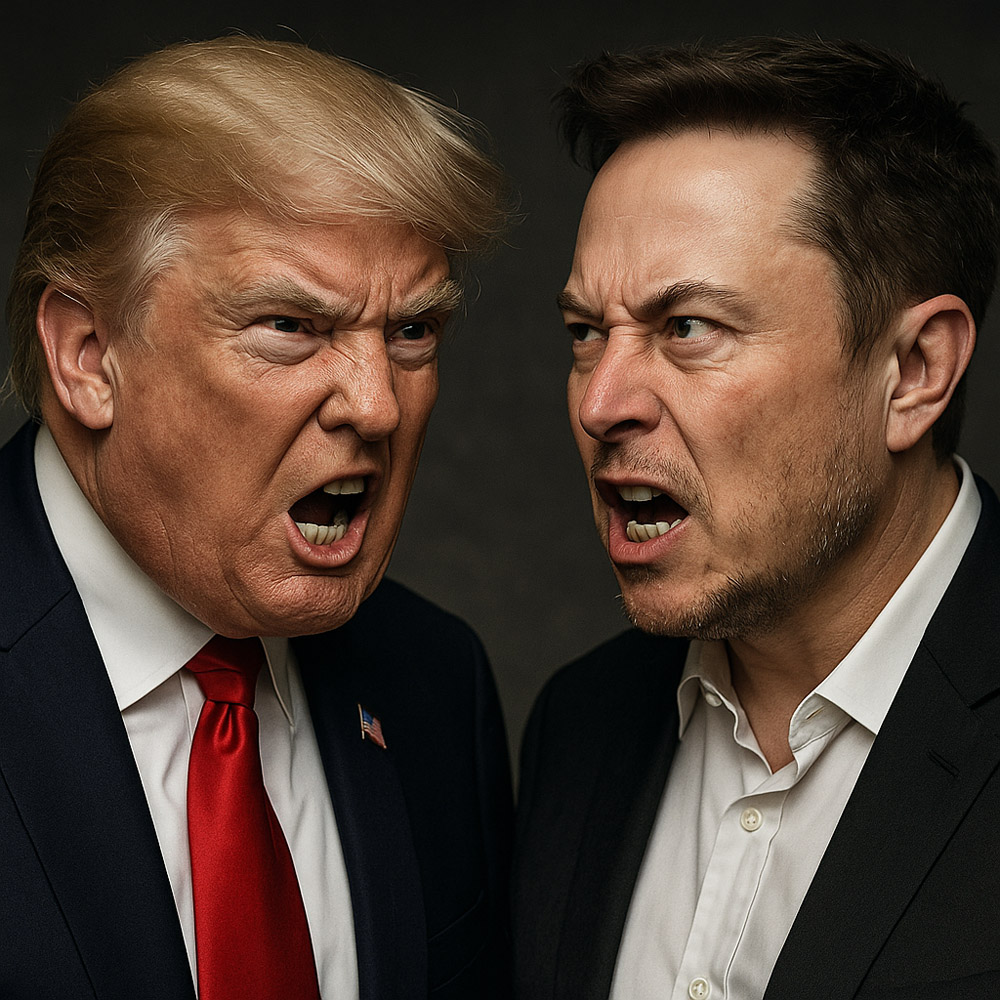
Once Allies, Now Adversaries: Trump and Musk’s Surprising Feud Shakes America
The political and tech worlds are colliding in a way no one expected. Once united as power players reshaping policy and innovation, Donald Trump and Elon Musk are now publicly clashing—and the fallout could carry seismic consequences for the U.S. economy, national space programs, and the broader tech sector.
On June 5, 2025, the world watched as Trump, during a live diplomatic briefing with German Chancellor Friedrich Merz, openly condemned Musk’s recent criticisms of the 2025 budget bill. What began as a difference in opinion over fiscal strategy has now spiraled into a high-profile feud featuring verbal jabs, threats of economic retaliation, and even scandalous accusations involving figures like Jeffrey Epstein.
This isn’t just a squabble between two billionaires. It’s a pivotal moment redefining the limits of corporate influence in politics—and vice versa.
The Public Breakdown: From the Oval Office to Social Media Crossfire
In front of reporters and foreign dignitaries, Trump declared he was “very disappointed” in Elon Musk. He went further, hinting at Musk’s “change in behavior” and alleging that Musk may be suffering from “anti-Trump derangement syndrome.” These remarks followed Musk’s scorching critique of the administration’s proposed federal budget, which he labeled on X as a “repugnant abomination.”
Trump’s tone was both sarcastic and sharp:
“Elon and I had an excellent relationship. I don’t know if that will still be the case. I’m surprised.”
“Elon knew the content of this law better than almost everyone here.”
This wasn’t just a falling out; it was a public declaration of war.
Musk responded almost instantly via X, countering Trump’s remarks with posts that read “Nonsense” and “Without me, Trump would have lost the 2024 election.” These weren’t just defensive – they were retaliatory.
Key Flashpoints in the Trump-Musk Fallout
Let’s break down the key moments that have intensified this very public feud:
- Budget Bill Controversy: Musk publicly condemned Trump’s budget bill, prompting Trump to accuse him of betrayal and hypocrisy.
- Government Efficiency Department: Musk, once the head of the Department of Government Efficiency (DOGE) during Trump’s term, was instrumental in shaping policy. Their past collaboration makes the split even more shocking.
- Public Accusations: Trump calls Musk “ungrateful,” while Musk counters with claims that he saved Trump’s 2024 campaign.
- Political Optics: Trump uses a diplomatic meeting to launch the attack—a sign this feud isn’t just personal, but strategic.
These confrontations expose growing tension between traditional political leadership and increasingly bold tech magnates asserting their own policy views.
From Heated Words to Costly Actions: An Economic Cold War Begins
The drama didn’t stay confined to public comments. Trump took to Truth Social the next day to escalate the conflict, announcing the termination of Musk’s advisory role and labeling him “crazy.” But he didn’t stop there.
Trump issued a thinly veiled threat:
“The simplest way to save billions and billions of dollars in our budget would be to cancel the subsidies and government contracts benefiting Tesla and SpaceX.
That’s no idle threat. SpaceX holds numerous billion-dollar contracts with NASA and the U.S. military. Tesla, too, relies on subsidies and tax breaks in multiple states. Musk, seemingly unshaken, fired back by accusing Trump of being involved in the suppressed Jeffrey Epstein files—an accusation lacking evidence but heavy in implication.
As the rhetoric soared, SpaceX made a stunning announcement: it would begin immediate decommissioning of the Dragon spacecraft, one of NASA’s critical transport vessels to the ISS. If followed through, this move could imperil NASA’s schedule and even national security interests.
Market Fallout: Tesla’s Plunge and Tech Sector Ripples
The market didn’t take kindly to the escalating feud. Tesla’s stock nosedived 14.04% within 24 hours, shedding over $140 billion in valuation and pushing it below the symbolic $1 trillion threshold. Investors were rattled not only by Musk’s feud with the president but also by the threat of federal backlash against Tesla and SpaceX.
Other tech giants watched nervously, fearing similar treatment if they crossed the administration. Amazon, Microsoft, and Google have substantial federal contracts as well, making the stakes far higher than one personal vendetta.
If this conflict intensifies, we could see a chilling effect on public-private partnerships across America.
What It Means for the Future of Tech and Politics
This isn’t just a personal rivalry—it’s a case study in how the lines between business and governance are rapidly blurring. With Musk acting as both an entrepreneur and a digital populist, and Trump doubling down as the spearhead of a new political conservatism, the collision was inevitable.
We’re witnessing a shift in the power dynamic:
- Corporate Titans as Political Actors: Musk, like other billionaires, is no longer content to stay in the boardroom. His political commentary, platform ownership (X), and aggressive policy critiques mark a new era.
- Government Retaliation as Policy Tool: Trump’s willingness to threaten corporate contracts signals a more aggressive approach toward tech giants who don’t toe the political line.
- Investor Uncertainty: With policy risk becoming more volatile, markets may start factoring in political allegiance into company valuations.
This war could set a precedent: disagreeing with the President may now come with significant economic consequences.
Will the Rift Be Permanent?
Despite the explosive nature of this fallout, some experts believe reconciliation is possible, especially if strategic or financial incentives align. Both Trump and Musk are known for their transactional thinking, and a temporary truce might not be out of the question.
Still, the damage is done. The public nature of the fight, the accusations, and the financial ripple effects have pushed this into historic territory.
Whether temporary or enduring, this feud is already reshaping the contours of U.S. tech policy, electoral narratives, and corporate-government relationships.
A Cautionary Tale of Ego, Power, and Influence
The Trump-Musk fallout is more than just a clash of personalities—it’s a cautionary tale about the volatile intersection of political power and technological influence. As elections approach and policy stakes rise, both leaders may have underestimated how costly such a public rift could be, not just to each other, but to the entire ecosystem that links Washington to Silicon Valley.
What comes next could be collaboration or catastrophe.









