
























































When entering the world of digital currencies, many newcomers use the terms coin and token interchangeably. It is a common mistake, but in the crypto industry, these two assets serve fundamentally different purposes and operate on completely different infrastructure. Understanding the structural differences between them is essential for anyone looking to invest, develop, or navigate the Web3 landscape. This guide provides a comprehensive breakdown of coins and tokens, how they function, and why this distinction matters for your crypto portfolio.
What Is a Crypto Coin?
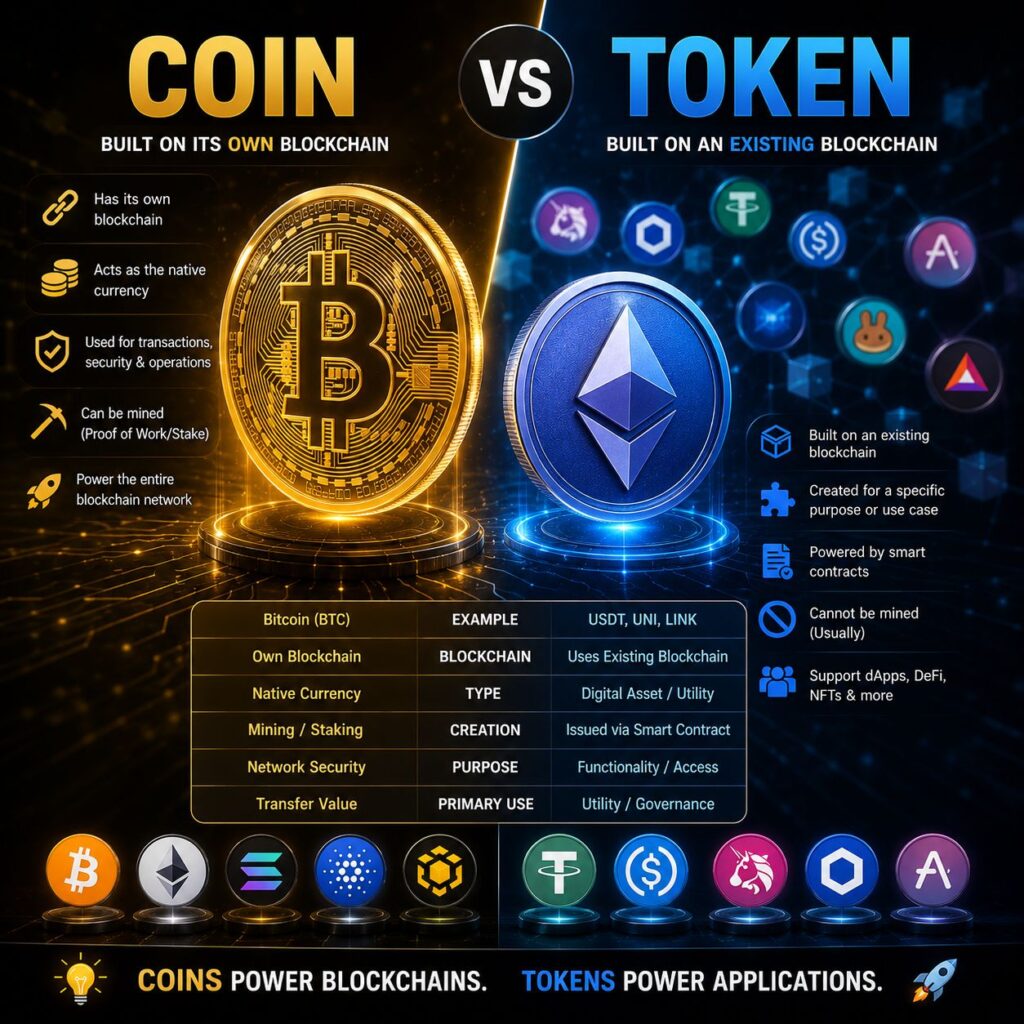
A cryptocurrency coin is a digital asset that is native to its own independent blockchain network. When a blockchain is built from scratch, the creators design a specific digital asset to serve as the core currency of that network. This native asset is what we call a coin.
Crypto coins are primarily designed to act like traditional fiat currency. They function as a store of value, a medium of exchange, and a unit of account. Because they operate on their own independent networks, the transactions involving these coins are validated directly by the consensus mechanism of that specific blockchain, whether it is through Proof-of-Work or Proof-of-Stake.
How Crypto Coins Operate on a Native Blockchain
To fully grasp what a coin is, you must look at its relationship with its underlying blockchain infrastructure. A native blockchain is an independent decentralized ledger that records all transactions securely across a network of computers.
When you send a native coin to another wallet, the transaction interacts directly with that specific blockchain ledger. The miners or validators of that network bundle the transaction into a block and secure it. The native coin is also used to pay for the computational power required to process these transactions. These processing fees are commonly referred to as gas fees. Without the native coin, the underlying blockchain network cannot function because there would be no incentive for validators to secure the ledger.
What Is a Crypto Token?
Unlike a crypto coin, a crypto token does not have its own independent blockchain. Instead, tokens are created and deployed on top of an existing blockchain network. Token creators utilize the pre-existing infrastructure, security, and consensus mechanism of a host blockchain to build their digital assets.
Tokens are typically created using smart contracts, which are self-executing pieces of code that run automatically when specific conditions are met. Because they rely on a host network, tokens do not need to maintain a separate decentralized network of computers to validate transactions. Instead, they inherit the security and processing power of the parent blockchain.
The Underlying Technology of Crypto Tokens
The creation of tokens became widespread with the launch of the Ethereum blockchain, which introduced programmable smart contracts. Developers realized they did not need to spend months or years building a new blockchain network from scratch just to launch a digital asset. They could simply write a smart contract on Ethereum and deploy a token within minutes.
To ensure compatibility across various wallets and decentralized applications, host blockchains establish specific token standards. For example, on the Ethereum network, the most common standard for fungible tokens is ERC-20, while unique digital collectibles use the ERC-721 or ERC-1155 standards. Other blockchains have their own standards, such as BEP-20 on the BNB Chain and SPL on the Solana network. These technical frameworks ensure that any token built on the host network can easily interact with decentralized exchanges and decentralized applications within that ecosystem.
Key Differences Between Coins and Tokens
To make this distinction as clear as possible, let us break down the primary structural differences between these two digital asset categories.
First, consider the infrastructure. A coin always operates on its own proprietary blockchain network, which requires independent validators or miners to keep it running. A token is a guest asset that lives entirely on an external blockchain network, relying completely on the host for survival and transaction execution.
Second, look at the utility and use cases. Coins are designed to function primarily as money, facilitating payments, storing wealth, and settling gas fees on the native network. Tokens have a much wider variety of use cases, ranging from granting voting rights in a project to representing a share in a decentralized finance pool or proving ownership of a unique piece of digital art.
Third, look at how transaction fees are paid. If you want to send a native coin like Ether over the Ethereum network, you pay the gas fee using Ether. However, if you want to send a token like Uniswap or Tether over the Ethereum network, you cannot pay the transaction fee with that token. You must still hold and use the native coin, Ether, to settle the gas fee for that transaction.
Real-World Examples of Crypto Coins
To better visualize these concepts, let us look at some of the most prominent examples of crypto coins in the market today.
Bitcoin is the ultimate example of a crypto coin. It operates on its own dedicated blockchain, which was launched in 2009. The Bitcoin network is maintained by miners around the world, and the Bitcoin coin is used strictly as a decentralized store of value and medium of exchange.
Ether is another major crypto coin. It is the native asset of the Ethereum blockchain. While Ethereum hosts thousands of tokens, Ether itself is the foundational coin required to execute any operation, run smart contracts, or transfer assets across the Ethereum network.
Solana is a high-speed blockchain network, and its native asset is SOL. This coin is used to pay for transaction fees and to participate in the network consensus through staking. Other prominent examples of native coins include Cardano, Polkadot, and Litecoin, each operating on its own unique and independent ledger.
Real-World Examples of Crypto Tokens
The token landscape is incredibly diverse, with thousands of projects built on top of major host networks.
Tether and USD Coin are excellent examples of tokens. Both are stablecoins pegged to the value of the US dollar. They do not have their own blockchains. Instead, they exist as tokens deployed across multiple host networks, including Ethereum, Solana, and BNB Chain. When you transfer Tether on Ethereum, you are interacting with an ERC-20 token contract.
Uniswap is the native asset of a major decentralized exchange. It was launched as a token on the Ethereum network to give holders voting power over the future development of the Uniswap protocol.
Shiba Inu is another famous example. It started as a meme token deployed on the Ethereum blockchain using the ERC-20 standard. Even though it has a massive market capitalization and community, it remains a token because it relies on the underlying Ethereum infrastructure to process and secure its transactions.
Why the Distinction Matters for Investors
Understanding whether an asset is a coin or a token is not just a matter of technical vocabulary. It has real practical implications for how you manage your crypto investments and interact with Web3 applications.
The most immediate practical concern is wallet compatibility and gas fees. If you buy an ERC-20 token and store it in a private crypto wallet, you cannot transfer that token to another wallet unless you also hold some Ether in that exact same wallet to cover the network processing fees. Many beginners find themselves trapped, unable to move their tokens because they do not own the native coin of the underlying network.
Furthermore, this distinction helps you evaluate the fundamental value and risk profile of a project. Building an independent blockchain network is a massive technical and financial undertaking that requires a global network of nodes, security audits, and constant developer updates. Projects with their own native coins often possess deep structural utility. On the other hand, anyone can create and deploy a token in a matter of minutes with minimal technical knowledge. While many tokens represent revolutionary projects, the barrier to entry is significantly lower, which means the token market contains a higher percentage of speculative or low-effort projects.
Different Categories of Crypto Tokens
Because tokens are powered by programmable smart contracts, developers can customize them to serve a massive array of digital functions. This has led to the creation of several distinct categories of tokens.
Utility tokens are designed to provide access to a specific product, service, or platform ecosystem. For example, a decentralized file storage project might require users to spend its native utility token to purchase storage space on its network.
Governance tokens give holders the right to vote on proposals that influence the direction of a blockchain project. In a decentralized autonomous organization, decisions regarding protocol upgrades, fee structures, and treasury management are decided by a vote where each governance token represents one vote.
Security tokens are digital assets that represent ownership rights in a real-world asset, such as company shares, real estate properties, or commodities. These tokens are heavily regulated because they function similarly to traditional securities and equities.
Non-fungible tokens, or NFTs, are unique digital assets that cannot be exchanged on a one-to-one basis with an identical asset. While standard tokens are fungible, meaning every token is identical and holds the exact same value, an NFT contains unique identification data embedded in its smart contract, making it ideal for digital art, collectibles, and proof of ownership.
The Evolution of Assets from Tokens to Coins
It is important to note that a digital asset’s classification is not always permanent. Many crypto projects choose to begin their journey as a token on an established blockchain like Ethereum to raise funds, build a community, and test their product without the burden of managing a raw blockchain.
Once the project matures and the developers finish building their own proprietary blockchain network, the project will execute a token migration or mainnet swap. During this process, the original tokens are burned or locked, and users receive brand-new native coins on the project’s independent blockchain on a one-to-one basis.
A famous example of this transition is BNB. It originally launched as an ERC-20 token on the Ethereum network during its initial coin offering. After developing its own high-performance blockchain infrastructure, the project migrated the assets over, transforming BNB from a guest token into a powerful native coin that now powers an entire ecosystem of decentralized applications.
Navigating the Crypto Ecosystem with Clarity
The difference between a crypto coin and a crypto token comes down to blockchain ownership. A coin is the sovereign currency of its own independent blockchain, while a token is a flexible digital asset built using smart contracts on an existing network.
Recognizing this difference allows you to understand how transaction fees work, how to secure your assets properly in decentralized wallets, and how to evaluate the underlying utility of any digital asset you encounter. As the Web3 space continues to grow, keeping this foundational distinction in mind will help you navigate the market with confidence and precision.








