



























































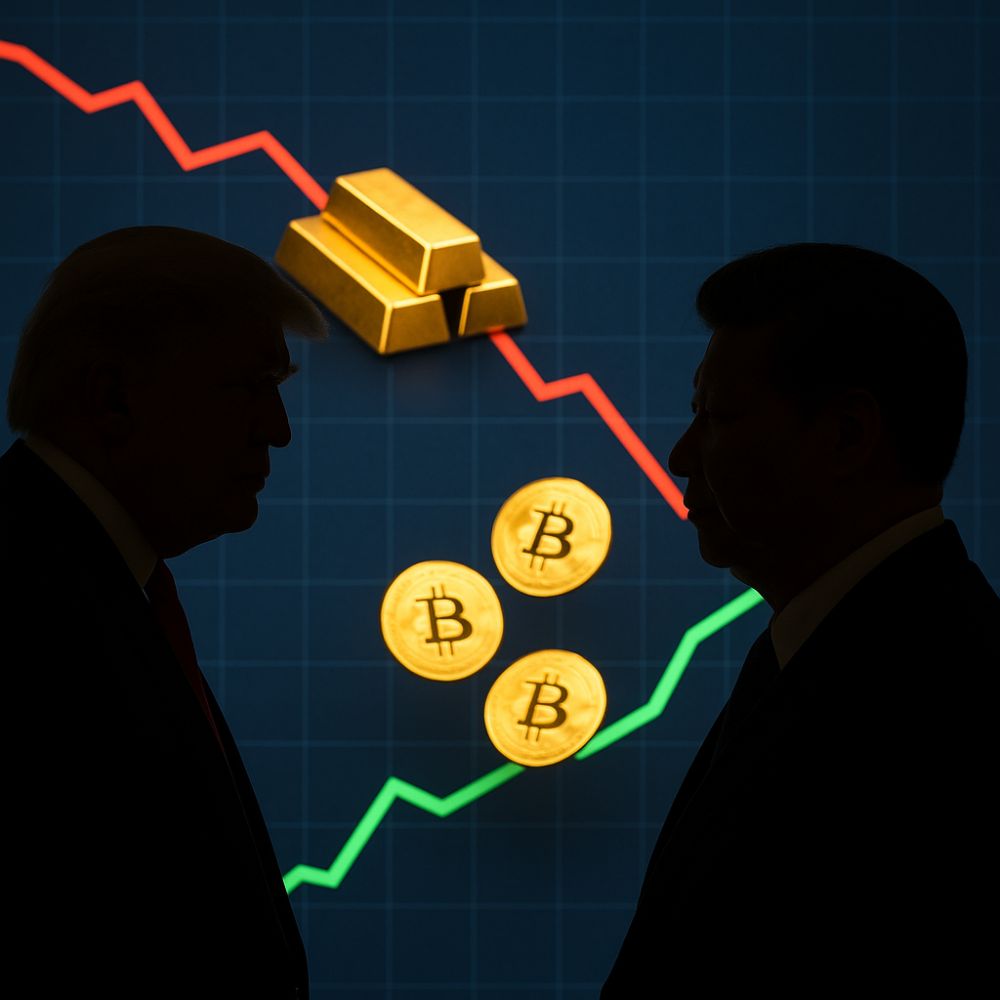
A Week That Redefined Safe Havens
Financial markets have entered a new era of turbulence. Gold, long considered the ultimate safe-haven asset, suffered one of its steepest declines in more than a decade. Meanwhile, Bitcoin — once dismissed as a speculative experiment – surged past $113,000, regaining investor confidence as global uncertainty mounted.
At the center of this storm stands former U.S. President Donald Trump. His unpredictable statements regarding trade relations with China have rippled through global economies, driving investors to rethink traditional hedging strategies. The question dominating every trader’s mind is no longer just about inflation or interest rates. It is now about which asset will define the next era of financial safety – gold or Bitcoin.
Gold Loses Its Shine as Markets Rebalance
For years, gold symbolized security in times of crisis. But in October 2025, the metal suffered its biggest one-day drop in twelve years, plunging more than five percent and erasing billions in global value. Prices fell from record highs near $4,300 per ounce, ending a decade-long rally that had seemed unstoppable.
Analysts point to several triggers behind this fall: profit-taking after months of consistent gains, a strengthening U.S. dollar, and a temporary easing of trade tensions between Washington and Beijing. Yet beneath the surface, deeper structural shifts are unfolding.
Tom Essaye, founder of the Sevens Report, summarized the moment best: “This is just a bump in the road. The underlying fundamentals that pushed gold up – low real interest rates, inflation pressure, and central bank buying – are still there.”
Indeed, global inflation remains stubbornly high, debt levels are rising, and monetary policy is stretched thin. Despite the pullback, institutional buyers continue to accumulate physical gold reserves. But for now, the metal’s golden era has hit an unexpected pause.
Bitcoin Takes Center Stage as a Modern Safe Haven
While gold stumbled, Bitcoin’s price soared. The world’s leading digital asset gained over two percent, reclaiming the $113,000 mark in a move that caught many traders by surprise. Market watchers believe this represents more than a short-term price bounce — it could mark the start of a new capital rotation away from traditional safe-haven assets and toward digital alternatives.
Bitwise CEO Hunter Horsley pointed out that the BTC-to-Gold ratio is turning sharply in Bitcoin’s favor, suggesting that investors now see higher risk-adjusted returns in the crypto sector. Hedge fund manager James Lavish had predicted this shift months earlier, warning that gold would “top out soon” before Bitcoin claimed its next leg upward.
Even Binance’s former CEO, Changpeng “CZ” Zhao, echoed that view, saying Bitcoin would one day surpass gold in market value. His words, once seen as overly ambitious, now seem increasingly realistic as Bitcoin’s resilience continues to defy macroeconomic headwinds.
The rally also highlights a generational divide. Younger investors, less attached to traditional finance, see Bitcoin as a borderless store of value that aligns with modern technological trends. In contrast, older generations still favor gold, valuing its physical scarcity and centuries-old reputation. This clash between digital scarcity and physical legacy is reshaping global asset allocation.
Trump’s Trade Remarks Shake Investor Confidence
Markets were just beginning to stabilize when a familiar source of volatility reemerged – Donald Trump. During a closed-door meeting with Republican senators, Trump hinted that his scheduled meeting with Chinese President Xi Jinping at the upcoming APEC summit might not happen. His words – “Maybe it won’t happen” — immediately triggered market jitters.
Bitcoin, which had been rallying, fell sharply within hours, dipping from $113,000 to $108,000 before recovering. Gold, typically a beneficiary of geopolitical tension, remained under pressure, unable to attract the safe-haven flows it once commanded.
Traders are growing increasingly wary of Trump’s unpredictable communication style. One day he promotes diplomacy and mutual trade benefits; the next, he threatens tariffs or hints at confrontation. This uncertainty has blurred the traditional relationships between political risk and market behavior.
As a result, both institutional and retail investors are diversifying more aggressively, splitting capital between old and new safe havens – gold for its legacy and Bitcoin for its innovation.
The Geopolitical Chess Game: Gold, Bitcoin, and China’s New Role
The U.S.-China dynamic continues to shape global finance. Historically, gold thrived during times of uncertainty, but now Bitcoin is beginning to share that spotlight. This shift marks a fundamental change in how investors interpret risk and opportunity.
China remains a central player in this narrative. Over the past five years, Beijing has steadily increased its gold reserves while simultaneously accelerating the development of the digital yuan (e-CNY) – a state-backed digital currency designed to challenge the dominance of the U.S. dollar.
By combining traditional asset accumulation with technological innovation, China has positioned itself to influence both old and new financial systems. For Western investors, this dual strategy raises important questions. Could the next global reserve shift involve both gold and digital assets?
Bitcoin’s rise as a decentralized alternative gives investors outside of traditional banking systems an unprecedented level of financial independence. Meanwhile, gold continues to act as a hedge against systemic risk and fiat currency debasement. Together, they form the backbone of a new geopolitical equation that balances tradition, technology, and power.
Economic Uncertainty and Investor Psychology
Behind every market move lies investor psychology. The fall in gold prices and the rise in Bitcoin reflect not just data but emotion – fear, greed, and the search for stability in a volatile world.
The modern investor is no longer confined to physical assets. The accessibility of digital markets has democratized wealth building, allowing anyone with an internet connection to participate in global finance.
At the same time, macroeconomic pressures – inflation, political division, and rising interest rates – are testing traditional models. Investors are learning to think beyond old playbooks. Many now see Bitcoin not as a speculative gamble, but as a strategic hedge against monetary mismanagement.
As Morgan Stanley’s digital asset strategist Alicia Rivers noted, “Bitcoin’s volatility is no longer a weakness — it is a reflection of freedom from government control.”
This sentiment, combined with the decentralization narrative, has fueled Bitcoin’s status as a parallel financial system capable of thriving even when traditional markets falter.
Gold’s Struggle in a New Financial Era
Gold’s decline in October does not mark its demise but signals a transformation in its role. For centuries, gold was the ultimate safe-haven asset — tangible, scarce, and globally recognized. But in a digital world where capital moves at the speed of a blockchain transaction, physical assets face new competition.
Gold’s strength lies in stability, but its weakness lies in its rigidity. Moving and storing gold is costly, and it lacks the flexibility of digital assets like Bitcoin or tokenized commodities.
However, central banks remain major gold buyers, particularly in Asia and the Middle East. These institutions understand gold’s strategic importance in maintaining monetary sovereignty. In 2025 alone, global central banks increased their gold holdings by more than 650 tons, a record that reinforces gold’s geopolitical value even amid short-term price drops.
In short, gold’s relevance persists, but it now coexists with Bitcoin rather than dominating it.
Bitcoin’s Institutional Renaissance
What began as a grassroots movement for financial freedom has evolved into a fully institutional asset class. The approval of multiple spot Bitcoin ETFs earlier this year opened the floodgates for billions in new capital.
Asset managers like BlackRock, Fidelity, and Ark Invest have allocated significant portions of their digital funds to Bitcoin exposure, further legitimizing it in traditional finance.
Moreover, recent discussions between the U.S. Federal Reserve and major financial institutions on the integration of blockchain-based payment systems show that digital assets are moving from the periphery to the core of global finance.
As liquidity deepens and regulations mature, Bitcoin’s correlation with equity markets continues to decline. This growing independence cements its role as a global macro hedge – one that can compete with gold in both perception and performance.
The Trump Effect and the Road Ahead
The world has learned that markets under Trump are anything but predictable. His foreign policy decisions often ripple instantly through global markets, affecting currencies, commodities, and now digital assets.
If Trump’s potential return to the global stage results in renewed trade tensions, Bitcoin may again emerge as a primary hedge against policy chaos. Meanwhile, if diplomacy succeeds and economic cooperation strengthens, gold may recover as a symbol of restored balance.
Either way, both assets are now central to the global risk conversation. The key takeaway for investors is that volatility is opportunity – and those who understand the interplay between politics, policy, and technology will stand to benefit the most.
The Future of Safe Havens Has Arrived
The debate between gold and Bitcoin is no longer about old versus new. It is about evolution. The digital economy has introduced a new era where traditional safe-haven assets coexist with decentralized alternatives.
Gold remains the backbone of institutional finance, trusted by governments and central banks alike. Bitcoin, on the other hand, represents the future – fast, borderless, transparent, and increasingly accepted by institutions.
Donald Trump’s unpredictable influence on global markets may continue to test both. But one thing is certain: the age of a single safe-haven asset is over. Investors must now navigate a dual system of security, balancing gold’s history with Bitcoin’s innovation.
As the world braces for new political and economic shifts, the next great market movement might not come from Wall Street or Beijing – but from the blockchain itself.









