


























































The financial world is witnessing a historic divergence between traditional safe havens and the digital frontier. According to a groundbreaking report from US banking giant JPMorgan, Bitcoin ($BTC) and gold have officially entered a period of opposing fund flows. While gold has long been the undisputed king of crisis insurance, the recent geopolitical tensions involving Iran have triggered a surprising rotation. Analysts led by Nikolaos Panigirtzoglou revealed that the world’s largest gold exchange-traded fund, SPDR Gold Shares (GLD), has seen a significant exodus of capital, while BlackRock’s iShares Bitcoin Trust (IBIT) is absorbing that liquidity at a record pace.
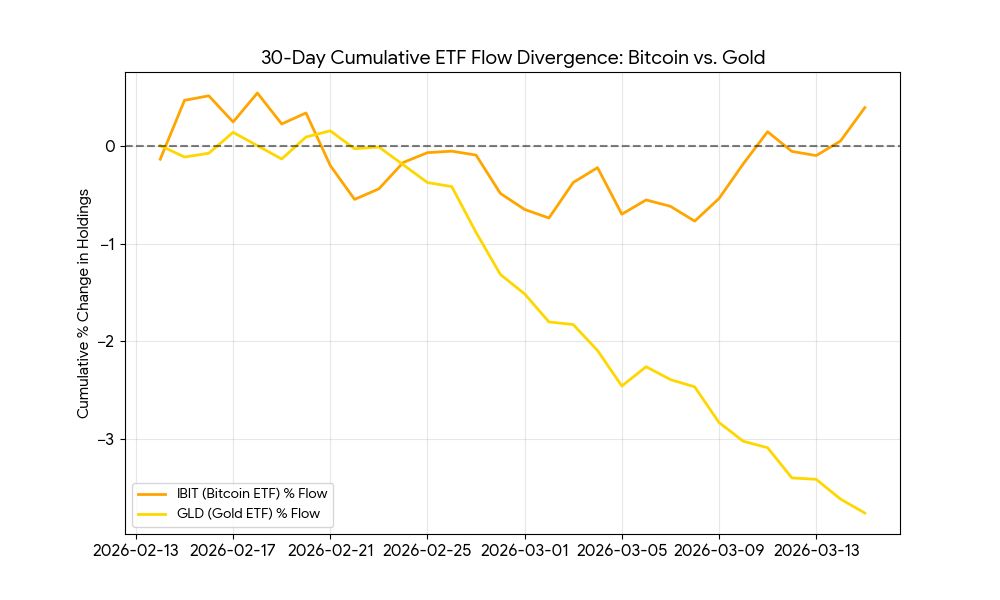
This shift marks a critical moment for the “digital gold” narrative. It suggests that institutional investors are increasingly viewing Bitcoin as a viable, and perhaps more efficient, alternative to the yellow metal during global macro shocks. Since the onset of the conflict in Iran, GLD experienced outflows equivalent to approximately 2.7% of its total assets, while IBIT recorded inflows representing 1.5% of its holdings. This is not just a minor statistical blip; it represents a fundamental change in how “smart money” manages risk in a digital-first world.
Why Investors are Choosing Bitcoin Over Gold in 2026
The reason for this “valuation flip” lies in the structural evolution of the Bitcoin market. JPMorgan’s report highlights that Bitcoin’s volatility is gradually decreasing as institutional participation reaches all-time highs. In early 2026, the volatility ratio between Bitcoin and gold reached a record low. Bitcoin is no longer the “wild west” asset it once was; it is maturing into a structured financial product.
Furthermore, the macro environment of 2026 has introduced new variables. With global trade wars and shifting currency alliances, the portability of digital assets has become a key differentiator. While moving $100 million in physical gold across borders during a crisis is a logistical nightmare, transferring the equivalent value in Bitcoin can be done in minutes. This utility, combined with gold hitting an “overbought” zone near $5,000 per ounce in late 2025, has made Bitcoin look like the more logical trade for those seeking both protection and growth.
30-Day ETF Flow Comparison: Bitcoin vs. Gold
The data reveals a clear capital rotation. Below is the recent percentage change in holdings for the two largest representative ETFs, showcasing the persistent divergence.
| Date | GLD (Gold) Flow % | IBIT (Bitcoin) Flow % | Market Context |
| 2026-03-10 | -0.20% | +0.36% | BTC Stabilization above $71k |
| 2026-03-11 | -0.07% | +0.33% | Institutional Accumulation Phase |
| 2026-03-12 | -0.32% | -0.20% | Local Profit Taking (Macro volatility) |
| 2026-03-13 | -0.01% | -0.04% | Market Consolidation |
| 2026-03-14 | -0.21% | +0.15% | Renewed Bullish Sentiment |
| 2026-03-15 | -0.15% | +0.34% | BTC Re-testing All-Time Highs |
The Role of BlackRock’s IBIT and the Institutional Floor
The primary engine of this recovery is BlackRock’s iShares Bitcoin Trust (IBIT), which has become the institutional benchmark for crypto pricing. By absorbing massive net inflows, IBIT has effectively reversed the bearish momentum seen earlier in the year. This consistent buying pressure provides a “floor” for the price. When the world’s largest asset manager provides a regulated vehicle for Bitcoin exposure, it removes the reputational risk that once kept conservative pension funds on the sidelines.
JPMorgan analysts point out that IBIT holders behave differently from retail speculators. These are strategic, long-term allocators. Even during periods of localized price drops, IBIT inflows often stay green – a phenomenon analysts describe as a “HODL clinic.” This indicates that Bitcoin is carving out its own niche in the global financial stack as a neutral, decentralized reserve asset.
Market Outlook: The Road to $266,000
Looking ahead, JPMorgan’s volatility-adjusted model suggests Bitcoin has significant room for growth. If Bitcoin were to reach parity with gold on a risk-adjusted basis, its market capitalization would rise until the price hits approximately $266,000 per token. While this is a long-term target, it serves as a mathematical roadmap for the asset’s potential.
The divergence between gold and Bitcoin ETFs is a signal of a generational shift. As younger, digital-native investors gain control of more capital, the preference for digital assets over physical metals is accelerating. Gold will likely always have a place in a diversified portfolio, but Bitcoin is winning the battle for the future of wealth preservation. The message from JPMorgan is clear: the era of gold’s undisputed dominance is coming to an end, and Bitcoin is ready to take the crown.









