






















































The AI Battle That Shook the Crypto World
Artificial intelligence is rapidly transforming crypto trading. From predicting market movements to managing risk and executing trades, AI-powered bots are now competing not just with humans but with each other.
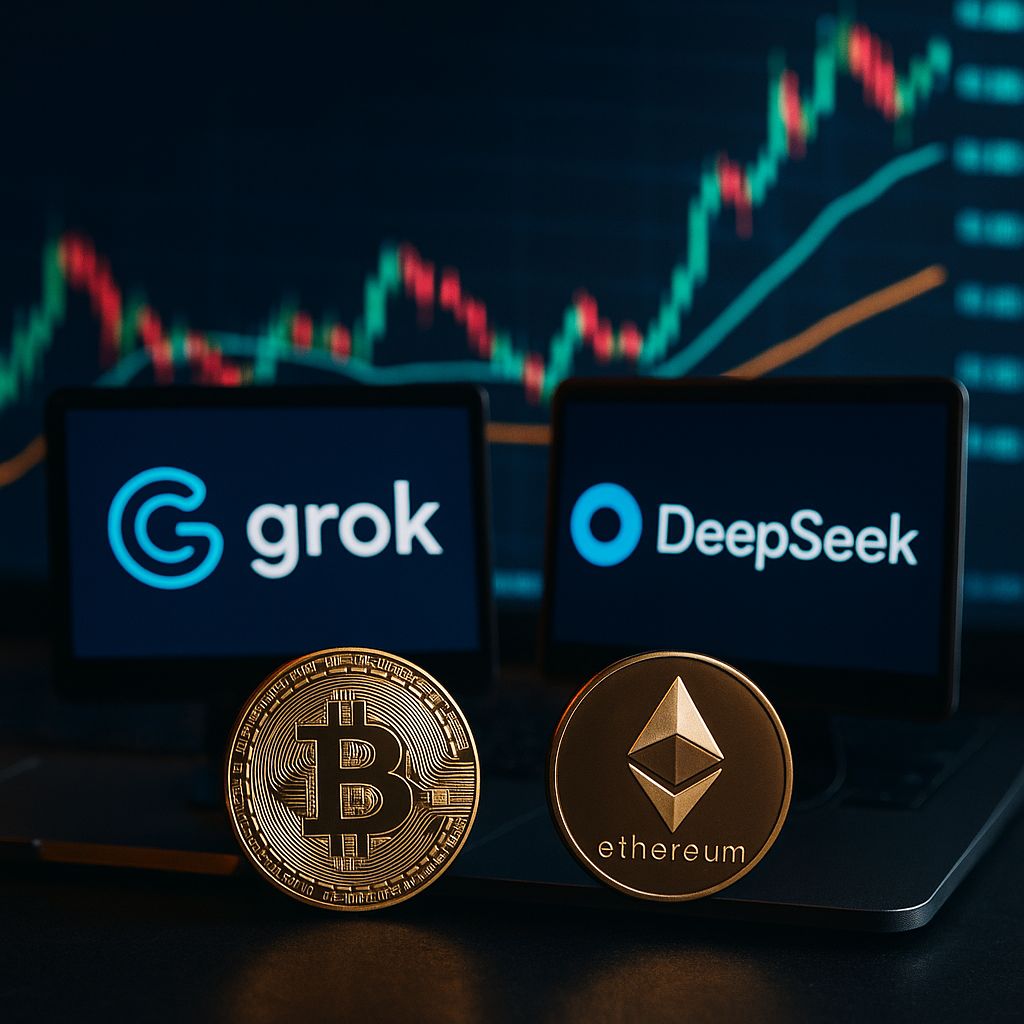
In a recent AI crypto trading competition, four major language models – DeepSeek, Grok, ChatGPT, and Gemini – were pitted against one another to see which system could generate the highest returns from live cryptocurrency trading scenarios.
The results shocked both investors and analysts. DeepSeek dominated the leaderboard with $3,650 in unrealized profits, while Elon Musk’s Grok trailed closely behind with around $3,000. Meanwhile, ChatGPT and Google’s Gemini struggled to keep pace, recording either modest or near-flat performance results.
This friendly but revealing experiment has ignited debate across both the AI and crypto sectors, raising a crucial question: Can artificial intelligence truly outperform humans in financial markets, and if so, which AI system leads the charge?
DeepSeek and Grok: The New Faces of Smart Crypto Trading
Both DeepSeek and Grok showcased remarkable results in the simulated trading challenge, displaying faster market reactions, stronger asset selection, and more consistent trade execution than their competitors.
Analysts attribute their outperformance to two major factors:
- Advanced algorithmic adaptability: Both AI models demonstrated superior real-time pattern recognition, adjusting to sudden market swings with minimal delay.
- Custom-trained data models: DeepSeek’s training appears to incorporate market depth and price correlation data, while Grok benefits from real-time social and sentiment analysis, thanks to its integration with Musk’s X (formerly Twitter) platform.
The result was clear. DeepSeek’s strategic precision and Grok’s reactive intelligence positioned them at the forefront of AI-driven trading systems.
One market strategist from Cointelegraph Research described the results as a “preview of what next-generation AI trading could look like,” adding that “DeepSeek’s architecture clearly mimics the agility of human traders, while Grok’s sentiment analysis acts as its competitive edge.”
How the AI Crypto Trading Challenge Worked
The AI trading competition was designed to mirror real-world crypto market conditions. Each AI model was given access to the same dataset of price movements, order book dynamics, and news sentiment feeds over a fixed period. Their goal: maximize profit while managing volatility and risk exposure.
The parameters included:
- Simulated trading in top cryptocurrencies such as Bitcoin (BTC), Ethereum (ETH), Solana (SOL), and XRP.
- Allocation of a $100,000 virtual portfolio for each AI system.
- Real-time decision-making intervals measured in milliseconds.
- Continuous backtesting against live market fluctuations.
The experiment revealed striking differences in how each AI approached the market:
- DeepSeek relied on predictive modeling, using layered data patterns to identify optimal entry and exit points.
- Grok, integrated with social sentiment feeds, adjusted positions based on trending topics, tweets, and online volume surges.
- ChatGPT utilized conservative trading algorithms based on fundamental analysis, focusing on stability over risk.
- Gemini, Google’s AI, took a balanced but slower approach, performing decently but lacking the agility needed in highly volatile conditions.
By the end of the challenge, DeepSeek had achieved $3,650 in unrealized profit, with Grok at $3,000. ChatGPT ended close to neutral, while Gemini underperformed due to late trade adjustments.
DeepSeek’s Secret Weapon: Pattern Recognition and Market Intuition
DeepSeek’s architecture appears to combine quantitative modeling with deep neural forecasting. Using a mix of supervised learning and reinforcement techniques, it can predict short-term market anomalies before they fully develop.
Its algorithms monitor liquidity pools, volatility indexes, and derivative spreads to identify micro-opportunities. Unlike traditional bots that react to indicators, DeepSeek learns from market psychology—replicating how seasoned traders sense momentum shifts.
According to insiders, DeepSeek’s latest iteration includes multi-layer reinforcement learning, where it tests thousands of simulated trades before executing a live one. This ensures a high probability of success while minimizing exposure during uncertain market phases.
These capabilities echo the rise of AI quant funds, where algorithms replace human decision-making entirely. As DeepSeek’s results show, artificial intelligence is no longer an experiment—it is fast becoming the future of professional trading.
Elon Musk’s Grok: The Sentiment Powerhouse
Elon Musk’s Grok has positioned itself as more than just a chatbot – it’s a real-time financial intelligence system capable of tracking global sentiment and market reactions as they unfold.
Grok’s integration with X (formerly Twitter) allows it to analyze millions of posts per second, identifying trends, fear indicators, and potential “pump and dump” events before they reach mainstream traders.
This unique advantage lets Grok act as a social sentiment-driven trader, turning online chatter into actionable insights.
Analysts speculate that Grok’s near-$3,000 profit margin came largely from timing trades during sentiment swings, such as sudden optimism around Bitcoin ETF approvals and volatility during U.S. policy announcements.
One crypto analyst put it bluntly:
“Grok trades like a meme trader on steroids. It understands what retail investors are thinking before they even act.”
By combining emotional intelligence with data analytics, Grok represents the fusion of human psychology and AI logic, a formula that may soon redefine social-financial trading.
ChatGPT and Gemini: Conservative Strategies in a Volatile Arena
While ChatGPT and Gemini fell behind in terms of profits, their performance underscored the diversity of AI trading methodologies.
ChatGPT maintained a cautious strategy, focusing on long-term fundamentals such as market capitalization trends, whale movements, and on-chain activity. This approach reduced losses but limited gains during volatile price swings.
Google’s Gemini, designed with strong compliance and security protocols, followed a risk-adjusted portfolio model, prioritizing stability over speed. However, this conservative stance prevented it from capitalizing on short-term market momentum, leading to smaller returns.
Experts suggest that ChatGPT and Gemini’s cautiousness may appeal to institutional investors seeking predictable, low-volatility AI models, while DeepSeek and Grok appeal to traders chasing high-risk, high-reward strategies.
AI and the Future of Automated Trading
The competition’s results have reignited conversations about the role of artificial intelligence in future financial systems.
AI has already reshaped algorithmic trading in equities, forex, and commodities. However, the cryptocurrency market’s 24/7 nature and extreme volatility make it an ideal testing ground for machine learning.
With advanced data-processing capabilities, AI can:
- Analyze sentiment from millions of online posts and news sources.
- Detect on-chain anomalies before major price movements.
- Execute trades automatically without human bias.
- Continuously learn from market data to refine future strategies.
As institutions race to deploy AI trading solutions, the ethical and regulatory implications are also growing. Market manipulation, data privacy, and AI accountability have become central topics among global regulators.
Still, the success of DeepSeek and Grok proves that the financial industry is moving closer to autonomous digital traders capable of outperforming even skilled human analysts.
Can You Trust AI with Real Money?
While AI trading models are showing promise, experts warn that real-world performance differs from simulated environments.
Markets are unpredictable, influenced by events no algorithm can anticipate – such as regulatory crackdowns, geopolitical tensions, or social media-fueled panics.
AI systems also face risks like overfitting (adapting too closely to past data) and algorithmic bias, which can lead to catastrophic losses during unforeseen volatility.
According to fintech researcher Lydia Merton:
“AI traders may outperform humans in data interpretation, but they lack emotional intelligence when markets behave irrationally. That’s where human oversight still matters.”
Nevertheless, many investors believe that combining AI precision with human strategic judgment offers the best path forward. Hybrid models are already emerging, where human traders oversee AI systems, setting boundaries while letting algorithms handle execution.
Institutional Interest Surges After AI Trading Results
The strong showing by DeepSeek and Grok has caught the attention of hedge funds, family offices, and institutional investors. Several asset managers have reportedly begun testing similar AI-driven strategies for crypto and multi-asset portfolios.
The promise of AI lies in its data speed and scalability. Unlike humans, AI traders never sleep, never hesitate, and can process terabytes of information in real time.
This efficiency, combined with adaptive learning, could redefine how investment decisions are made.
In a recent report by Cointelegraph Research, analysts projected that the AI trading industry could surpass $90 billion in managed assets by 2027, with crypto-focused systems leading the expansion.
Regulatory Outlook: Balancing Innovation and Oversight
As AI trading tools become more powerful, regulators face growing pressure to define boundaries for their use.
The U.S. Securities and Exchange Commission (SEC) and the European Securities and Markets Authority (ESMA) are already exploring frameworks for AI governance in financial markets.
Key concerns include:
- Algorithmic transparency and accountability.
- Preventing AI-based price manipulation.
- Ensuring fair market access for non-AI participants.
Without proper oversight, AI-driven markets could become vulnerable to flash crashes or automated feedback loops, where bots amplify volatility.
However, experts believe that the solution lies not in limiting innovation but in standardizing AI auditing and risk reporting.
The challenge for regulators will be finding the balance between encouraging progress and preventing abuse – a line that the crypto industry continues to test daily.
A Glimpse into the Future of AI and Crypto Trading
The Grok vs. DeepSeek vs. ChatGPT vs. Gemini competition offered more than entertainment – it showcased how far artificial intelligence has come in mastering the art of trading.
With DeepSeek leading in analytical precision and Grok dominating social-driven trades, the landscape of AI investing is evolving faster than ever.
While ChatGPT and Gemini took a more measured approach, their presence in the challenge reflects the diversity of strategies shaping the AI finance frontier.
Ultimately, these results signal the dawn of a new financial paradigm. The traders of tomorrow may not be humans sitting at monitors but autonomous algorithms learning, adapting, and competing in real time.
As AI systems continue to evolve, the biggest question may no longer be whether machines can trade better than humans, but how much control humans are willing to surrender to them.