





















































A $1 Bet That Became a Six-Figure Fortune
The NFT market may have cooled off since its 2021 boom, but every now and then, a story surfaces that reignites the imagination of crypto investors. One such story belongs to Justin Trimble, an early collector who purchased a Beeple NFT for just $1 in 2020 – a digital artwork that today is worth over $150,000.
At a time when many investors lost fortunes chasing overhyped non-fungible tokens, Trimble’s tiny $1 investment turned into a massive success story. His experience highlights how early conviction, patience, and understanding of blockchain art can transform small bets into incredible returns.
But what makes this story even more fascinating is that it wasn’t pure luck. It was part of a larger evolution in the NFT ecosystem – one that began with experimentation and matured into a global movement blending art, technology, and digital ownership.
The Rise of Beeple: From Digital Artist to NFT Legend
Before NFTs became a household term, Mike Winkelmann, known globally as Beeple, was already one of the most recognized digital artists online. His works mixed surreal political commentary, futuristic imagery, and pop culture satire – a style that later became iconic in the NFT era.
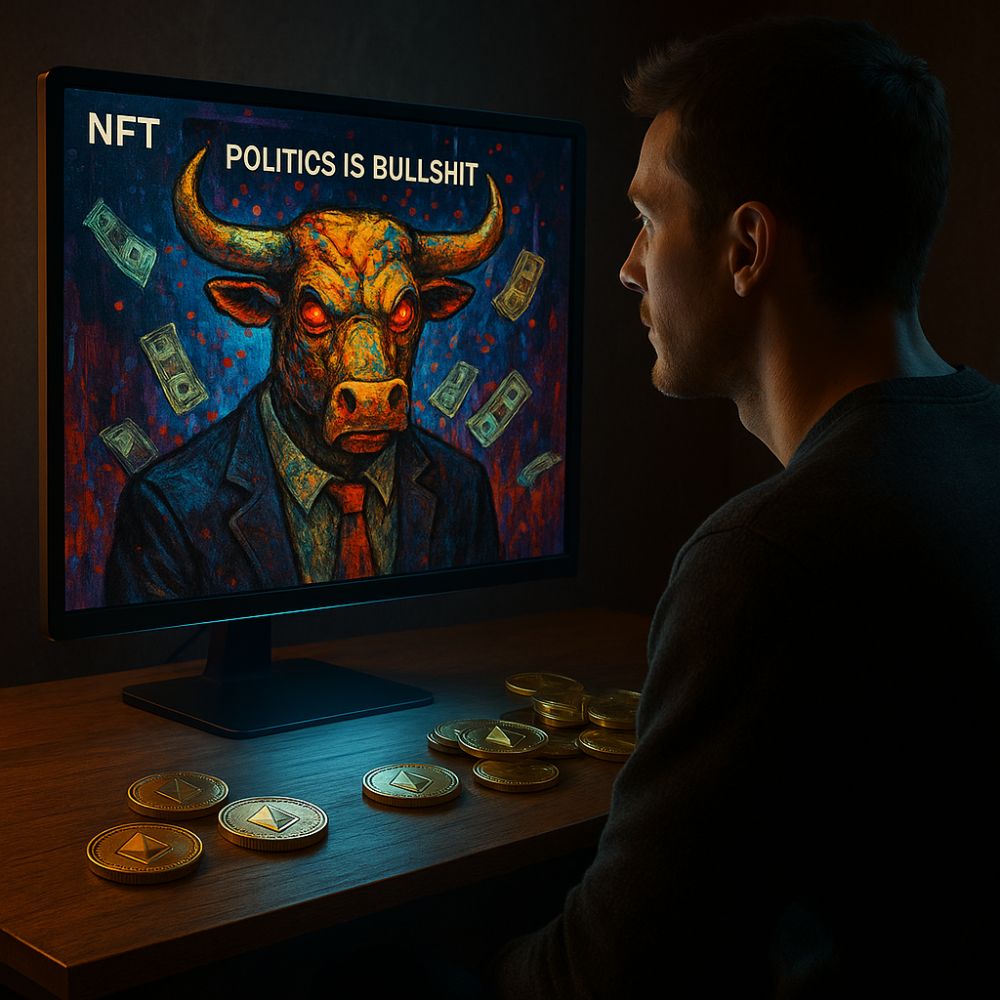
In October 2020, Beeple released an NFT titled “POLITICS IS BULLSHIT”, part of his political series reflecting societal division and the influence of media. It was sold on a digital marketplace for a mere $1 – a symbolic price that few could have predicted would later skyrocket to six figures.
The piece captured the mood of the times – falling money signifying the crumbling balance of economic equality, combined with distorted imagery representing chaos and change. To the casual eye, it was a provocative artwork; to early NFT believers like Trimble, it was a symbol of what digital ownership could become.
By 2025, that same NFT has reached a market valuation of $150,000, proving that Beeple’s influence remains strong even amid crypto volatility.
Meet Justin Trimble: The Early Collector Who Saw the Future
Justin Trimble isn’t your typical investor. As a co-founder of Braindrops, a platform focused on AI-generated art, and an early advisor to Stability AI, he has long stood at the intersection of creativity and machine intelligence.
He entered the crypto world in early 2020, intrigued by how blockchain could transform not just currency, but culture itself. Like many pioneers, he began with Bitcoin and Ethereum but soon discovered something even more captivating: digital art stored permanently on the blockchain.
“I remember when I first saw Beeple’s work,” Trimble said in a 2025 interview. “It wasn’t about speculation. It was about permanence – the idea that art could exist without galleries, middlemen, or censorship.”
That conviction led him to purchase several NFTs at extremely low prices, including Beeple’s “POLITICS IS BULLSHIT” for just one U.S. dollar. His collection today includes pieces from other renowned digital creators such as Osinachi and SnowFro, the artist behind Chromie Squiggles – another iconic NFT series on Ethereum.
The NFT That Made History: Politics, Art, and Timing
Beeple’s “POLITICS IS BULLSHIT” NFT wasn’t just art – it was social commentary wrapped in digital symbolism. Released just before the 2020 U.S. presidential election, the artwork captured the growing public disillusionment with politics, media bias, and the echo chambers of online debate.
In hindsight, this timing was perfect. The NFT became a snapshot of a historic era – one where blockchain technology collided with political expression. By owning this NFT, Trimble essentially secured a digital relic of modern history.
Beeple himself described his work as “a mirror reflecting what society refuses to see.” That emotional weight, combined with Beeple’s meteoric rise to fame, turned even his earliest pieces into coveted collector’s items.
When Beeple’s “Everydays: The First 5000 Days” sold for $69.3 million at Christie’s in March 2021, the entire NFT market exploded. Collectors began hunting down his older, cheaper works, sending prices soaring. Trimble’s $1 NFT was suddenly part of digital art royalty.
Trimble’s Expanding Digital Empire: From AI Art to Cultural Preservation
Beyond his Beeple collection, Trimble’s digital art portfolio reflects his belief in the fusion of art and artificial intelligence. Through Braindrops, his AI art platform, Trimble supports generative artists who use algorithms to create evolving digital pieces.
He is also deeply involved with Stability AI, a company developing open-source AI models that power much of the generative art movement today. His vision is to bridge traditional art forms with the technological revolution, empowering artists to experiment with blockchain, code, and machine learning.
Trimble’s other notable acquisitions include:
- “Nwanyi-Sunday” by Osinachi, portraying a woman in a red-patterned dress inspired by Nigerian culture.
- “A Woman Scorned” (2015), another early Osinachi piece that reflects feminine strength and emotional resilience.
- Multiple “Pipe Chromie Squiggles” by SnowFro, some of the rarest generative pieces on Ethereum, known for their unique colors and three-dimensional patterns.
Each of these works represents a moment in the evolution of digital art – from cultural identity to algorithmic expression — and together, they form one of the most forward-thinking collections in the NFT space.
Beeple’s Wild Ride: From $69 Million to $10 Million
While some NFT investors like Trimble struck gold, others faced devastating losses. The most famous example remains the buyer of Beeple’s “Everydays: The First 5000 Days,” who purchased it for $69.3 million in 2021 — only to see its valuation drop to around $10 million by 2025.
That sharp decline highlights the volatility of NFT pricing, which depends on sentiment, demand, and cultural relevance. Even masterpieces can lose value as trends shift and hype fades.
Still, Beeple remains one of the few artists to transcend the NFT bubble. His continued success, combined with his ability to evolve his art into physical installations and metaverse experiences, ensures that his works maintain long-term cultural and financial value.
As for Trimble, his modest $1 investment reminds collectors that the most valuable pieces are often those bought with vision, not speculation.
The Changing Face of the NFT Market in 2025
The NFT market in 2025 looks very different from its early days. Gone are the wild speculative peaks of 2021, replaced by a more mature ecosystem driven by utility, creativity, and authenticity.
While trading volumes have decreased, interest in NFTs as digital property rights has grown substantially. Institutional investors, luxury brands, and gaming companies now integrate NFTs as part of larger ecosystems, from digital art curation to real-world asset tokenization.
Recent data shows:
- Over 65% of active NFT projects in 2025 focus on utility-based assets, such as tokenized memberships or digital collectibles linked to real-world events.
- Generative and AI art NFTs are now the fastest-growing niche in the space, outperforming profile-picture projects.
- Major artists like Beeple, Pak, XCOPY, and Refik Anadol continue to lead the market in both volume and cultural impact.
In this new landscape, Trimble’s early conviction in digital art appears prophetic. His ability to identify meaningful projects early, when few understood their potential, is a lesson in both patience and perspective.
What This $1-to-$150K Story Teaches NFT Investors
Trimble’s success story offers several valuable lessons for current and future NFT collectors:
- Artistry and narrative matter more than hype.
The value of NFTs tied to cultural, historical, or emotional meaning tends to endure, while trend-driven collections often collapse. - Patience outperforms speculation.
Holding an NFT through market cycles can yield extraordinary returns, especially if the artist’s legacy grows. - Diversification reduces risk.
Trimble’s portfolio includes both early digital art icons and emerging generative creators, balancing risk and opportunity. - Blockchain provenance is the new authenticity.
Verified ownership history and on-chain transparency are becoming as crucial as an artist’s reputation.
In short, the NFT market is evolving from short-term hype to long-term value, rewarding investors who focus on quality, storytelling, and community impact.
The Emotional Side of NFT Collecting
While profits make headlines, Trimble insists his passion for NFTs goes deeper than financial gain.
“I never viewed these artworks as lottery tickets,” he said. “Each piece tells a story about human creativity in the digital age. I believe future generations will study this era the way we study the Renaissance.”
This mindset mirrors a growing movement among digital collectors who view NFTs as a bridge between technology and art history. As AI and blockchain merge, these collectors see themselves not just as investors, but as curators of a new cultural archive.
Looking Ahead: NFTs, AI, and the Future of Digital Ownership
The next wave of NFTs will likely expand beyond art into AI-generated content, virtual real estate, and intellectual property tokenization.
Platforms like Braindrops, Art Blocks, and Async Art are already redefining how creative works are made, distributed, and monetized. Meanwhile, artists are collaborating directly with algorithms to create art that evolves over time – dynamic NFTs that change based on market data or audience interaction.
Experts believe that NFT 2.0, powered by artificial intelligence and cross-chain integration, will make digital ownership even more powerful. Instead of static images, collectors will own living artworks – self-updating, interactive, and deeply personalized.
Conclusion: A Dollar That Redefined Digital Art Investing
Justin Trimble’s story isn’t just a tale of lucky timing – it’s a reflection of how conviction, creativity, and technology can combine to produce life-changing outcomes.
What started as a $1 NFT purchase became a $150,000 digital asset, a symbol of how blockchain continues to challenge traditional concepts of art, value, and ownership.
In a world where markets rise and fall, stories like this remind us that innovation still rewards those who see beyond the hype. The NFT market may be volatile, but as Trimble’s Beeple artwork proves, vision is still the most valuable currency in the digital age.









