



























































Ethereum Supply Shock Why 31 Million Dollars in ETH Leaving Exchanges Could Spark a Price Rally
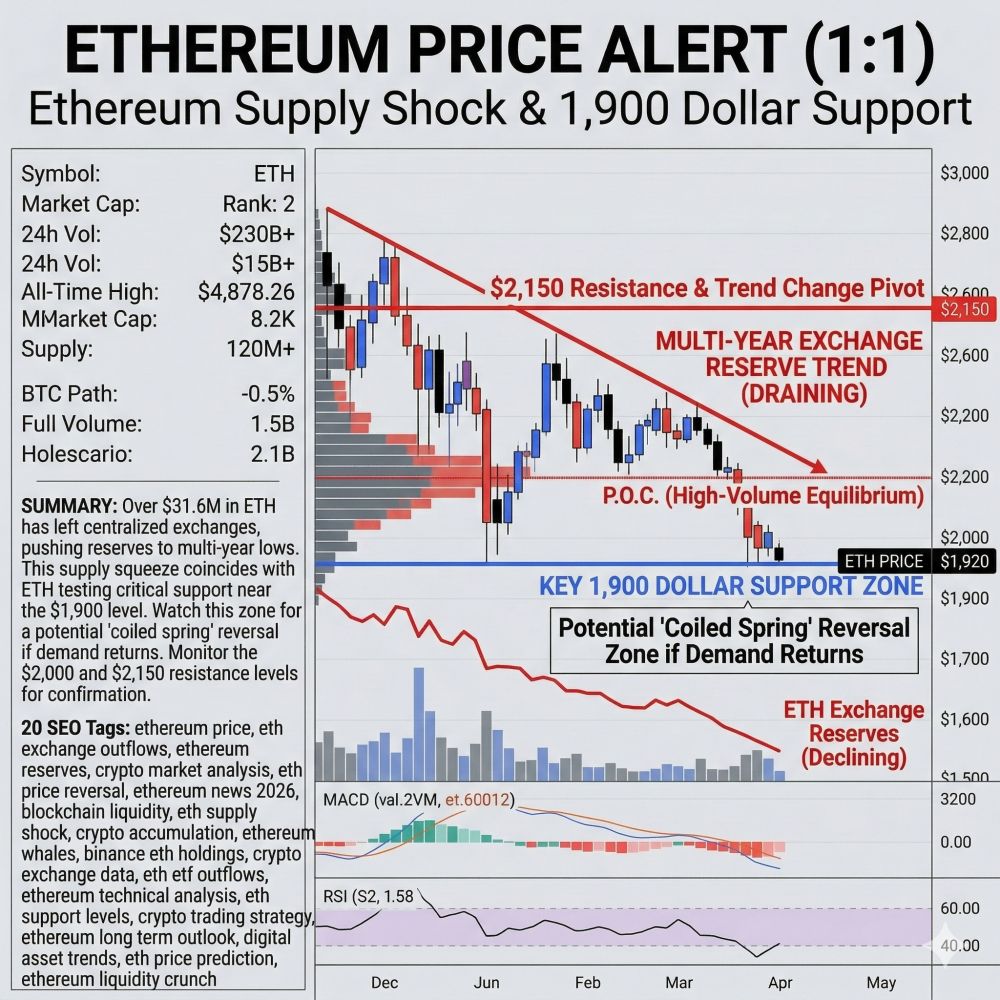
The Ethereum ecosystem is currently experiencing a profound shift in liquidity dynamics that has caught the attention of market analysts and long-term investors alike. In a single trading day, approximately 31.6 million dollars worth of ETH was moved off centralized exchanges, contributing to a trend that has pushed exchange reserves to multi-year lows. This type of movement is historically significant because it typically indicates that large holders, often referred to as whales, are moving their assets into private cold storage or decentralized staking protocols rather than keeping them on exchanges to be sold. When exchange reserves hit these types of historical lows, it creates a supply crunch. If the broader market demand begins to recover while the available supply on trading platforms continues to dwindle, the resulting imbalance often acts as a powerful catalyst for a price reversal.
The current accumulation pattern bears a striking resemblance to the market behavior observed during the late 2025 accumulation phases. Despite the fact that Ethereum is currently trading at levels significantly below its previous all-time highs, the persistent outflow suggests that sophisticated market participants are not exiting their positions. Instead, they appear to be quietly positioning themselves for a potential turnaround. This silent accumulation during a period of price weakness is a classic signal of institutional conviction. While retail sentiment may remain cautious due to recent volatility, the data shows that the “smart money” is actively removing liquidity from the open market, effectively reducing the overhead selling pressure that has plagued the asset in recent months.
Analyzing the Macro Trend of Declining Ethereum Exchange Reserves
The 31.6 million dollar outflow recorded recently is just one piece of a much larger puzzle regarding Ethereum’s market structure in 2026. Exchange reserves have been on a steady decline for several months, reaching levels not seen in over half a decade. To put this in perspective, major platforms like Binance have seen their holdings drop significantly. In February alone, approximately 14.45 million ETH left Binance wallets, bringing its total holdings down to roughly 3.46 million ETH. This represents the lowest reserve level for the platform since 2020. Similar patterns have been observed on other top-tier exchanges such as OKX and Kraken, indicating a cross-industry trend of de-risking from centralized platforms in favor of self-custody or long-term yield generation.
This trend is particularly noteworthy because it is occurring while price action remains relatively stagnant or weak. In a typical bearish environment, falling prices often trigger a rush of deposits as panicked traders move their assets to exchanges to sell them for stablecoins or fiat. The fact that we are seeing the opposite behavior—consistent and massive withdrawals during a price lull—suggests a fundamental shift in investor psychology. Many analysts interpret this as a sign that the market is currently in a state of quiet accumulation. If the supply on exchanges continues to shrink at this rate, even a modest increase in buying interest could trigger a sharp upside squeeze, as there simply will not be enough liquid ETH available on order books to satisfy new demand.
Evaluating the Conflict Between Exchange Outflows and ETF Trends
While the exchange outflow data paints a bullish picture of supply constraints, the broader investment landscape for Ethereum is currently a mix of conflicting signals. On one hand, the internal mechanics of the blockchain and exchange reserves suggest a tightening market. On the other hand, the performance of Ethereum exchange-traded funds (ETFs) in the United States has introduced some bearish pressure. Over the past few months, these regulated investment vehicles have recorded heavy outflows, indicating that a segment of traditional institutional investors is still in the process of reducing their exposure to digital assets. This divergence between “native” crypto participants moving ETH off exchanges and traditional finance participants exiting ETFs creates a complex tug-of-war for price direction.
This conflict highlights the current maturity phase of Ethereum as an asset. It is no longer just a playground for crypto-native developers and speculators; it is now a multi-faceted financial instrument integrated into the global economy. The ETF outflows may be a reflection of broader macroeconomic concerns, such as interest rate uncertainty or geopolitical tensions, which often cause traditional fund managers to rotate out of “risk-on” assets. However, if the supply on the crypto-native side continues to reach multi-year lows, the structural shortage could eventually override the selling pressure coming from the ETF sector. Investors are currently weighing whether the fundamental supply shock will be strong enough to offset the cautious stance of the traditional financial sector.
Key Technical Levels and the Road to an Ethereum Price Reversal
From a technical analysis perspective, Ethereum is currently navigating a fragile but critical support zone. The price has been hovering near its 2026 lows, specifically within the 1,900 to 1,950 dollar range. For a true bullish reversal to be confirmed, the first major objective for buyers is to reclaim the 2,150 dollar level. Breaking above this resistance would signal a shift in the current bearish market structure and could pave the way for a more sustained rally. Currently, the 1,900 dollar mark is the absolute floor that bulls must defend. As long as Ethereum holds above this level, the shrinking supply on exchanges remains a potent “coiled spring” that could eventually propel the price back toward the 2,400 dollar territory.
The most important psychological and technical pivot to watch in the coming weeks is the 2,000 dollar level. This round number has become a focal point for both buyers and sellers, acting as the ultimate decider for Ethereum’s short-term trend. If the price can establish firm acceptance above 2,000 dollars, it will likely confirm that the recent exchange outflows were indeed part of a successful accumulation phase. However, if the 1,900 dollar support fails, the downside could open up rapidly. In markets with low exchange liquidity, price movements tend to be much more violent once key technical levels are breached. Therefore, while the low supply on exchanges is a positive long-term indicator, the short-term price action remains a high-stakes battle between structural supply constraints and immediate market sentiment.