




















































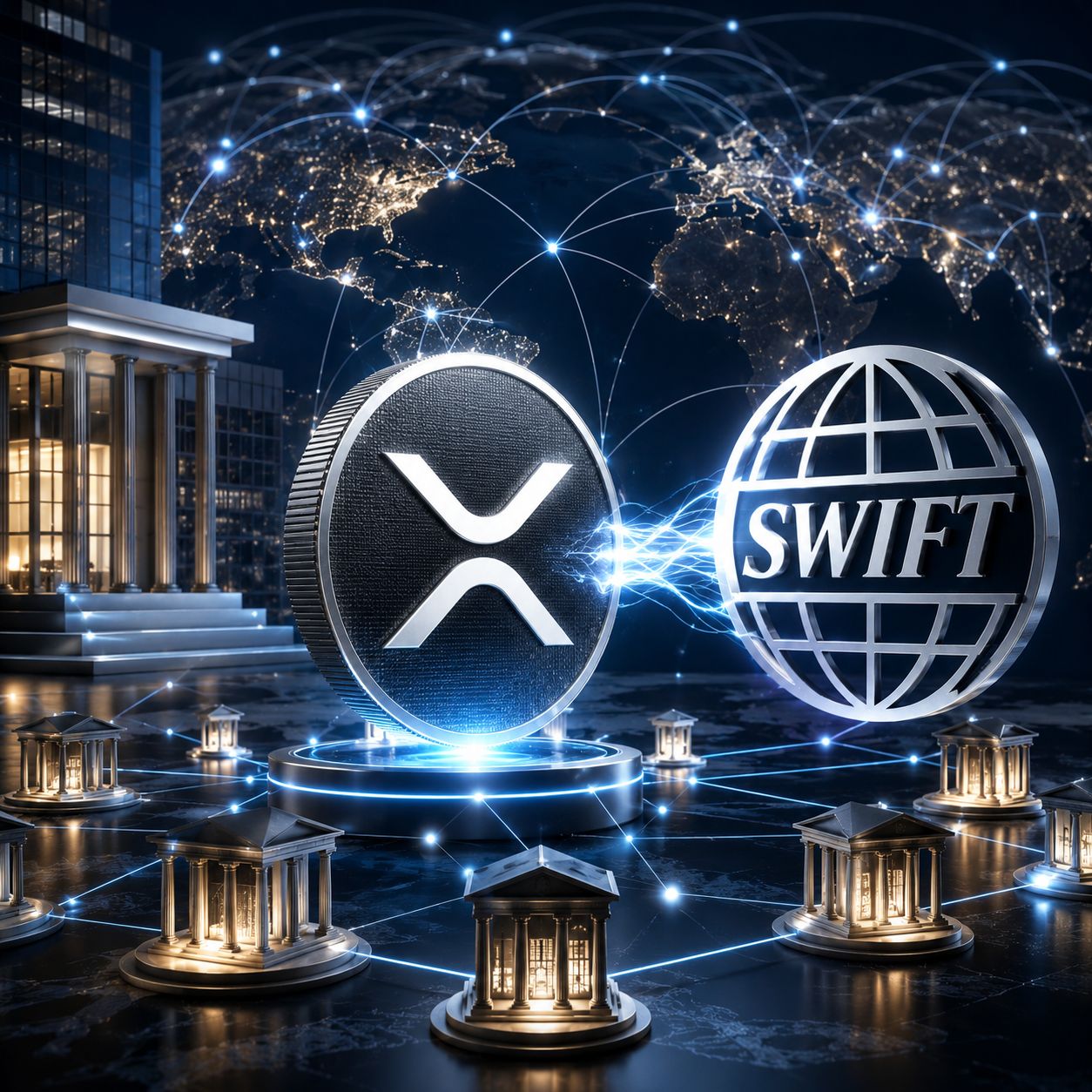
The global financial landscape is moving through an era of deep technological reorganization. For decades, the Society for Worldwide Interbank Financial Telecommunication, universally known as SWIFT, has held a secure monopoly over cross border interbank communication. However, the rise of financial technology and distributed ledger assets has created alternative paths for capital settlement. At the center of this dialogue is XRP, the digital asset native to the decentralized XRP Ledger. While speculative retail communities often suggest a scenario where blockchain networks fully replace old structures, the operational reality is far more practical. The future of banking does not require the complete elimination of legacy infrastructure. Instead, it relies on a hybrid framework where old communication channels connect directly with modern blockchain execution layers. This deep dive analysis unpacks the precise structural, technological, and architectural realities of how XRP and RippleNet systems interface with the existing global monetary network.
To comprehend the mechanics of this cross network integration, market participants must separate the acts of financial messaging from financial settlement. Historically, legacy networks have bundled these two distinct operational steps into a single slow sequence. When an enterprise initiates an international wire transfer, the message containing the payment details travels across a chain of intermediary correspondent banks. Each step requires manual validation, compliance processing, and balance adjustments before the actual cash capital is cleared at the destination. By introducing distributed network components into this layout, financial institutions can separate communication from settlement. Legacy systems can preserve their foundational role as the secure data coordination layer, while the actual movement of economic value shifts onto high throughput cryptographic ledgers.
This paradigm shift highlights the importance of open standards over closed ecosystems. Large scale legacy banks do not abandon their core internal systems for unproven public networks. They adapt by requiring all connected applications to utilize a shared global data dictionary. This technical convergence is exactly where the paths of old banking systems and blockchain settlement assets intersect, changing how multinational liquidity flows are managed.
The Structural Role of ISO 20022 as the Unified Language of Modern Banking
The core structural component enabling direct compatibility between traditional banking networks and distributed ledgers is the universal adoption of ISO 20022. This open international messaging standard is designed to replace aging message formats that have powered legacy infrastructure for nearly half a century. The primary limitation of old financial communication protocols is their highly restrictive data capacity. Legacy bank messages allow only simple, unformatted text blocks, which frequently results in missing documentation, false compliance alerts, and manual processing exceptions that delay global clearings for multiple business days.
In contrast, ISO 20022 utilizes an incredibly rich, highly structured, data heavy layout based on extensible markup languages. This framework permits financial networks to attach comprehensive remittance information, clear legal identifier codes, tax data, and complete corporate invoice details directly to an individual payment instruction. Every major banking region, central banking clearing house, and high value payment system across the globe has established strict deadlines to fully migrate their internal architectures over to this modernized data standard.
The primary point of intersection for public crypto assets occurred when Ripple became the first distributed ledger technology corporation formally admitted into the ISO 20022 standards body. This strategic entry ensured that the proprietary payment solutions built for corporate clients were architected from the ground up to speak the exact native language of central banks. More importantly, technical advancements have led to the native integration of these messaging frameworks directly onto the decentralized open source ledger. This development allows the blockchain platform to parse, format, and execute transactional data packages without relying on third party translation layers, matching the exact compliance and data standards required by global regulators.
Separating Communication Channels from Real-Time Settlement Layers
A widespread misconception across the financial technology sector is the idea that messaging systems function as direct liquidity pools. SWIFT does not move physical currency, nor does it hold sovereign cash reserves within a centralized repository. It operates strictly as a highly secure, private communication network that instructs banking entities to adjust their respective balances across internal ledgers. The actual settlement of funds relies on pre-funded correspondent accounts, known within the industry as Nostro and Vostro balances, maintained by commercial institutions in foreign jurisdictions worldwide.
This traditional pre-funding model is highly capital inefficient, locking up trillions of dollars in stagnant corporate liquidity to facilitate day to day international transactions. The true value proposition of the XRP asset lies in its ability to act as a neutral, real-time liquidity bridge, transforming how value moves after a message is received. Under this operational architecture, the communication path remains completely unchanged, allowing institutions to send verified payment notifications through traditional channels.
Once the payment instruction is validated on the communication network, the settlement mechanism shifts directly onto blockchain infrastructure. The sender’s local fiat currency is instantly converted into the digital asset, transferred across the decentralized network within seconds, and immediately settled as the recipient’s domestic fiat currency on the other side of the globe. This entire process bypasses the slow multi day correspondent bank chain entirely. By using a digital asset as a bridge, commercial enterprises can eliminate the need to maintain expensive, pre-funded accounts in foreign countries, freeing up vast amounts of working capital for more productive corporate uses.
How Commercial Banking APIs Create a Multi-Network Bridge
The practical implementation of this multi network connection does not require traditional banking applications to interact directly with public blockchain nodes. Instead, the operational bridge is managed by corporate software suites that utilize advanced, standardized application programming interfaces, or APIs. These software interfaces serve as automated translators, monitoring legacy systems for incoming payment requests and instantly executing corresponding cryptographic actions on secondary distributed ledgers.
When a client initiates a cross border commercial transaction at a licensed banking firm, the internal payment gateway generates a standardized, data rich message. The corporate API instantly extracts the essential transaction fields, including currency pairs, legal identifiers, and value amounts. If the software determines that the specific corridor is optimized for digital asset routing, it simultaneously interacts with licensed liquidity hubs to source the necessary asset depth on open secondary spot markets.
The digital asset is programmatically purchased, transferred across the global distributed ledger, and sold for the target fiat asset in under five seconds. Once the on-chain execution is finalized, the API transmits a structured confirmation message back to the primary legacy communication network to update the master record. This hybrid operational model delivers the speed, security, and low cost fees of public cryptography while preserving the formal reporting, auditing, and regulatory workflows that compliance officers require.
Navigating the Nuances of Institutional Adoption and Regulatory Paths
While the technical integration path between public ledger infrastructure and traditional financial communication channels is clear, widespread adoption depends heavily on regulatory frameworks. Large tier financial organizations operate under strict supervision and are legally prohibited from exposing customer funds to unhedged market volatility or ambiguous compliance structures. For a public digital asset to function effectively as an institutional liquidity bridge, clear legal frameworks regarding asset classification, custody rules, and digital transaction processing must be firmly established by global financial watchdogs.
Furthermore, market depth and liquidity concentration present unique operational hurdles for enterprise scale cross border payments. For a digital asset to process billions of dollars in daily corporate payment volume without causing extreme spot market price fluctuations, its underlying order books must be incredibly deep and highly resilient. This requirement explains why institutional development efforts focus heavily on onboarding major banking entities, multi-national market makers, and institutional liquidity providers to build dense order books across distinct global fiat corridors.
The transition to a modernized global payment architecture is a gradual process of convergence rather than a sudden disruption. Legacy communication networks are actively building their own distributed ledger projects and exploring tokenized deposit frameworks, acknowledging the clear operational advantages of on-chain asset movement. As these legacy systems become more comfortable with blockchain infrastructure, the friction between traditional financial communication layers and neutral public settlement assets will continue to decrease, paving the way for a more efficient, interconnected global economy.