


























































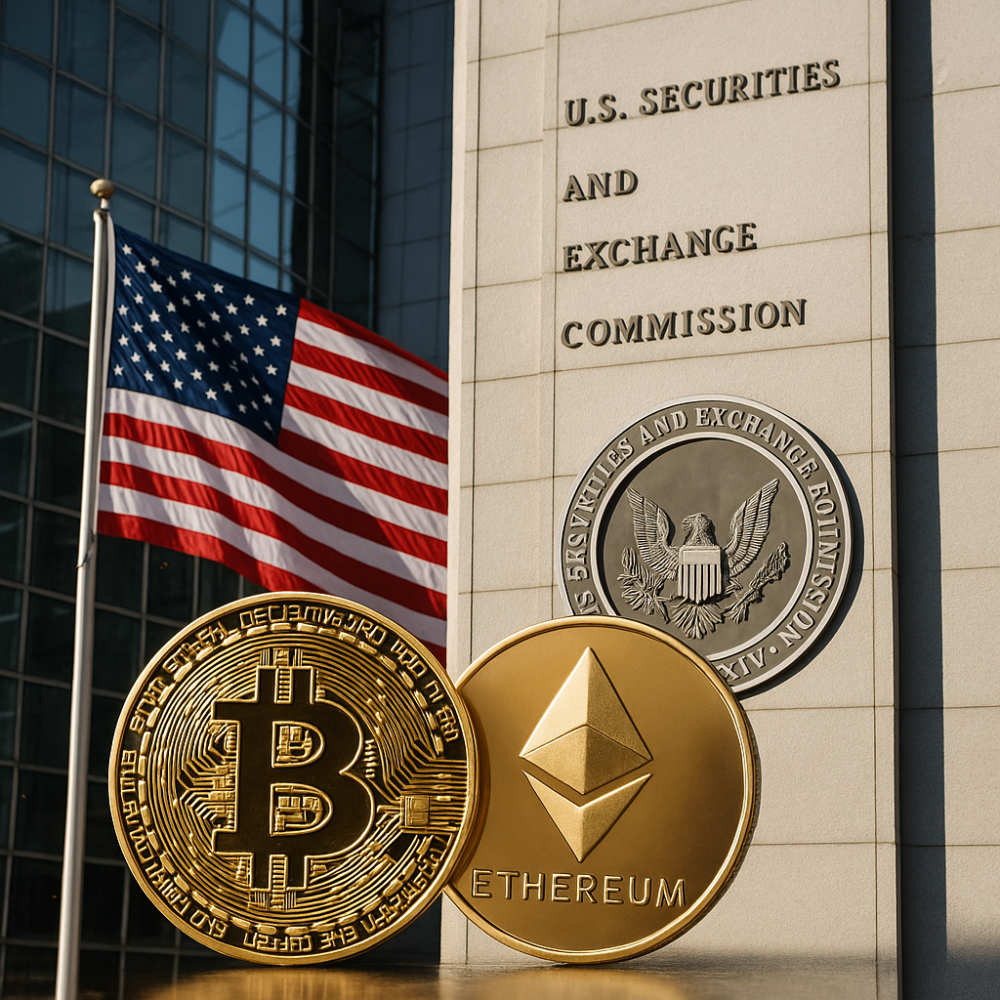
The United States Finally Moves to Catch Up
After years of uncertainty, the United States Securities and Exchange Commission (SEC) is taking decisive steps to reshape the cryptocurrency landscape.
During an October 2025 event in Washington D.C., SEC Chairman Paul Atkins addressed one of the most pressing concerns in modern finance: the United States’ decade-long lag in crypto regulation.
Atkins acknowledged that while nations like the United Kingdom, Singapore, and the European Union have introduced clear regulatory frameworks, the U.S. has been stuck in ambiguity, forcing innovators and investors to move abroad.
That era, he says, is ending.
The SEC is now prioritizing a comprehensive crypto framework aimed at restoring investor confidence, attracting global blockchain talent back to the U.S., and encouraging responsible innovation in a market that has grown too powerful to ignore.
SEC Chairman Paul Atkins: “The U.S. Has Fallen Behind”
Paul Atkins did not mince words when discussing America’s position in the global race for crypto leadership. According to him, the United States trails nearly a decade behind other regions that have already established solid crypto policies.
“We have spent years debating definitions instead of building frameworks,” Atkins said. “That hesitation cost us talent, innovation, and capital.”
He emphasized that the SEC’s new approach is not merely about regulation but about creating predictable, transparent guidelines that will allow businesses to thrive without the constant fear of enforcement confusion.
In his remarks, Atkins laid out three primary goals for the agency’s new direction:
- Regain global competitiveness in blockchain and digital asset innovation.
- Attract back U.S. entrepreneurs who left due to unclear regulatory environments.
- Establish trust between regulators, investors, and developers.
This shift represents a significant pivot from the SEC’s previous posture of reactive enforcement, often criticized as “regulation by lawsuit.”
Atkins’s comments were part of a larger panel that included U.S. Senate Finance Committee members, industry executives, and researchers from leading blockchain analytics firms.
Closing the Decade-Long Regulatory Gap
The SEC’s new initiative aims to close what Atkins described as a 10-year oversight gap. Since Bitcoin’s early years, regulatory clarity has been a recurring issue in the United States, with conflicting guidance between the SEC, CFTC, and IRS often paralyzing innovation.
This disjointed environment drove many crypto startups offshore. Major American projects relocated to Europe, Dubai, and Hong Kong, where governments moved faster to implement comprehensive digital asset policies.
The new framework proposed by Atkins and his team seeks to reverse this trend by addressing several long-standing issues:
- Clear classification of tokens as securities, commodities, or payment instruments.
- Practical registration pathways for exchanges and decentralized platforms.
- Updated disclosure requirements for blockchain projects and token issuers.
- Investor protection standards that balance safety with innovation.
Atkins noted that discussions with industry leaders from Coinbase, Circle, and the SEC’s own Crypto Task Force are helping to shape these new rules.
The goal is to provide transparency without suffocating innovation, fostering an environment where both traditional and decentralized financial systems can coexist and evolve.
A Framework Designed to Bring Talent Back Home
Over the past few years, America’s regulatory indecision has caused an exodus of crypto talent. Startups, developers, and venture capital firms found it easier to operate in countries where blockchain was not viewed as a threat but as an opportunity.
According to Atkins, the new SEC framework will specifically target this issue by re-establishing the U.S. as a global hub for blockchain entrepreneurship.
“Our innovators should not have to leave the country to pursue their ideas,” he said. “We want the next great blockchain revolution to happen here, not overseas.”
The framework will include incentives for blockchain startups, simplified reporting procedures, and coordinated oversight with other agencies such as the CFTC and FinCEN.
Atkins also hinted that the new regulatory roadmap could include sandbox environments – pilot zones where startups can test blockchain products under lighter regulatory supervision.
Industry analysts view this as a major shift, comparing it to Singapore’s and the EU’s MiCA framework, which attracted dozens of major companies by offering clarity and compliance predictability.
Industry Leaders React: A Mix of Optimism and Caution
Reactions to Atkins’s announcement have been mixed but largely optimistic.
Executives from Coinbase, Gemini, and Ripple applauded the SEC’s new direction, calling it long overdue.
However, some industry experts warn that over-regulation remains a risk.
Hester Peirce, the SEC Commissioner often referred to as “Crypto Mom,” stressed that the U.S. must ensure its policies protect privacy, promote innovation, and prevent heavy-handed enforcement that could stifle growth.
“We can regulate without strangling innovation,” Peirce said during the same event. “Our job is to set the boundaries, not build the walls.”
Meanwhile, institutional investors welcomed the move as a step toward reducing market uncertainty.
Crypto hedge funds and traditional financial institutions alike have argued for years that a clear framework is necessary for mainstream adoption.
According to CoinMetrics data, institutional inflows into crypto ETFs, funds, and trusts increased by nearly 25% after the SEC approved Bitcoin and Ethereum ETFs earlier in 2025.
Many analysts now expect similar momentum if altcoins receive structured regulatory treatment.
The Broader Impact on the Crypto Market
The announcement has already sparked movement across digital asset markets.
Bitcoin briefly surged past $110,000 following Atkins’s remarks, while Ethereum climbed 3% on speculation that the new framework could fast-track approval for decentralized finance (DeFi) products.
According to J.P. Morgan’s crypto strategy report, the SEC’s efforts to modernize its policies could unlock a wave of institutional adoption, potentially attracting trillions in capital over the next few years.
Key market data from CoinMarketCap as of October 2025:
- Bitcoin market cap: $2.13 trillion
- 24-hour trading volume: $78.3 billion
- 7-day price change: -4.32%
- 30-day price change: -8.84%
Analysts at Coincu Research noted that historically, regulation-driven clarity has been followed by sustained rallies in crypto valuations, as investors gain confidence in market stability.
From Enforcement to Empowerment: The New SEC Mindset
For years, the SEC’s reputation in the crypto world was synonymous with aggressive enforcement. The agency pursued numerous lawsuits against exchanges, token issuers, and even NFT platforms.
Atkins now seeks to reverse that image. The new SEC, he insists, will prioritize cooperation over confrontation.
Instead of viewing blockchain companies as potential violators, the agency aims to work alongside innovators to establish smart compliance systems that protect investors while supporting creativity.
This marks a clear break from the previous administration’s approach under former Chair Gary Gensler, whose tenure was defined by contentious lawsuits against major players like Binance and Ripple.
A Turning Point for U.S. Competitiveness
Global markets have noticed America’s shifting tone.
Countries like Japan, Switzerland, and the UAE have already built strong reputations as crypto-friendly jurisdictions. Their early regulatory clarity has attracted startups, exchanges, and venture funds worth billions.
The SEC’s new direction could finally restore the U.S. as a serious competitor in the digital asset economy.
Economic analysts believe that if the United States manages to combine strong consumer protections with regulatory flexibility, it could quickly reclaim leadership in blockchain finance, particularly in sectors such as tokenized assets, stablecoins, and decentralized trading.
“Innovation does not stop because regulation is late,” said Atkins. “But it can return home when regulation gets smart.”
Lessons from Bitcoin and Ethereum ETF Approvals
The recent success of Bitcoin and Ethereum ETFs provides a blueprint for how clear regulation can accelerate adoption.
When the SEC approved the first spot Bitcoin ETFs in January 2025, capital inflows surged across the crypto sector. Ethereum ETFs followed shortly after, driving another wave of institutional participation.
The result was not chaos but stability – proof that oversight, when structured correctly, can strengthen markets instead of weakening them.
Atkins and his team appear to be drawing on those lessons, aiming to replicate similar frameworks for altcoins, DeFi platforms, and tokenized real-world assets.
What the Future of U.S. Crypto Regulation Could Look Like
If the SEC’s new framework delivers as promised, the next few years could see transformative developments, including:
- National crypto licensing standards for exchanges and custodians.
- Streamlined registration paths for decentralized autonomous organizations (DAOs).
- Unified disclosure systems integrating blockchain transparency with traditional auditing.
- Cross-agency cooperation between the SEC, CFTC, and Treasury Department.
- Educational programs to help investors understand risks and opportunities.
These changes would not only restore clarity but also rebuild trust between regulators and the public -something the crypto industry desperately needs after years of courtroom battles and fragmented policy.
Market Outlook: A New Era of Regulatory Maturity
As of late 2025, the global crypto market capitalization exceeds $4.6 trillion, with over 600 million active wallets worldwide.
Despite market volatility, institutional participation continues to rise, driven by increasing confidence that digital assets are here to stay.
Experts predict that the SEC’s policy shift will trigger a new phase of regulatory maturity, allowing the market to evolve without losing its innovative edge.
For investors, this means more accessible, transparent, and compliant pathways into crypto exposure.
For developers, it means fewer barriers and more opportunities to build within U.S. borders.
For policymakers, it represents a long-overdue alignment between financial innovation and national competitiveness.
The SEC’s Crypto Reformation Has Begun
The United States is finally waking up to the reality that crypto is not a passing trend but a foundational pillar of future finance.
Chairman Paul Atkins’s initiative signals a new era of cooperation, modernization, and regulatory intelligence. By focusing on innovation rather than punishment, the SEC is setting the stage for a more balanced, competitive, and transparent crypto market.
If successful, this framework could mark a historic turning point – one that transforms the U.S. from a hesitant observer into a global leader in blockchain innovation.
As Atkins himself concluded during his remarks in Washington:
“The goal is simple. We want the United States to be the best place in the world to innovate safely, build boldly, and invest confidently.”









