























































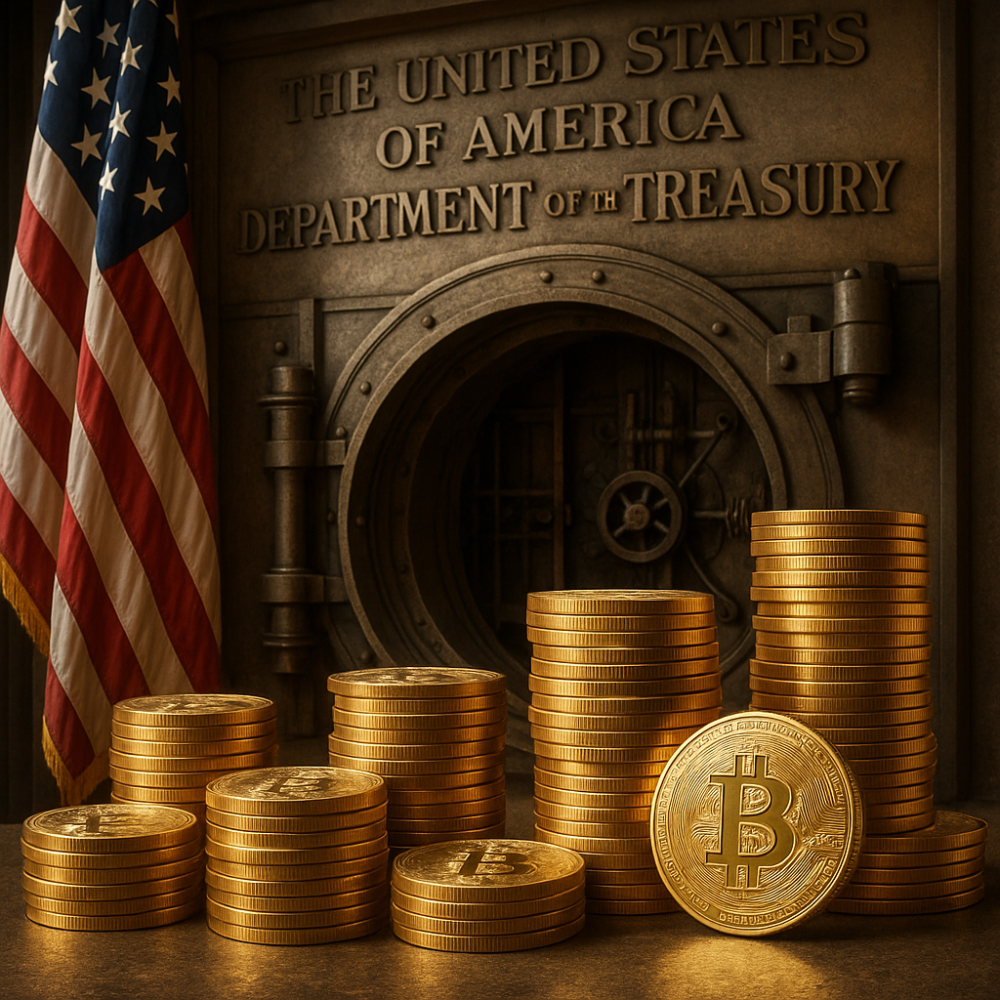
A New Era for America’s Crypto Policy
Under President Donald Trump’s renewed leadership, the United States has entered an unprecedented phase in its approach to cryptocurrency. What was once a fragmented policy of liquidation and asset sales has transformed into a strategic accumulation initiative, turning America into one of the largest institutional holders of Bitcoin worldwide.
This shift has stunned analysts, reshaped global narratives about digital assets, and positioned Bitcoin as a new pillar of U.S. economic strength. What was initially a series of law enforcement seizures has now evolved into the Strategic Bitcoin Reserve, a national asset vault designed to hedge against inflation, diversify government reserves, and secure America’s position in the digital economy.
Before Trump took office, most seized cryptocurrencies were sold quickly under court orders, often through government-approved brokers such as Coinbase Prime. But since early 2025, the strategy has completely reversed. The U.S. Treasury, under Trump’s direction, now retains these digital assets, signaling a seismic shift in how Washington views Bitcoin – not as a threat, but as a strategic national resource.
The Transformation of U.S. Bitcoin Policy
For years, U.S. agencies such as the Department of Justice (DOJ) and the U.S. Marshals Service routinely auctioned off seized cryptocurrencies. Bitcoin confiscated from criminal cases like Silk Road, Bitfinex, and ransomware operations would quickly be converted to cash and transferred to the Treasury’s general fund.
That changed dramatically in 2025. Following an executive order issued on March 6, 2025, President Trump authorized the creation of the Strategic Bitcoin Reserve (SBR) — a new entity within the Treasury designed to store, secure, and manage Bitcoin and other digital assets seized in federal operations.
Instead of liquidating these holdings, the SBR keeps them as long-term strategic assets. The decision instantly expanded U.S. crypto reserves by more than 64% overnight, with holdings surpassing 3.5% of the nation’s total gold reserves in comparative valuation.
By the end of Q2 2025, the U.S. held more Bitcoin than any country on Earth – except for one: MicroStrategy, the software firm led by Michael Saylor, which remains the world’s largest private BTC holder.
This government-driven accumulation marks the first time in history that a national treasury has treated Bitcoin as a monetary reserve asset, not merely as confiscated property.
The Massive DOJ Seizure That Sparked the Shift
The turning point came when the U.S. Department of Justice successfully seized 127,271 BTC, valued at approximately $15 billion, from a sprawling international fraud network led by Chen Zhi, the chairman of Cambodia’s Prince Holding Group.
According to Galaxy Research and U.S. court filings, Chen’s operation was one of the largest cyber-fraud and forced-labor schemes ever uncovered. Victims were recruited under the pretense of overseas job offers, then coerced into operating illegal online investment and crypto-scam centers across Southeast Asia.
The investigation revealed a vast ecosystem of shell companies and illicit mining operations used to launder stolen digital assets. Two key entities — Warp Data, based in Laos with a Texas subsidiary, and LuBian, a mining company in China — were identified as core facilitators of the scheme.
The case took an even darker turn when forensic blockchain analysis linked LuBian to one of the most infamous private key leaks in history. The “Milk Sad” software bug in 2020 exposed thousands of Bitcoin wallets, resulting in the theft of 127,000 BTC. Although LuBian never publicly admitted to the breach, an on-chain message later confirmed the incident, calling for the return of stolen assets.
When the DOJ traced the wallets connected to Chen and his network, they discovered that these funds were not random holdings — they represented the proceeds of an organized criminal enterprise that had operated globally for years.
The seizure marked one of the largest single recoveries of Bitcoin in U.S. history and became the catalyst for rethinking how such digital assets should be managed.
From Seizure to Strategy: The Birth of the Strategic Bitcoin Reserve
Historically, confiscated Bitcoin would have been auctioned off within months, as seen in previous cases like the Silk Road auction of 2014, where early investors (including venture capitalist Tim Draper) purchased BTC directly from the U.S. government.
However, under the new administration, Trump signed an executive order granting the U.S. Treasury explicit authority to retain and manage seized digital assets as part of a newly formed Strategic Bitcoin Reserve.
The purpose of this reserve, according to the official document, is to:
- Preserve Bitcoin as a strategic hedge against inflation and currency devaluation.
- Diversify national assets beyond gold and foreign bonds.
- Strengthen America’s influence in the global digital asset economy.
- Develop sovereign blockchain security infrastructure to safeguard holdings.
This decision marked a significant philosophical shift — from viewing Bitcoin as a speculative or criminally-associated asset to recognizing it as a digital commodity of national importance.
Trump’s move aligns with his broader economic vision of “sound money and strong assets”, often echoed in his public speeches about gold, oil, and Bitcoin.
Understanding the 127,271 BTC Seizure and Its Implications
The details of the DOJ’s operation shed light on the growing sophistication of international crypto crime networks.
Court documents revealed that Chen Zhi personally kept detailed records of wallet addresses and seed phrases linked to the scam’s financial flows. These notes, recovered from encrypted drives, were instrumental in locating and securing the seized assets.
Investigators also discovered that Prince Group and LuBian were not separate organizations but rather interconnected divisions of a larger criminal enterprise, funneling profits from forced labor and digital fraud operations through mining farms and shell entities.
The DOJ’s seizure demonstrated the power of blockchain forensics and international cooperation in digital asset recovery.
More importantly, it gave the U.S. government an unprecedented cache of clean, verifiable Bitcoin — creating the perfect foundation for launching the Strategic Bitcoin Reserve.
How the Strategic Bitcoin Reserve Operates
Unlike traditional financial reserves, the Strategic Bitcoin Reserve functions as a hybrid entity between the Treasury Department and the Department of Justice. Its mandate allows it to:
- Secure seized crypto assets using multi-signature cold storage systems distributed across multiple federal agencies.
- Report holdings quarterly to the Office of the Comptroller of the Currency (OCC).
- Use blockchain verification tools to ensure public transparency without revealing private key locations.
- Engage with select custodians for secure management of digital assets, including the potential use of Coinbase Prime as a service provider.
The Reserve operates under a non-liquidation policy, meaning none of its Bitcoin will be sold unless explicitly authorized by the President or the Secretary of the Treasury.
As a result, the United States is effectively hodling – a term borrowed from crypto culture that means long-term holding despite volatility.
This approach not only positions the U.S. as a major Bitcoin holder but also indirectly supports the broader crypto market by reducing available supply on exchanges.
Economic and Strategic Motivations Behind Trump’s Bitcoin Policy
Analysts view Trump’s Bitcoin strategy as both symbolic and strategic.
Symbolically, it represents a break from legacy finance, positioning America as a participant -not an observer – in the evolution of monetary systems.
Strategically, it addresses several economic realities:
- Inflation Hedge: By holding Bitcoin, the U.S. diversifies away from over-reliance on the dollar and Treasury bonds, both affected by inflationary pressures.
- Digital Competitiveness: Maintaining large Bitcoin reserves strengthens the U.S. role in the global digital asset ecosystem, countering China’s dominance in mining and blockchain infrastructure.
- Fiscal Resilience: Bitcoin’s capped supply offers a long-term asset that cannot be debased by monetary expansion, potentially reinforcing confidence in U.S. fiscal management.
This mirrors historical precedents: just as gold reserves once anchored the dollar, Bitcoin may now serve as a digital anchor of trust for future generations.
Global Impact: The U.S. as a Bitcoin Superpower
Trump’s policy has triggered widespread debate among economists, politicians, and crypto advocates.
Some praise the initiative as visionary, arguing that it transforms the U.S. into a Bitcoin superpower, capable of influencing global market sentiment. Others criticize it as risky, citing Bitcoin’s volatility and lack of correlation with traditional financial instruments.
Nevertheless, the global crypto community has responded positively. Bitcoin’s price surged following the Treasury’s reserve announcement, as investors interpreted the decision as a de facto endorsement of BTC as a legitimate sovereign asset.
Foreign governments have also taken notice. Reports indicate that both Japan and the United Arab Emirates are studying similar reserve models, while smaller economies in Latin America have expressed interest in diversifying their central bank holdings with crypto assets.
If these trends continue, 2025 could mark the beginning of a “digital Bretton Woods” moment – where Bitcoin becomes a recognized component of global monetary stability.
The Numbers: How Much Bitcoin Does the U.S. Actually Hold?
As of Q4 2025, official data estimates that the U.S. government’s total Bitcoin holdings exceed 215,000 BTC, spread across various agencies and the Strategic Bitcoin Reserve.
These assets are valued at roughly $26 billion at current market prices, representing about 1% of Bitcoin’s total circulating supply.
While this may seem modest, it places the United States second globally, only behind MicroStrategy’s private holdings and well ahead of major public corporations like Tesla, Marathon Digital, and Galaxy Digital.
Furthermore, analysts predict that ongoing DOJ seizures and forfeitures could expand the reserve by another 30,000 BTC within the next 12 months.
Policy Outlook: What Comes Next
The Strategic Bitcoin Reserve policy is set to remain in effect through 2028, coinciding with the end of Trump’s term.
According to administration sources, future plans may include:
- Introducing a “Digital Gold Standard” proposal, where Bitcoin serves as a hedge asset for Treasury bonds.
- Expanding the Reserve’s authority to hold other blockchain-based assets, such as tokenized U.S. bonds or digital gold.
- Partnering with American mining firms to secure domestic Bitcoin production.
- Launching educational programs through the Department of Commerce to promote blockchain innovation.
Critics worry that such consolidation of digital wealth under government control could distort free markets. However, supporters argue it provides the necessary foundation for a sovereign digital economy that protects American interests.
The Digital Reserve Era Begins
In less than a year, the Trump administration has redefined how the world’s largest economy approaches cryptocurrency.
What began as a routine law enforcement action against international fraud has evolved into a national digital reserve strategy, signaling a tectonic shift in global finance.
By embracing Bitcoin not as a speculative gamble but as a strategic reserve asset, the U.S. government has quietly positioned itself for leadership in the next era of monetary evolution.
Whether this bold move will strengthen America’s financial resilience or expose it to new risks remains to be seen. But one fact is undeniable:
the United States now officially holds Bitcoin as part of its sovereign wealth, forever changing the narrative of digital money in global economics.









