























































A New Era for Stablecoin Payments
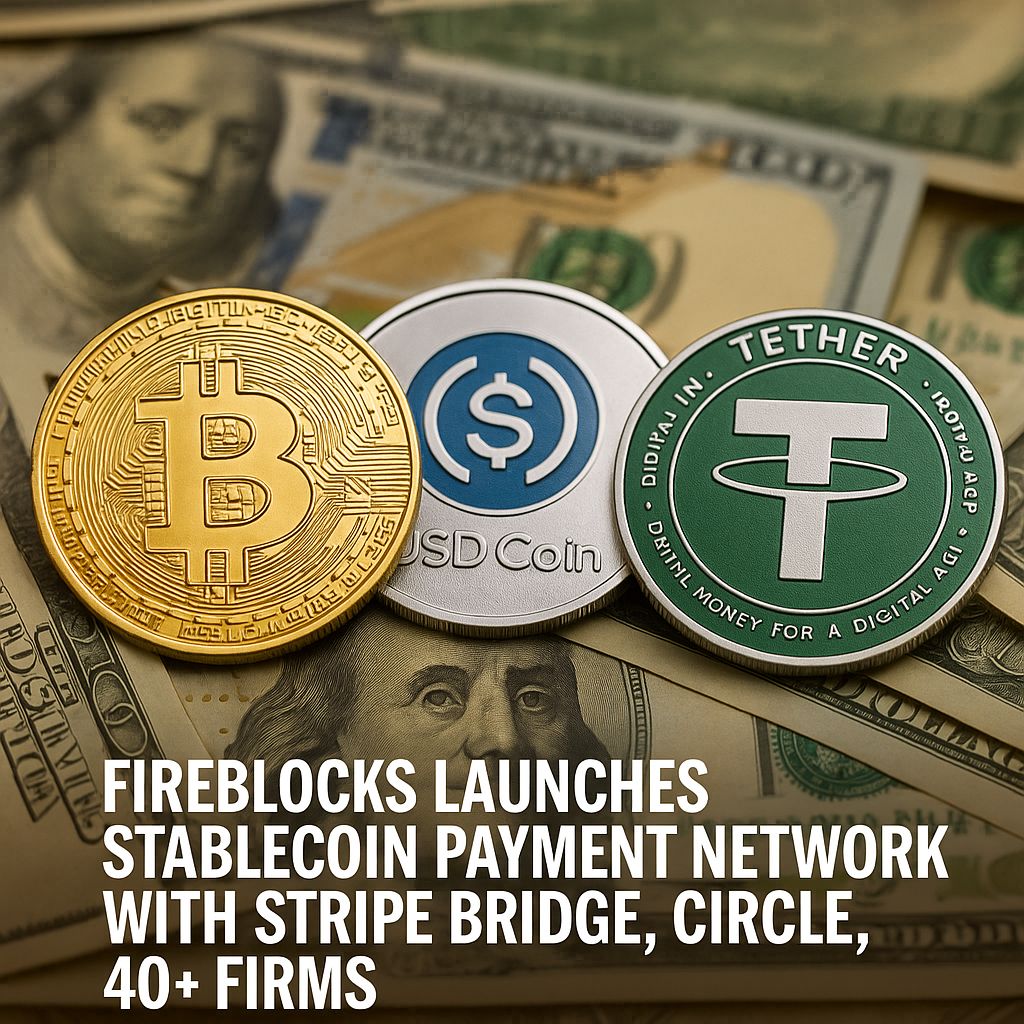
The stablecoin industry has entered a new phase of mass adoption in 2025, and the latest move by Fireblocks signals a significant shift in how global transactions will be handled. The $8 billion crypto infrastructure provider has officially launched the Fireblocks Network for Payments, partnering with Stripe’s Bridge, Circle, Zerohash, Yellow Card, and more than 40 leading financial institutions.
This revolutionary network aims to streamline global payments, enable cross-border transfers, and bridge the gap between traditional finance and blockchain-based settlements. With stablecoins rapidly reshaping global money flows, Fireblocks’ new platform could be one of the most pivotal launches of 2025.
Fireblocks’ Stablecoin Payments Network – What It Means
Fireblocks has already established itself as a leader in digital asset infrastructure, processing billions of dollars in transactions daily. Now, the company is taking a bold step by launching a multi-stablecoin payment network that integrates with over 40 institutional partners.
Key Partners and Integrations
- Bridge – recently acquired by Stripe, enabling seamless global payment rails.
- Circle – issuer of USDC, one of the world’s most widely used stablecoins.
- Zerohash & Yellow Card – powering instant on/off ramps across key global regions.
- Ava Labs & SMBC – collaborating on Japanese stablecoin pilots.
Unlike Circle’s existing USDC-exclusive network, Fireblocks’ platform supports multiple stablecoins, offering greater flexibility for businesses and institutions to choose, convert, and move stablecoins across different ecosystems in real time.
Multi-Stablecoin Infrastructure – Solving Industry Pain Points
One of the biggest challenges in cross-border payments has been the fragmentation of stablecoin liquidity. Fireblocks addresses this issue head-on by creating a multi-stablecoin infrastructure designed for seamless conversion between assets like USDC, USDT, PYUSD, EUROC, and others.
Key Advantages
- Faster settlement times – instant clearing without relying on SWIFT intermediaries.
- Lower transaction fees – stablecoin payments bypass expensive banking rails.
- Cross-border integration – supports global banking relationships and regulatory compliance.
- Codex blockchain integration – Fireblocks has partnered with Codex, a purpose-built blockchain designed for stablecoin finance, enabling instant settlement and zero-integration wallets for institutions.
In July 2025 alone, Fireblocks processed $212 billion in stablecoin transaction volume, marking an all-time high. With this new network, that figure is expected to multiply exponentially.
Institutional Adoption Accelerates
According to Fireblocks’ May 2025 survey of 295 financial executives from banks, fintech firms, and payment processors, the results are staggering:
- 90% of institutions are actively using or exploring stablecoin integration.
- Amazon and Walmart are reportedly preparing their own USD-backed stablecoins.
- Stripe has confirmed its work on a dollar-backed stablecoin targeted at non-U.S. markets, enhancing its already global reach.
This surge in institutional involvement highlights a major paradigm shift: stablecoins are no longer a niche DeFi tool — they are becoming the foundation of digital money.
Japanese Stablecoin Pilots – SMBC & Ava Labs
In a landmark development, Sumitomo Mitsui Financial Group (SMFG) – Japan’s second-largest bank – has partnered with Fireblocks and Ava Labs to pilot a stablecoin designed for cross-border settlements.
If successful, this initiative could:
- Bypass SWIFT payment rails,
- Cut cross-border transaction costs by up to 70%,
- And enable near-instant international settlements.
The trials are expected to begin in Q4 2025, with full-scale deployment possible in 2026.
Stablecoin Market Outlook – Growth Beyond Expectations
According to DefiLlama, the total stablecoin market capitalization now stands at $285 billion, marking a 56% year-over-year increase. But this is just the beginning:
- Annual stablecoin payment volumes are projected to reach $1 trillion by 2028.
- Citigroup predicts a $2 trillion+ market cap by 2030.
With Fireblocks now providing a unified multi-stablecoin infrastructure, analysts believe stablecoins could surpass traditional payment rails faster than expected.
Banking Industry Concerns – Systemic Risks on the Horizon
While stablecoin adoption accelerates, traditional banking institutions are growing increasingly concerned.
Key Warnings
- Citigroup executives have warned that high-yield stablecoin products could trigger a deposit flight crisis, similar to the 1980s money market disruption.
- The American Bankers Association (ABA) is lobbying Congress to close regulatory “loopholes” in the GENIUS Act, which currently allows exchanges to offer yields on third-party stablecoins.
- Former People’s Bank of China Governor Zhou Xiaochuan has cautioned that poorly designed stablecoins could face redemption pressure similar to TerraUSD’s 2022 collapse.
Despite these concerns, U.S. Treasury Secretary Scott Bessent remains optimistic, stating:
“Digital dollars will expand dollar access globally and drive unprecedented demand for U.S. Treasuries.”
What It Means for Crypto Investors
For traders and long-term investors, Fireblocks’ move represents a turning point:
- Stablecoins are becoming an institutional necessity, not just a crypto-native tool.
- Liquidity is consolidating across fewer, more regulated providers.
- Multi-stablecoin conversion will create new opportunities in DeFi arbitrage and cross-border payments.
- Institutional giants like Stripe, Circle, and SMBC are pushing stablecoins deeper into mainstream finance.
With global payment networks integrating stablecoins at scale, the competitive advantage for early adopters has never been more substantial.
The launch of the Fireblocks Network for Payments represents a historic milestone for the cryptocurrency industry. By connecting 40+ institutions, integrating with Stripe Bridge and Circle, and supporting multi-stablecoin settlement, Fireblocks is positioning itself as a critical backbone for the future of digital payments.
As stablecoin adoption surges, investors, businesses, and institutions must adapt to the new reality: stablecoins are no longer optional – they’re becoming the default payment standard.









