

























































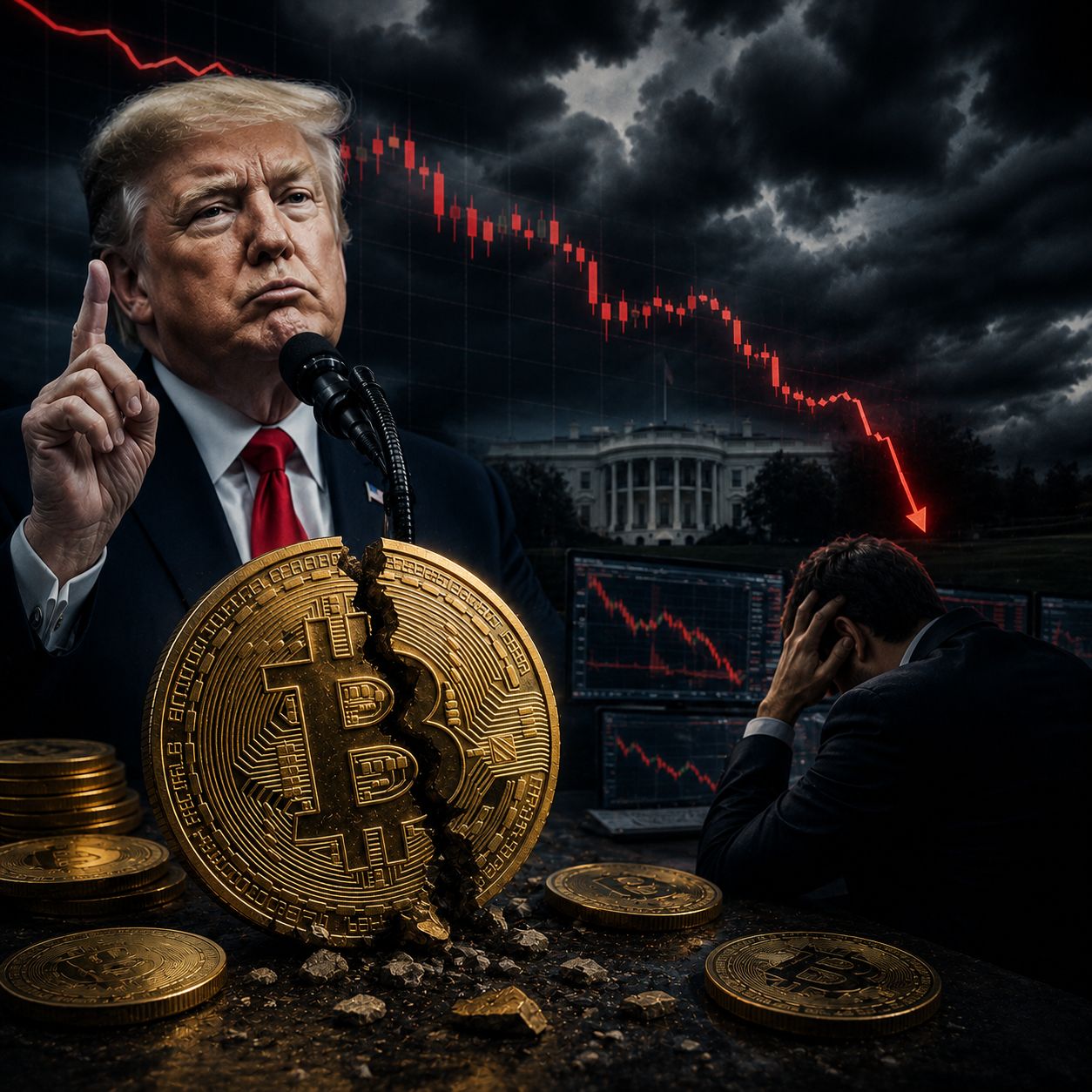
Donald Trump recently made a major statement promising that he will never let the crypto industry down. While many expected this bullish commitment to send prices soaring, the actual market reaction was the exact opposite. Bitcoin experienced a sharp rejection, falling roughly 2000 dollars in a matter of hours. This phenomenon has left many investors wondering why a direct promise of support from a major political figure resulted in a sudden market decline. To understand this, we must look deeper into the mechanics of sell-the-news events, the impact of high leverage, and the external geopolitical factors that often overshadow political headlines.
The statement from Trump was part of an intensified campaign strategy aimed at securing the support of the digital asset community. By positioning himself as a definitive protector of crypto in America, he signaled a massive shift from his previous skepticism. However, seasoned traders often view such high-profile proclamations as distribution events. Instead of attracting new institutional buyers, these headlines often provide the necessary liquidity for large holders to exit their positions. When the market is crowded with retail investors buying into the hype, whales often take the opportunity to sell, leading to the rapid price drops we observed following the announcement.
Analyzing the Sell the News Dynamic in Modern Markets
The concept of selling the news is a staple in financial markets, but it has taken on a unique character in the world of cryptocurrency. In the case of Trump’s bullish vow, Bitcoin was already testing a significant resistance zone near the 70,000 dollar level. Resistance zones are areas where selling pressure typically outweighs buying interest. When news breaks that seems overwhelmingly positive, it often pushes retail sentiment to an extreme. This surge in retail buying provides the perfect exit for institutional players who have been looking for a way to sell their holdings without causing a massive price slippage.
Furthermore, technical data from liquidation heatmaps showed a dense cluster of long positions around the 70,000 dollar mark. As the price failed to break higher and began its descent, these leveraged positions were forced to close. This creates a cascading effect where selling triggers more selling, leading to the sharp 2000 dollar drop. Traders on social media platforms have even started referring to this as a reverse Midas touch, where the most vocal bullish predictions from political figures serve as a signal for the market to move in the opposite direction.
Geopolitical Pressure and External Market Catalysts
While the political rhetoric was the primary headline, external factors played a critical role in the market’s bearish turn. During the same period, geopolitical tensions in the Middle East, specifically involving Iran, began to weigh heavily on risk assets. In times of global uncertainty, investors tend to move away from volatile assets like Bitcoin and shift toward safe havens. The threat of escalating conflict often causes a broad de-risking across all financial sectors, and crypto is frequently the first to feel the impact due to its 24-7 trading nature and high volatility.
Data from exchange-traded funds (ETFs) also provided clues about the market’s underlying health. Large off-exchange trades, often referred to as dark pool movements, suggested that major institutions were repositioning their portfolios. A massive 1.289 billion dollar movement in a leading Bitcoin ETF signaled that big money was not necessarily accumulating more coins, but rather shifting assets in anticipation of further volatility. When institutional sentiment is cautious, even the most bullish political promises struggle to sustain a price rally.
Political Influence on Digital Assets
As we move closer to the next electoral cycle, the intersection of politics and cryptocurrency will only become more prominent. Candidates are increasingly recognizing the voting power of the crypto community, leading to more frequent and more aggressive pro-crypto statements. However, for investors, the lesson from the recent Bitcoin drop is clear: political promises do not always equal price appreciation. The market is a complex ecosystem driven by liquidity, leverage, and global macro trends that often override individual headlines.
To navigate this landscape, investors must look beyond the immediate noise of political vows. Understanding the structural health of the market, including ETF flows, liquidation levels, and geopolitical stability, is far more important than reacting to a single tweet or speech. While the long-term outlook for crypto may be bolstered by favorable legislation and political support, the short-term reality remains highly sensitive to technical factors. Moving forward, the industry will continue to watch how these political narratives play out and whether they can eventually lead to the structural growth the community hopes for.