




















































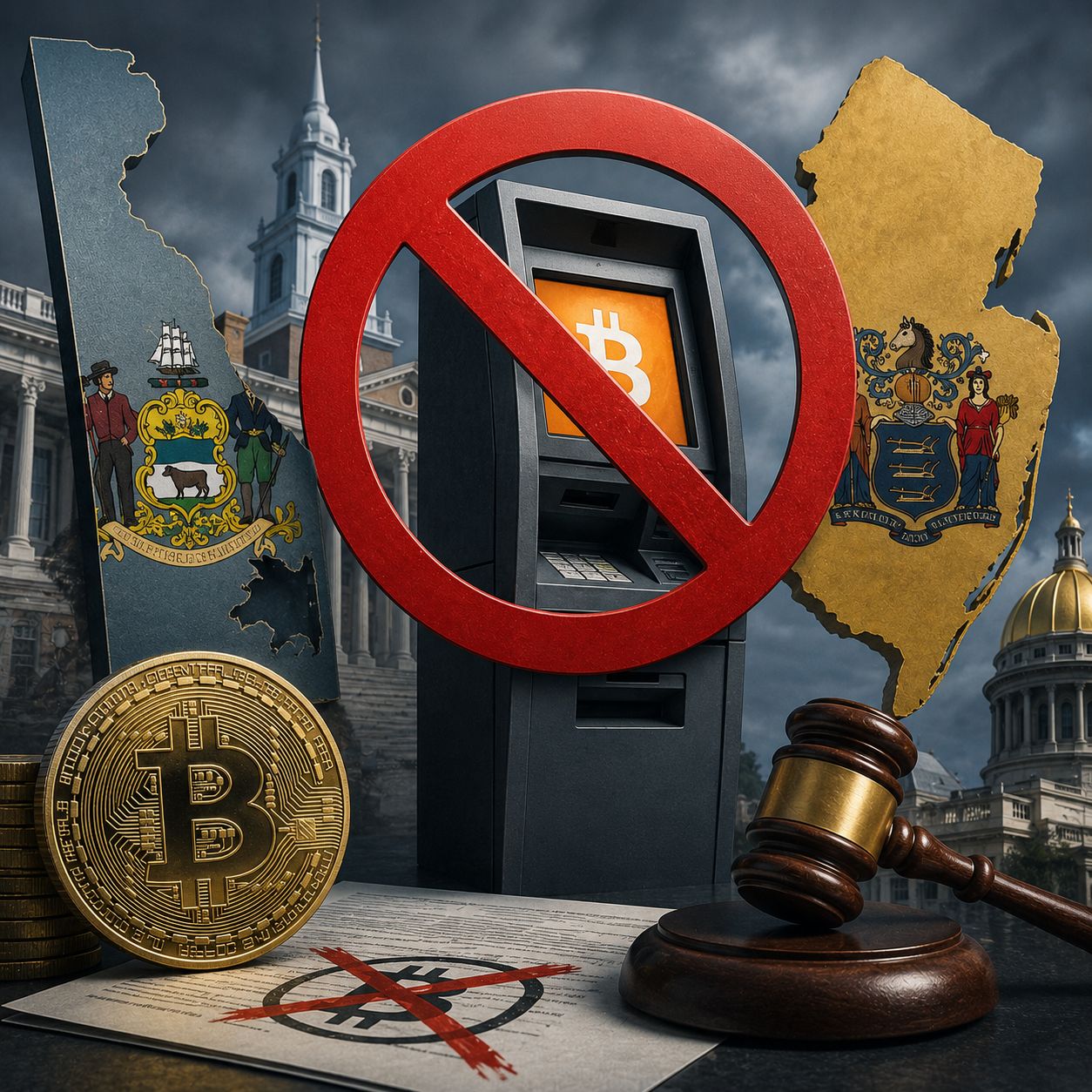
The regulatory landscape surrounding digital currencies is undergoing a massive shift as state governments confront the rising tide of physical cryptocurrency kiosk fraud. In a coordinated legislative push, lawmakers in Delaware and New Jersey have advanced aggressive new bills that seek to completely outlaw the installation, ownership, and operation of cryptocurrency automated teller machines, commonly referred to as crypto ATMs or Bitcoin kiosks. This rapid regulatory movement marks a dramatic escalation in state-level oversight, pivoting away from standard consumer warning labels and daily transaction limits toward outright prohibition. Driven by alarming fraud statistics released by federal law enforcement, these states are positioning themselves at the forefront of a growing national trend aimed at eradicating what officials describe as predatory financial infrastructure.
For years, crypto ATMs have been a common fixture in convenience stores, gas stations, and urban bodegas, offering a physical portal for users to convert paper cash into digital assets. However, state representatives argue that these machines serve almost no legitimate consumer purpose and instead function primarily as decentralized collection points for international scam networks. As these bills head to full legislative chambers for definitive votes, the cryptocurrency kiosk industry is launching a massive pushback, warning that total bans will stifle financial inclusion and penalize honest retail consumers who rely on cash-to-crypto gateways. This detailed report explores the inner mechanics of the proposed bans, the staggering federal fraud data motivating state lawmakers, and the intensifying battle between public safety advocates and digital asset providers.
The Legislative Breakdown of the Upgraded East Coast Crackdown
The legislative push intensified on June 8, 2026, when the New Jersey Senate Commerce Committee voted unanimously to advance Senate Bill 2141. Sponsored by Senator Paul Moriarty, a prominent consumer advocate from Gloucester County, the bill targets the entire business supply chain of the kiosk industry. Under the strict terms of the New Jersey proposal, it would become explicitly illegal for any business entity to own, control, install, manage, sell, or even offer for sale a cryptocurrency automated teller machine within state borders. The committee’s decisive and unanimous vote sent the bill directly to the full Senate chamber for final legislative consideration, signaling powerful, bipartisan momentum among Garden State lawmakers who view the kiosks as high-tech engines of financial exploitation.
Just twenty-four hours later, on June 9, 2026, the Delaware House Economic Committee matched New Jersey’s regulatory aggression by passing House Bill 441. Sponsored by Representative Cyndie Romer, who also chairs the House Technology and Telecommunications Committee, the Delaware legislation establishes an ironclad prohibition on the ownership, installation, or operation of any cryptocurrency kiosk throughout the state. To ensure that operators cannot exploit legal loopholes, the Delaware text goes a step further by explicitly banning any retail point-of-sale systems or cashier-assisted fiat-to-crypto transactions that replicate or substitute the functionality of a physical kiosk. If signed into law, the Delaware statute would mandate that every single existing crypto ATM within the state be taken completely offline immediately, with a strict legal requirement for total physical removal from all commercial premises within ninety days.
The penalties outlined in both pieces of legislation are designed to be economically devastating for non-compliant business entities. In Delaware, violations of the kiosk ban would be legally classified as unlawful trade practices and prohibited trade practices under the state’s existing consumer protection laws. Kiosk operators who defy the ban face civil fines reaching up to 10,000 dollars per violation, and any transaction fees illegally harvested from consumers must be fully refunded to the victims within thirty days or forfeited directly to the Delaware Consumer Protection Fund. In New Jersey, violating the proposed law is treated as an infraction under the robust Consumer Fraud Act, carrying a maximum civil penalty of 10,000 dollars for an initial offense and rising sharply to 20,000 dollars for each subsequent violation, creating a severe financial deterrent for store owners and network operators alike.
The Alarming Federal Fraud Statistics Driving State Intervention
The primary catalyst for this sudden wave of legislative prohibitions is a massive spike in reported consumer losses linked directly to physical crypto kiosks. According to comprehensive data released by the Federal Bureau of Investigation, the internet crime complaint center received nearly 13,500 formal complaints regarding cryptocurrency ATM scams over a single twelve-month period. These reported incidents accounted for an astronomical 388 million dollars in total nationwide losses, representing a staggering twenty-three percent increase in total complaints and a massive fifty-eight percent surge in financial losses compared to the prior calendar year. Federal investigators warn that because a significant percentage of financial fraud goes completely unreported due to victim shame and embarrassment, these figures represent only a conservative baseline of the true economic damage.
A deeply troubling aspect of the federal data is the disproportionate targeting of older citizens and vulnerable populations. Over half of all complaints submitted to the federal government involved victims who were over fifty years of age, with total financial losses for this specific demographic exceeding 302 million dollars. State lawmakers have weaponized these statistics to demonstrate that crypto ATMs have evolved into a highly specialized tool for elder financial abuse. In New Jersey alone, state officials documented 369 verified victims who lost a combined total of roughly 18 million dollars to kiosk scams in a single year, with seniors being calculated as three times more likely to suffer a severe financial loss through a physical bitcoin machine than younger adults.
The mechanics of these predatory scams typically rely on highly aggressive social engineering scripts rather than complex software hacking. Fraudsters generally initiate contact through unsolicited phone calls, deceptive text messages, social media direct messages, or urgent computer pop-up windows, often impersonating trusted authorities such as internal revenue service agents, local law enforcement officials, bank security personnel, or corporate tech support representatives. The criminals manufacture a sense of absolute panic, falsely claiming that the victim’s bank accounts have been compromised, that they owe immediate back taxes, or that an active warrant has been issued for their arrest. The victim is then ordered to immediately withdraw physical cash from their traditional bank, drive to a local convenience store, and deposit the paper currency into a crypto ATM, which instantly converts the fiat cash into digital tokens and transfers them directly to an anonymous, untraceable wallet controlled by the offshore scammer.
The Economic Arguments Against High Fee Crypto Kiosks
Public safety advocates and state lawmakers are not merely criticizing the criminal exploitation of crypto ATMs; they are also taking direct aim at the underlying business model of the kiosk industry itself. During legislative hearings, Representative Cyndie Romer stated flatly that these physical machines reduce digital currency to a predatory cash grab that drains wealth from local communities. A primary economic criticism centered on the exorbitant transaction fees imposed by kiosk operators, which are drastically higher than the costs associated with traditional financial institutions or mainstream online cryptocurrency exchanges.
Financial data presented during the legislative debates revealed that regular, experienced cryptocurrency traders almost never use physical crypto ATMs to manage their digital asset portfolios. While established web-based digital asset exchanges typically charge transaction fees ranging from 0.4 percent to 1 percent of the total trade value, physical crypto kiosks frequently levy transaction fees upwards of fifteen to twenty percent of the total cash deposited. For a vulnerable consumer or an elderly scam victim depositing 10,000 dollars in cash, the kiosk operator instantly skims off 1,500 dollars to 2,000 dollars in pure profit, leaving the victim with significantly diminished asset value before the funds are even transmitted across the blockchain. Lawmakers argue that there is no valid public policy reason to protect or support a business architecture that pairs predatory pricing models with a complete lack of consumer utility.
Furthermore, state officials emphasize that once cash enters a physical cryptocurrency kiosk, the transaction is completely irreversible due to the immutable nature of blockchain technology. Unlike traditional credit cards, debit cards, or electronic bank wires, which feature robust consumer protection mechanisms, fraud alerts, and the legal ability to initiate a chargeback or freeze a transaction in progress, a crypto ATM deposit transfers ownership of the underlying asset within seconds. Once the machine processes the paper bills and broadcasts the transaction to the digital ledger, the funds are permanently gone, leaving local police departments and state consumer protection agencies with virtually no mechanical or legal avenue to recover the stolen wealth for defrauded citizens.
The Kiosk Industry Strikes Back with Push for Regulation over Prohibition
As the legislative threat to their business survival intensifies, major players within the cryptocurrency kiosk industry are mobilizing a significant lobbying and public relations counter-offensive. Industry representatives argue that enacting an outright, total ban on physical machines is an overly simplistic and reactionary approach that ignores the legitimate financial needs of unbanked and underbanked populations. Executives contend that physical kiosks provide a vital, bridge-like service for millions of cash-reliant retail consumers who want to participate in the burgeoning digital economy but lack access to traditional credit cards, formal checking accounts, or mainstream online trading platforms.
During the intense testimony before the New Jersey Senate Commerce Committee, Larry Lipka, the general counsel for CoinFlip, the world’s largest cryptocurrency kiosk operator, strongly defended the legitimacy of the industry’s customer base. Lipka testified that his company serves more than 23,000 active, recurring customers within the state of New Jersey alone. Crucially, he pointed out that internal compliance data demonstrates that the verified scam rate across their entire network is less than one percent of total transaction volume. The industry argues that it defies basic economic logic to permanently dismantle a thriving financial network and penalize tens of thousands of law-abiding retail users simply because a tiny fraction of the infrastructure is targeted by criminal third parties.
Instead of pursuing total prohibition, the kiosk industry is actively urging state lawmakers to adopt a uniform, comprehensive regulatory framework that mandates strict consumer protections across all operators. Industry proposals include legally requiring all kiosk networks to implement advanced transaction monitoring software, enforce mandatory identity verification protocols, utilize real-time blockchain analytics to flag and block known fraudulent wallet addresses, and institute temporary consumer protection holds on all first-time user transactions to allow a window for cancellation. To prove their commitment to consumer safety, some major operators have even expressed a willingness to support legislation that would legally compel companies to fully refund the cash amounts to verified fraud victims, provided that lawmakers choose to enact rigorous regulatory oversight rather than a blunt, industry-destroying ban.
The Expanding National Map of Cryptocurrency Kiosk Prohibitions
The rapid legislative advancements in Delaware and New Jersey are not occurring in a vacuum; rather, they reflect an accelerating geographical expansion of state-enacted crypto ATM bans across the United States. If both states successfully pass their respective bills into law, they will join a growing vanguard of jurisdictions that have decided that the societal costs of physical cryptocurrency kiosks far outweigh their economic benefits. Currently, at least three other US states, Indiana, Tennessee, and Minnesota, have already enacted total, comprehensive bans on the ownership and operation of cryptocurrency kiosks in direct response to the catastrophic rise in localized consumer fraud.
This shifting regulatory tide marks a dramatic departure from the historical approach taken by state governments over the past decade. Previously, states generally attempted to manage the risks associated with crypto ATMs by applying existing money transmitter laws, requiring operators to display prominent fraud warning signs on the physical machines, capping daily transaction limits at 1,000 dollars or 2,000 dollars, or mandating that the kiosks provide printed receipts with explicit disclosures. However, as the latest FBI data conclusively proves that these minor consumer adjustments have completely failed to slow down international scam syndicates, state legislatures are concluding that physical kiosks are inherently unsafe for public commercial spaces.
The expanding map of state-level bans is also triggering a broader international conversation regarding the long-term viability of physical digital currency machines. Outside of the United States, major regulatory bodies are experiencing similar pressures; for example, federal authorities in Canada are currently evaluating severe nationwide restrictions on crypto kiosks following a parallel surge in elder fraud and illicit money laundering complaints. As more jurisdictions move toward total prohibition, the physical footprint of the crypto kiosk industry is shrinking rapidly, forcing operators to completely reevaluate their business models and heavily invest in digital-only alternatives.
The Long-Term Impact of a Total Kiosk Ban on Consumers and Retailers
If Delaware and New Jersey successfully transition these bills into active statutes, the immediate real-world consequences will reverberate far beyond the kiosk operators themselves, impacting local commercial retail landscapes and the broader digital asset market. For thousands of independent small business owners, including convenience store operators, gas station franchisees, and grocery store managers, the forced removal of crypto ATMs will result in a direct hit to their ancillary revenue streams. Kiosk companies typically pay retail hosts attractive monthly rental fees or transaction-based commission splits to secure floor space, providing an easy source of passive income for small businesses operating on razor-thin profit margins.
From a consumer perspective, a total ban will completely eliminate the physical cash-to-crypto gateway in these states, forcing retail users to adapt to an entirely digital environment. While this will successfully cut off the primary mechanism used by scammers to extract physical paper currency from elderly victims, it also means that unbanked individuals who legitimate wish to purchase digital assets using cash will be effectively locked out of the market unless they can secure a traditional bank account or find alternative, highly regulated point-of-sale services. Financial analysts predict that this disruption will accelerate the adoption of peer-to-peer digital payments and compel mainstream crypto exchanges to develop more accessible, low-fee onboarding methods for cash-preferred demographics.
Ultimately, the aggressive legislative actions pushing through the committee rooms in Dover and Trenton send an unmistakable signal to the entire financial technology sector: the era of freewheeling, unregulated physical crypto infrastructure is rapidly coming to an end. State lawmakers are proving that they are entirely willing to dismantle an entire multi-million-dollar retail industry if it is deemed to be a systematic threat to the financial security of their oldest and most vulnerable constituents. As the full state senates and assemblies prepare to debate these historic bans, the outcome will likely serve as a decisive blueprint for dozens of other states currently grappling with the complex intersection of digital innovation, physical access, and consumer protection.









