

























































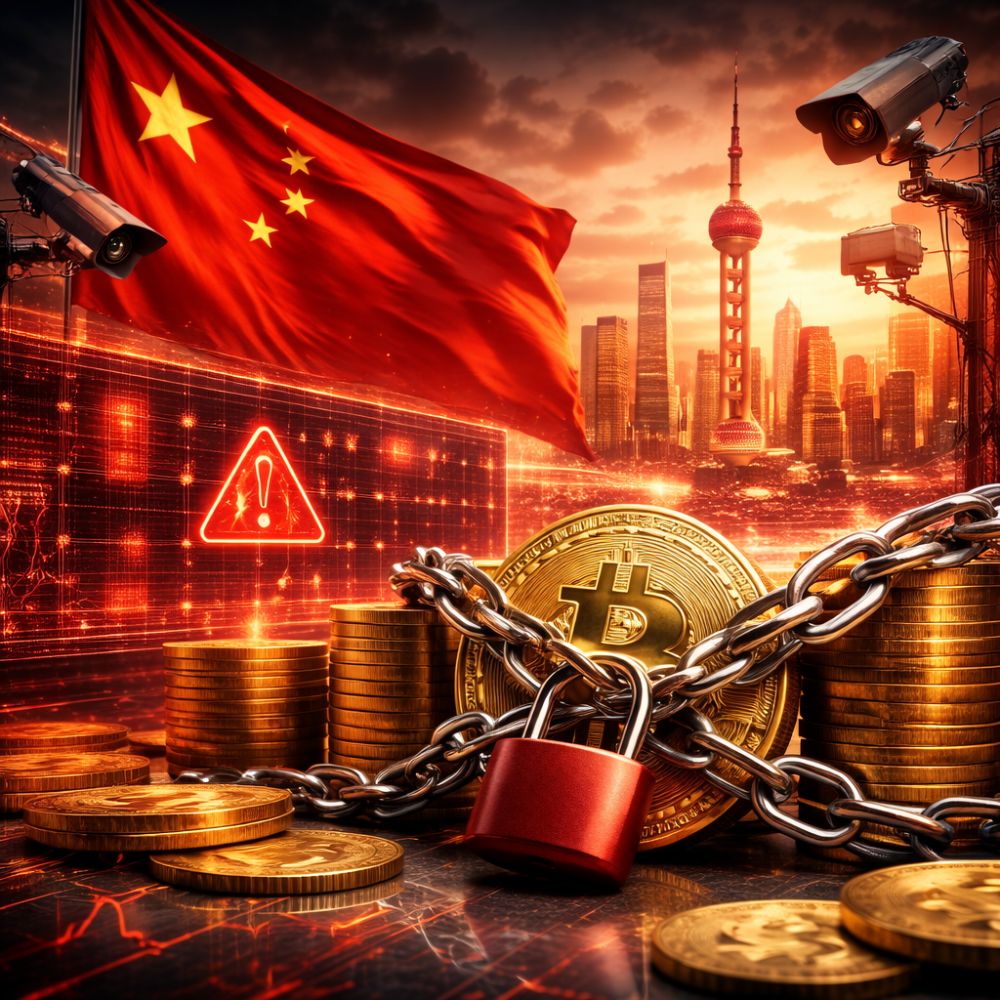
China Reinforces Its Hardline Stance on Digital Assets
People’s Bank of China has joined nine other regulatory authorities in issuing a joint notice that significantly strengthens China’s already strict approach to cryptocurrencies and blockchain-based financial products. The announcement prohibits the issuance of unapproved yuan-pegged stablecoins and categorizes most forms of real world asset tokenization as illegal financial activity.
This move signals that Chinese regulators are not only maintaining their long-standing skepticism toward cryptocurrencies but are also expanding the scope of enforcement to include emerging digital finance models. Stablecoins tied to the Chinese yuan and tokenized representations of physical or financial assets are now firmly placed outside the boundaries of permissible activity unless explicitly approved by authorities.
The new measures reinforce China’s commitment to preserving strict control over its monetary system, capital flows, and financial innovation channels. While other major economies continue to experiment with regulatory frameworks designed to integrate digital assets into traditional finance, China is choosing a more restrictive path that prioritizes centralized oversight and risk containment.
Coordinated Regulatory Action Across Multiple Agencies
The joint notice issued by the central bank and nine other regulators highlights a coordinated approach to digital asset supervision. Rather than isolated policy statements from individual agencies, China is presenting a unified regulatory front designed to leave little room for ambiguity.
Under the new guidance, any organization or individual issuing yuan-linked stablecoins without explicit authorization faces immediate prohibition. Authorities also clarified that most real world asset tokenization activities fall into the category of illegal fundraising or unauthorized securities issuance.
This coordinated stance reflects concerns that tokenization and stablecoins could be used to bypass capital controls, facilitate illicit financial activity, or create parallel monetary systems that weaken the effectiveness of national economic policy.
By classifying these activities as illegal, regulators aim to eliminate gray areas that previously allowed some blockchain projects to operate in semi-compliance. The message is clear that innovation must align strictly with state-approved frameworks or not exist at all.
Why Yuan-Linked Stablecoins Are a Particular Focus
Stablecoins pegged to fiat currencies have become a cornerstone of the global crypto economy. They enable traders to move quickly between volatile assets and more stable value references without relying on traditional banking rails.
For Chinese regulators, yuan-linked stablecoins present unique challenges. If widely adopted, they could function as private-sector substitutes for official currency, reducing the government’s ability to monitor and control money supply and capital flows.
China has invested heavily in developing its own central bank digital currency, the digital yuan, which is designed to operate within a tightly controlled ecosystem. Unapproved stablecoins could undermine this initiative by offering alternative digital representations of the yuan outside state oversight.
By banning unapproved issuance outright, authorities are ensuring that only state-sanctioned digital currency solutions can operate within China’s financial system.
Real World Asset Tokenization Under Scrutiny
Real world asset tokenization involves converting ownership rights to physical or financial assets into blockchain-based tokens. These can represent real estate, commodities, bonds, equities, or even fine art.
Globally, tokenization is often promoted as a way to increase liquidity, improve transparency, and broaden access to investment opportunities. However, Chinese regulators view most tokenization models as high-risk and potentially deceptive.
The joint notice classifies many of these projects as illegal, particularly when they resemble unregistered securities offerings or promise investment returns without proper authorization.
Authorities are concerned that tokenization platforms could facilitate fraud, misrepresentation, and unauthorized fundraising. By drawing a hard line against such activities, China aims to protect retail investors and maintain tight control over capital markets.
Locking in a Restrictive Crypto Policy
China’s relationship with cryptocurrency has been characterized by caution and periodic crackdowns for more than a decade. From early restrictions on exchanges to outright bans on mining and trading, the country has consistently prioritized financial stability over crypto-driven innovation.
The latest regulatory action confirms that this philosophy remains unchanged. Rather than signaling any potential softening, the new measures lock in a restrictive approach that leaves little room for decentralized or privately issued digital assets.
This stands in contrast to jurisdictions that are attempting to balance innovation with oversight through licensing regimes and regulatory sandboxes. China’s model emphasizes prohibition and state dominance instead.
Implications for Domestic Blockchain Development
Despite its tough stance on cryptocurrencies, China continues to support blockchain technology for enterprise and government use cases. Supply chain tracking, digital identity, and administrative recordkeeping are among the areas where blockchain adoption is encouraged.
However, these applications operate within permissioned networks and under strict regulatory supervision. The new rules further separate state-approved blockchain development from open, decentralized crypto ecosystems.
For domestic developers, this means focusing on enterprise-grade solutions rather than consumer-facing crypto products. Projects involving stablecoins or tokenized assets are effectively off-limits unless integrated into government-backed frameworks.
Impact on Global Crypto Markets
While China’s crypto bans have historically caused short-term market volatility, their long-term impact has diminished as the industry becomes more geographically diversified.
Mining operations have largely relocated, and trading activity now centers in other regions. As a result, global markets are less sensitive to Chinese policy shifts than in previous years.
However, China’s stance still influences global regulatory discussions. Other countries often look to China as an example of a strict, risk-averse approach to digital assets.
The renewed crackdown may embolden regulators elsewhere to take tougher positions on stablecoins and tokenization, particularly if concerns about consumer protection and financial stability grow.
A Clear Message to the Crypto Industry
China’s latest joint notice sends a clear and unambiguous message that unauthorized digital asset activities will not be tolerated.
Unapproved yuan-linked stablecoins are banned. Most real world asset tokenization models are illegal. The regulatory environment is not evolving toward accommodation but toward tighter control.
For crypto businesses and investors, this reinforces the importance of understanding regional regulatory landscapes and avoiding assumptions that global trends will apply uniformly.
China has chosen a path that prioritizes centralized authority and state-led digital currency solutions, and the new measures ensure that this direction is firmly entrenched.
Looking Ahead
As the global crypto industry continues to mature, regulatory divergence between regions is becoming more pronounced.
Some countries are building frameworks to integrate digital assets into existing financial systems. China, by contrast, is doubling down on a restrictive model that excludes most decentralized crypto activity.
The joint action by the central bank and other regulators demonstrates that this approach is not temporary. It is a long-term policy choice designed to shape the future of digital finance in China on the government’s terms.
For the foreseeable future, China’s crypto landscape will remain tightly controlled, with limited space for privately issued digital currencies or tokenized investment products.









