
























































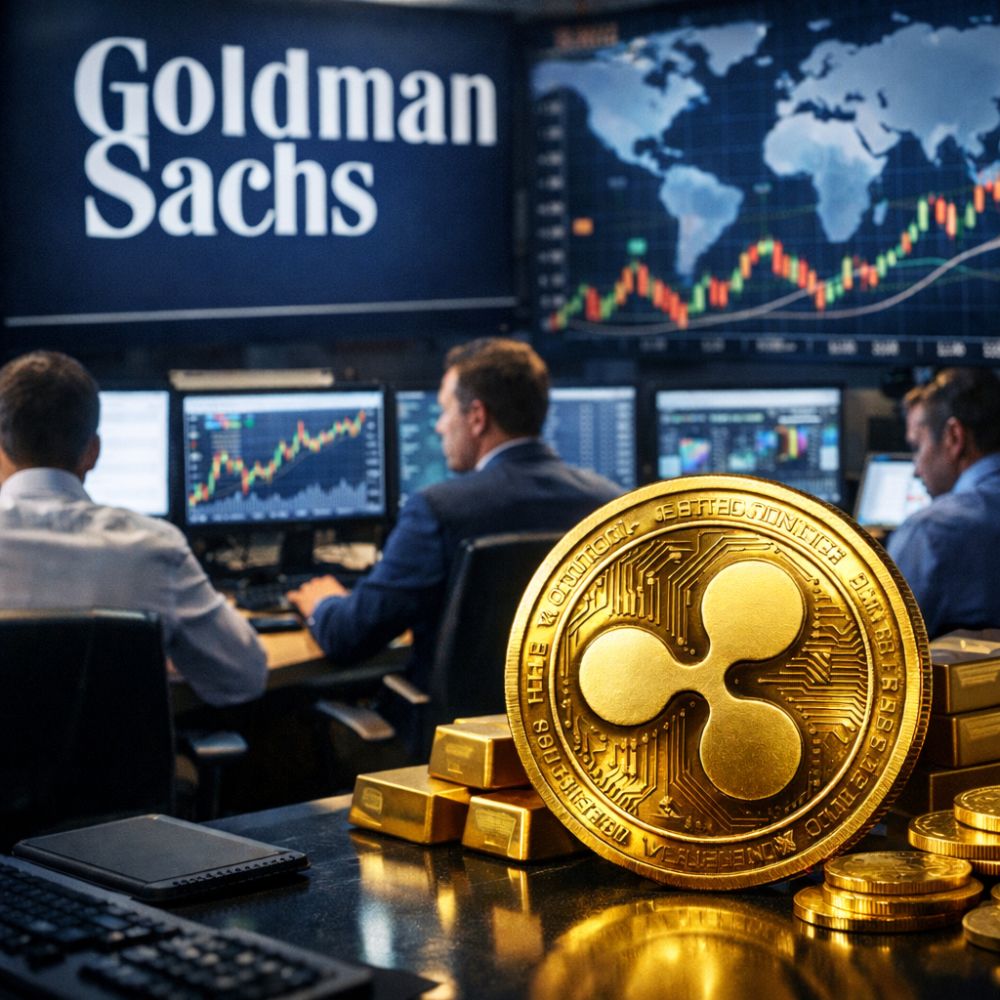
The landscape of institutional cryptocurrency adoption reached a significant milestone at the end of 2025 as the global banking giant Goldman Sachs emerged as a premier holder of spot XRP exchange-traded funds. According to recent 13F filings, the financial titan disclosed a substantial position totaling nearly $154 million in XRP-linked shares, signaling a major pivot in how Wall Street views the cross-border payment asset. This move by Goldman Sachs is not an isolated event but rather a headline-grabbing highlight in a broader trend of “smart money” moving into the XRP ecosystem. As of early 2026, spot XRP funds have successfully amassed a combined $1.44 billion in assets under management, showcasing a level of institutional appetite that many analysts believe marks the beginning of a new era for digital finance.
While the presence of a banking powerhouse like Goldman Sachs is undeniable, market analysts point out that the public filings only tell a fraction of the story. Bloomberg Intelligence analyst James Seyffart recently emphasized that the “vast majority” of XRP ETF investors remain invisible to the public eye because they do not meet the $100 million reporting threshold required for SEC 13F disclosures. Data reveals that while the top 30 institutional holders account for roughly $211 million in shares, the cumulative inflows into these funds surged past $1.3 billion by the end of the year. This massive discrepancy suggests a hidden layer of “super fans” and high-net-worth individuals who are aggressively accumulating XRP via regulated channels, potentially creating a supply shock that could influence future price discovery.
The Role of Institutional Utility and Global Clearing Infrastructure
A critical driver behind this institutional migration is the evolving utility of the XRP Ledger within the global clearing and settlement framework. In March 2026, the Depository Trust and Clearing Corporation (DTCC) officially connected Wall Street’s post-trade clearing infrastructure to the XRP Ledger through the integration of Hidden Road. This development moves XRP from the realm of speculative digital currency into a functional component of the “plumbing” of global finance. By acting as a bridge asset for high-speed, low-cost international transfers, XRP is being positioned as a direct competitor to traditional messaging systems like SWIFT. Large-scale financial institutions are increasingly attracted to the efficiency gains offered by blockchain-based settlement, especially when backed by the regulatory clarity provided by the recent passage of the Clarity Act.
Furthermore, the introduction of Ripple USD (RLUSD) has added a new layer of stability to the ecosystem, allowing institutions to utilize the XRP Ledger’s speed without the volatility traditionally associated with cryptocurrencies. This stablecoin infrastructure, combined with the liquidity provided by spot ETFs from providers like Bitwise, 21Shares, and Franklin Templeton, creates a comprehensive environment for corporate treasury management. As Ripple CEO Brad Garlinghouse noted, the token serves as the “North Star” for the company’s vision of a decentralized financial network. For institutions, the ability to gain exposure through a regulated ETF avoids the complexities of direct token custody while providing a direct line to the growth of this burgeoning financial infrastructure.
Market Dynamics and the Scarcity Engine for 2026
The convergence of record-breaking ETF inflows and tightening exchange supply is creating a unique supply-demand imbalance for XRP. By early 2026, exchange-held XRP balances plummeted to seven-year lows as custodians for the various spot ETFs moved to secure the underlying assets. This “supply shock” mechanism is particularly potent for XRP because it possesses one of the most vocal and loyal retail communities in the crypto space, often referred to as the “XRP Army.” Unlike casual traders, this community tends to hold through periods of high volatility, effectively removing a significant portion of the circulating supply from the active market. When institutional demand from giants like Goldman Sachs collides with this retail “HODL” culture, the potential for non-linear price appreciation increases significantly.
Technical analysts are keeping a close watch on key psychological resistance levels, specifically the $1.50 and $2.00 marks. While the broader market experienced a correction in late 2025, XRP ETFs maintained a remarkable 55-day streak of consecutive inflows, a feat unmatched by many traditional asset classes. This resilience suggests that institutional buying is structural rather than speculative. If the current trajectory of $1.3 billion to $1.4 billion in AUM continues to grow, XRP could see a market re-rating based on its integration into the $150 trillion annual global payments market. Investors should remain focused on the “utility gap” – the speed at which Ripple can convert its 300-plus banking partnerships into active users of XRP-powered liquidity.
Long-Term Outlook and the Evolution of Digital Asset Policies
The long-term value proposition for XRP is now firmly anchored in institutional fundamentals rather than retail hype. The resolution of multi-year regulatory hurdles in late 2025 has cleared the path for regulated funds and banks to enter the market without the “legal overhang” that suppressed the asset for years. As we move deeper into 2026, the focus has shifted toward measurable adoption metrics, such as the volume of real-world asset tokenization occurring on the XRP Ledger. Partnerships with institutions like Braza Bank and Corpay are live examples of how the network is being used for cross-border enterprise payments.
As Goldman Sachs and other Wall Street leaders continue to expand their digital asset portfolios, the normalization of crypto-related ETFs is expected to accelerate. This institutionalization brings with it a higher level of stability and regulatory oversight, making XRP a more attractive option for conservative portfolios. While volatility will always be a characteristic of the digital asset market, the structural supports currently in place—ranging from ETF demand to DTCC clearing integrations—provide a solid floor for the asset’s future. For those tracking the evolution of the global economy, the story of XRP in 2026 is no longer about “if” it will be used, but “how fast” it will be integrated into the core of the financial system.