

























































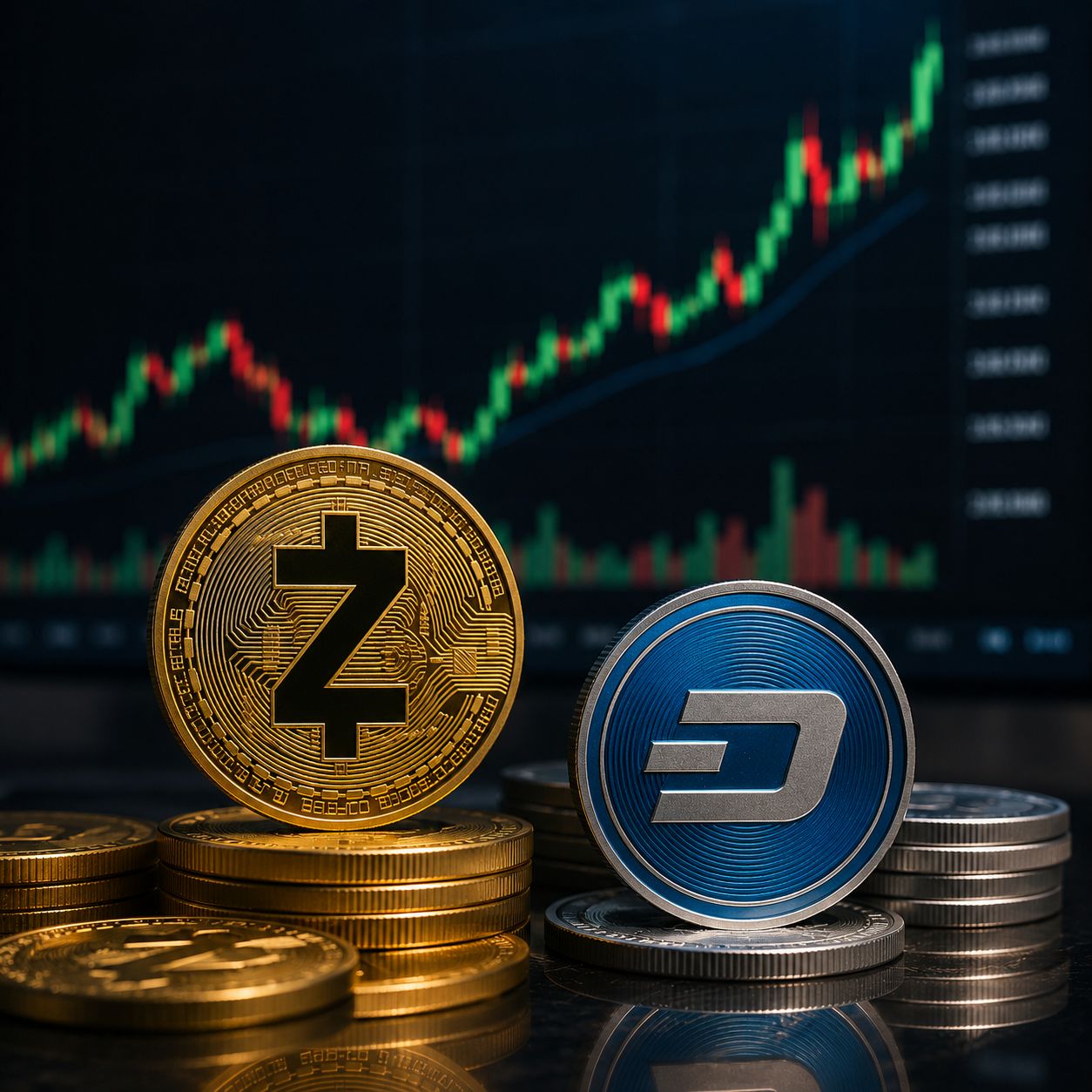
The digital asset landscape is currently witnessing a historic shift as privacy-centric cryptocurrencies, led by Zcash (ZEC) and Dash (DASH), decouple from the broader market to post massive gains. In a financial environment increasingly dominated by transparency and surveillance, the demand for “shielded” transactions has reached a fever pitch. Today, Zcash has achieved a monumental milestone by hitting the $669 mark, while Dash has surged past $49, signaling a robust “privacy season” that many analysts believe is only just beginning. This price action is not merely a short-term pump; it represents a fundamental repricing of digital anonymity in an age where institutional involvement and regulatory scrutiny are at an all-time high. Investors are moving away from the “glass house” nature of traditional blockchains like Bitcoin and Ethereum, seeking refuge in protocols that offer zero-knowledge proofs and advanced mixing technologies.
The primary driver behind the Zcash explosion to $669 is a landmark resolution of regulatory uncertainty. For nearly three years, the Zcash Foundation was under the shadow of a US SEC investigation. News recently broke that the SEC has officially concluded this probe without recommending any enforcement actions. This “regulatory green light” has fundamentally changed the risk profile for ZEC, allowing institutional “smart money” to enter the ecosystem without the fear of legal repercussions. Furthermore, the Zcash Foundation’s Q1 2026 report revealed a highly stable treasury of over $36.7 million, proving that the project has the financial runway to continue developing its cutting-edge zk-SNARKs technology. With the upcoming Network Upgrade 7 (NU7) on the horizon, Zcash is positioning itself as the gold standard for compliant yet private financial infrastructure, attracting a new wave of long-term holders who view it as the ultimate hedge against the “institutionalization” of Bitcoin.
Dash, on the other hand, is benefiting from a massive technical pivot that has revitalized its utility as a daily payment method. While Dash has historically relied on its PrivateSend mixing feature, the market is reacting positively to the integration of more advanced privacy tools that align with modern global standards. The surge past $49 is fueled by a 115 percent month-on-month growth rate, making it one of the top-performing assets in the mid-cap category. Traders are particularly excited about the “golden cross” observed on Dash’s technical charts, a rare signal where the 50-day moving average crosses above the 200-day moving average, typically indicating the start of a multi-month bull run. As Dash bridges the gap between fast, low-cost payments and robust user protection, it is capturing the attention of retail users who want the convenience of digital cash without sacrificing their personal data to public ledgers.
Looking ahead, the trajectory for privacy coins remains steeply bullish as the “opt-out” movement gains global momentum. The convergence of technical breakthroughs, such as the reduction in shielded transaction sizes, and macroeconomic factors, like the implementation of strict digital surveillance laws, has created a “perfect storm” for these assets. If Zcash can maintain its support above $625, the next psychological barrier at $750 seems inevitable. Similarly, for Dash, a sustained close above the $50 resistance level could open the gates for a rally toward the $80 to $100 range by the end of the year. While the path forward will involve natural market volatility, the underlying demand for financial freedom and transactional confidentiality ensures that Zcash and Dash will remain at the forefront of the 2026 crypto narrative.
Understanding the Zcash zk-SNARKs Technology Advantage
The core of the recent Zcash rally lies in its unique cryptographic foundation. Unlike Bitcoin, which records every transaction detail on a public ledger, Zcash utilizes Zero-Knowledge Succinct Non-Interactive Arguments of Knowledge (zk-SNARKs). This allows the network to verify that a transaction is valid without revealing the sender, the receiver, or the amount being sent. This “shielded” transaction model is what sets Zcash apart in 2026. As more users realize that public blockchains are essentially permanent, searchable databases of their spending habits, the migration to shielded pools is accelerating. The latest data shows that over 4.9 million ZEC are now held in these private pools, a record high that proves the technology is finally moving from a niche experiment to a mainstream financial tool.
Dash and the Evolution of Private Payments
Dash has carved out its own space by focusing on the “velocity of money.” While other privacy coins focus solely on anonymity, Dash prioritizes speed through its InstantSend feature. The recent price jump to $49 reflects a growing appreciation for this hybrid model. By offering “optional” privacy, Dash remains more palatable to certain exchanges and jurisdictions while still providing users with the tools to mask their activities when necessary. The project’s recent governance upgrades have also allowed for more efficient allocation of treasury funds, leading to new partnerships in emerging markets where digital cash is a necessity rather than a luxury. This practical application is a key reason why Dash is currently leading the market alongside Zcash.
The Impact of SEC Regulatory Clarity on Privacy Assets
One cannot overstate the importance of the SEC’s decision to close its investigation into Zcash. For years, the “privacy coin” label was seen as a scarlet letter in the eyes of regulators. However, the 2026 landscape is different. Regulators are beginning to distinguish between “tools for illicit activity” and “tools for basic human rights.” By clearing Zcash of wrongdoing, the SEC has effectively acknowledged that privacy-preserving technology has a legitimate place in the digital economy. This has led to ZEC being listed on more mainstream platforms, including a recent addition to Robinhood, which has provided the liquidity necessary for the current surge to $669.
Institutional Adoption of Shielded Transactions
We are now entering an era where Fortune 500 companies are exploring Zcash technology for supply chain privacy. A company doesn’t want its competitors to see exactly how much it is paying its suppliers or which vendors it is using. The “transparent” nature of Bitcoin is a deal-breaker for enterprise use, but the “shielded” nature of Zcash is a solution. In 2026, we have seen several pilot programs where large-scale financial institutions use Zcash’s underlying protocol to settle internal balances privately. This “enterprise-grade” privacy is the silent engine driving the valuation of ZEC higher, as it proves the coin has utility far beyond simple retail speculation.
Technical Analysis: ZEC and DASH Support and Resistance
From a technical perspective, the charts for both Zcash and Dash are “screaming” bullish. Zcash has successfully flipped its previous resistance at $580 into a strong support floor. As long as it remains above this level, the path to $700 is clear of major obstacles. Dash is facing a slight hurdle at the $52 level, which was a significant peak in 2024. If the current volume continues to trend upward, a “short squeeze” is likely, where traders betting against the coin are forced to buy back their positions, further accelerating the price. Analysts are keeping a close eye on the Relative Strength Index (RSI), which is currently high but not yet in the “danger zone,” suggesting there is still room for more growth in this cycle.
Why 2026 is the Year of the Privacy Coin
The broader cryptocurrency market has become “sanitized” and “institutionalized,” leading many original crypto enthusiasts back to the assets that stay true to the vision of decentralization. Privacy coins are the ultimate expression of this vision. With the rise of Central Bank Digital Currencies (CBDCs) and increased government monitoring of digital wallets, the “value” of privacy has transitioned from an abstract concept to a tangible asset class. Zcash at $669 and Dash at $49 are just the first indicators of a global re-evaluation of what it means to own “private” money. As we move into the second half of 2026, the market dominance of these assets is expected to grow as the global demand for financial autonomy remains unsatisfied by traditional digital assets.









