

























































The global financial landscape is currently navigating one of its most precarious periods in recent history. Andrew Bailey, the Chair of the Financial Stability Board (FSB) and Governor of the Bank of England, has issued a stark warning regarding a potential “triple whammy” crisis. In a high-level letter addressed to G20 finance ministers and central bank governors, the FSB outlined a scenario where several dormant vulnerabilities could ignite simultaneously. This isn’t just a single-sector issue; it represents a convergence of high interest rates, geopolitical instability, and a rapidly expanding private credit market that operates largely outside the view of traditional banking regulators. The primary fear is that these factors could combine to create a feedback loop that destabilizes global markets in a way not seen since the 2008 financial crisis.
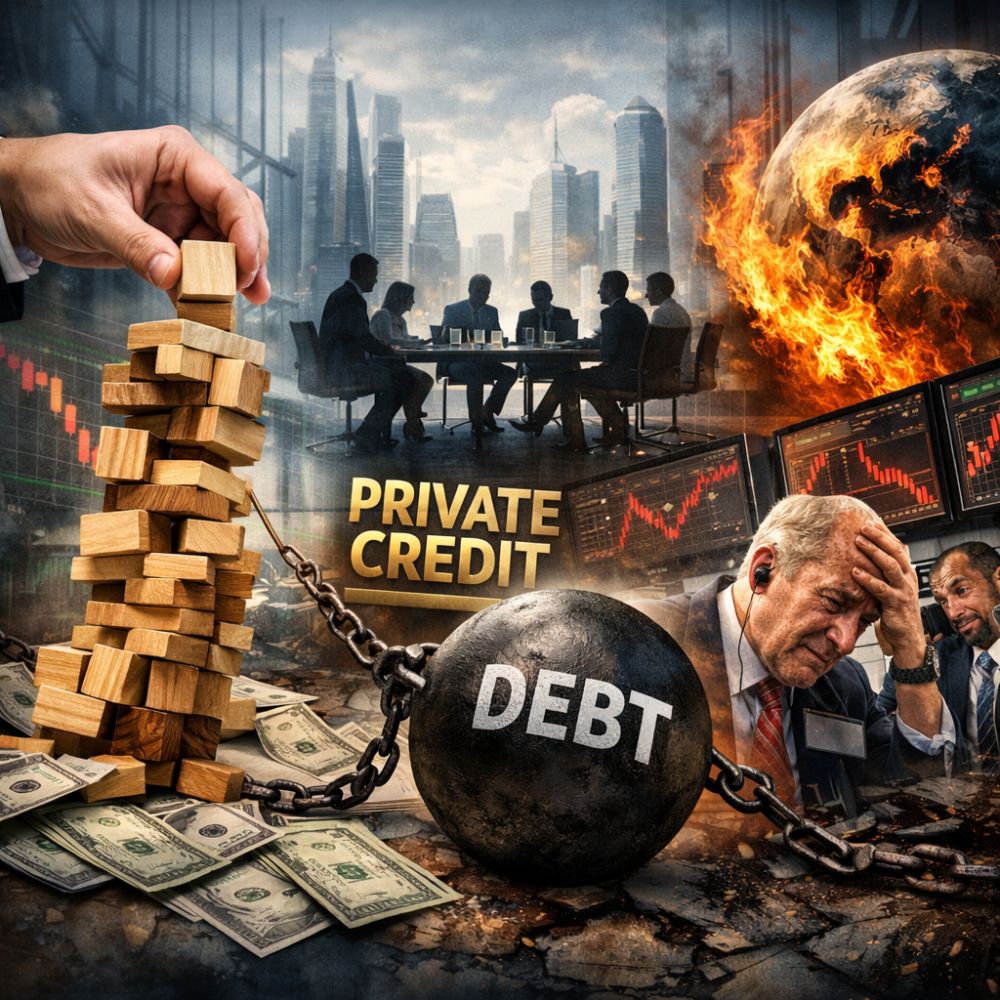
At the heart of this warning is the “shadow banking” sector, officially known as non-bank financial intermediation (NBFI). Over the last decade, risk has migrated away from highly regulated commercial banks and into the hands of hedge funds, private equity firms, and private credit lenders. This shift has created a massive credit ecosystem that is now estimated to be worth nearly 2 trillion dollars. While this growth has provided vital funding for businesses, it has also introduced a “liquidity mismatch” risk. Many of these funds promise investors the ability to withdraw their money relatively quickly, yet the loans they hold are inherently illiquid. If a sudden market shock occurs, a “rush for the exits” could lead to a systemic freeze as funds are forced to halt redemptions or engage in fire sales of their assets to meet liquidity demands.
Understanding the Triple Whammy: High Rates, Debt, and Volatility
The “triple whammy” refers to three specific pressures hitting the economy at once. First, the transition to a higher-for-longer interest rate environment is putting immense strain on borrowers who grew accustomed to a decade of cheap money. As these debts come due for refinancing, many companies – particularly those in the middle market – are finding their interest payments have doubled or tripled. Second, stretched asset valuations in both public and private markets are vulnerable to sharp corrections. If investors begin to doubt the future earnings potential of these companies, the resulting sell-off could be abrupt. Third, the ongoing geopolitical conflicts, specifically the volatility in the Middle East, have injected a high degree of unpredictability into energy prices and government bond yields, further tightening global financial conditions.
When these three factors interact, the risk of a “disorderly unwinding” increases. For example, if a sharp increase in energy prices causes a sudden spike in inflation, central banks might be forced to raise rates even higher. This would simultaneously lower the value of existing bonds and increase the default risk of private credit borrowers. This interconnectedness is what keeps regulators awake at night. The FSB has noted that bank lending to non-bank financial institutions has nearly quadrupled over the past ten years, meaning that a crisis in the private credit market would almost certainly bleed back into the traditional banking system, creating a truly global systemic event.
The Private Credit Trap: Why Transparency is the New Gold Standard
Private credit has long been touted as a resilient alternative to public debt markets, but the FSB suggests that its “opacity” is now its greatest weakness. Because these loans are negotiated privately and are not traded on public exchanges, there is a distinct lack of data regarding the quality of the collateral and the true level of leverage involved. In a period of stability, this isn’t an issue, but in a crisis, a lack of transparency leads to a “loss of confidence.” Investors who cannot see the health of a fund’s portfolio are likely to panic and pull their capital at the first sign of trouble. This opacity can turn a localized problem with a few specific borrowers into a generalized market panic.
The FSB is currently working on a specialized report to address these exact vulnerabilities. The goal is to establish new standards for data availability and risk management within the private credit sector. This includes looking at “leverage at the fund level” and how synthetic leverage through derivatives might be hiding the true extent of risk. By bringing these shadow banking activities into the light, regulators hope to prevent the “amplification channels” that turned the 2008 housing market downturn into a global depression. The message from the FSB is clear: the era of “trust us” in private markets is over, and a new era of stringent oversight is beginning.
Strategic Resilience: How Markets Can Weather the Coming Storm
Despite the dire warnings, the global financial system has shown a surprising degree of resilience thus far. High levels of capital and liquidity in the core banking sector act as a vital buffer against shocks. However, the FSB emphasizes that resilience is not a static state; it requires constant vigilance. To navigate the “triple whammy,” the FSB is calling for a multi-pronged approach: enhanced surveillance of sovereign bond markets, more frequent stress testing for non-bank entities, and a global effort to fix the structural issues in cross-border payments. The aim is to ensure that even if a major private credit fund fails, the “pipes” of the global financial system remain open and functional.
For individual investors and institutional allocators, the takeaway is the importance of diversification and liquidity. In a high-volatility environment, being “locked in” to an illiquid private fund can be a dangerous position. As we move through 2026, the market will likely see a flight to quality, where assets with clear valuations and high transparency are favored over complex, leveraged products. The FSB’s “triple whammy” warning serves as a necessary wake-up call, reminding us that the next crisis rarely looks like the last one, and that the biggest threats are often those currently hidden from the headlines.